Designed by John Drawe and built by Johannsen Boat Works since 2001, this compact centerboard dinghy delivers impressive performance in a lightweight fiberglass package. The cat-rigged design features an unstayed mast configuration that simplifies setup and reduces maintenance while providing excellent power delivery through its 123 square feet of sail area.
At just 200 pounds displacement, the Raider 16 Sport offers exceptional portability and easy launching from beaches or ramps. The centerboard configuration allows sailing in shallow waters while still providing adequate lateral resistance when the board is deployed. With a hull speed of 5.35 knots, this boat can move surprisingly well for its size, making it equally suitable for recreational sailing, sailing instruction, or small boat racing.
The boat's proportions suggest good stability for day sailing and coastal exploration, though the low comfort ratio indicates it's primarily designed for shorter outings rather than extended cruising. The relatively high SA/Displacement ratio of 57.59 promises spirited performance in moderate conditions. This makes the Raider 16 Sport an excellent choice for sailors seeking an affordable, manageable boat that doesn't compromise on sailing excitement, whether for solo adventures or introducing others to the sport.
No owner reviews yet — be the first to share your experience with this boat.
Performance Ratios
SA/Displacement
Sail Area to Displacement ratio measures how much sail power a boat has relative to its weight. Higher values mean more performance and speed.
Under 14 — Heavy cruiser, slow14–18 — Cruising sailboat18–22 — Cruiser/racerOver 22 — Performance racer
57.59
Displacement/Length
Displacement to Length ratio measures how heavy a boat is relative to its waterline length. Lower values mean a lighter, faster boat.
Under 100 — Ultralight racer100–200 — Light cruiser/racer200–300 — Moderate cruiser300–400 — Heavy cruiserOver 400 — Very heavy
22.13
Comfort Ratio
Ted Brewer's Comfort Ratio predicts how comfortable a boat will feel in offshore conditions. Higher values mean a steadier, more comfortable motion in a seaway.
Under 20 — Uncomfortably rough20–30 — Acceptable coastal30–40 — Good offshore comfortOver 40 — Very comfortable offshore
1.36
Capsize Screening Formula
The USHS Capsize Screening Formula estimates offshore capsize risk. Lower is safer — values under 2.0 are considered acceptable for offshore sailing.
Under 2.0 — Safe for offshore2.0–2.2 — Borderline offshoreOver 2.2 — Coastal use recommended
5.02
Hull Speed
Hull Speed is the theoretical maximum speed of a displacement hull, calculated from waterline length. Most cruising sailboats reach this speed in moderate conditions.
5.35 kn
S# (Speed Number)
The Speed Number (S#) is a quick performance index. Higher values indicate a faster, more powerful design relative to its size.
Under 3.0 — Slow cruiser3.0–5.0 — Average cruiser5.0–7.0 — Performance cruiserOver 7.0 — Racer
10.69
Pounds/Inch Immersion
Pounds per Inch Immersion (PPI) tells you how much weight is needed to sink the boat one inch. Useful for calculating how additional gear and stores affect waterline.
416.96 pounds/inch
SA/Displacement (Calc)
Calculated Sail Area to Displacement ratio using actual measured sail dimensions rather than reported values. More precise than the reported SA/Disp figure.
41.78
Rig Dimensions
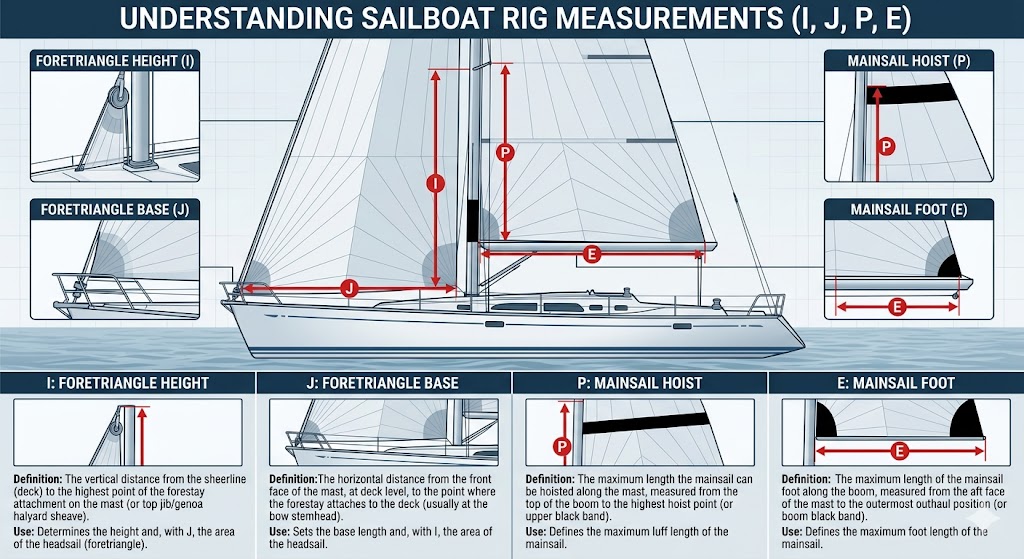
P (Mainsail Luff)
19.83 ft / 6.04 m
E (Mainsail Foot)
9.00 ft / 2.74 m
SA Main
89.24 ft² / 8.29 m²
SA Total (100%)
89.24 ft² / 8.29 m²
How It Compares
vs. Balboa 16, Com Pac 16, Hobie Max, Leeward 16 Luger, Sweet Sixteen