Back to Search
Passport 40
Designer: Robert Perry  ·  Builder: Passport Yachts Inc. (Taiwan)  ·  First built: 1980
+ Add to Compare
Videos
About the Passport 40

Robert Perry designed this elegant 40-footer during the height of his career, creating a yacht that exemplifies the finest qualities of 1980s performance cruising design. Built by Passport Yachts in Taiwan from 1980 to 1991, with 148 hulls completed, the Passport 40 earned a reputation as a serious bluewater cruiser capable of handling demanding offshore passages. The yacht's substantial displacement of 22,771 pounds and generous ballast of 8,500 pounds create exceptional stability and seaworthiness. Perry's signature fin keel with rudder on skeg configuration provides excellent tracking and directional stability, while the masthead sloop rig delivers balanced sail handling characteristics. With 762 square feet of sail area driving a 33-foot waterline, the boat achieves a respectable hull speed of 7.75 knots. The Passport 40's comfort ratio of 33.96 indicates a motion that's comfortable for extended passages, while the capsize screening formula of 1.79 confirms its offshore capability. This design attracted serious cruisers seeking a yacht that could cross oceans safely while maintaining reasonable performance. The fiberglass construction and Taiwanese build quality have proven durable over the decades, making well-maintained examples highly sought after in today's used boat market.

Core Dimensions
LOA (Length Overall) 39.42 ft / 12.02 m
LWL (Waterline Length) 33.42 ft / 10.19 m
Beam 12.67 ft / 3.86 m
Max Draft 5.75 ft / 1.75 m
Displacement 22,771.00 lb / 10,329 kg
Ballast 8,500.00 lb / 3,856 kg
Sail Area (Reported) 762.00 ft² / 70.79 m²
Design & Construction
Hull Type Fin with rudder on skeg
Rigging Type Masthead Sloop
Construction FG
Designer Robert Perry
Builder Passport Yachts Inc. (TAIWAN)
First Built 1980
Last Built 1991
Number Built 148
Owner Reviews

No owner reviews yet — be the first to share your experience with this boat.

Known Issues & What to Watch For
High Hull/Deck
The balsa core used in deck construction on early models is prone to moisture intrusion around deck hardware, chainplates, and stanchion bases. Wet core is widespread on boats that have not had fastener bedding regularly maintained, leading to soft spots and delamination.
1980–1986 models
Medium Hull/Deck
The hull-to-deck joint on Taiwan-built Passport 40s uses an inward-turning flange mechanically fastened and bonded. This joint is known to develop leaks, particularly at the bow and stern quarters, and the sealant degrades over time allowing water intrusion into the joint.
High Keel
The encapsulated lead keel on some hulls has keel bolt access that is difficult to inspect without removing interior flooring. Keel bolt corrosion and weeping at the keel-to-hull interface have been reported, and the bedding compound between the keel stub and hull can crack allowing water to migrate upward.
High Rigging
The chainplate knees are glassed into the interior liner and tabbed to the hull. On older boats the tabbing can delaminate from the liner rather than the hull due to poor secondary bonding common in Taiwanese production of this era. Chainplate pull-through is a real risk if this bonding is not verified.
1980–1985 models
Medium Rigging
The mast step on deck-stepped rigs can develop crazing and cracking in the deck laminate under the compression post below, particularly if the compression post has shifted or was not properly aligned. Inspect the cabin top and headliner directly below the mast step for stress cracking.
High Hull/Deck
Teak decks installed at the factory were bedded with a polysulfide compound over balsa-cored decking. As the teak ages and the bungs dry out, fastener holes allow water directly into the core. Many Passport 40s have significant core rot beneath teak deck areas.
Medium Accommodations
The interior joinery is fitted as a prefabricated liner that is not fully bonded to the hull, leaving voids between the liner and hull shell. These voids trap moisture and are difficult to inspect or dry out, and can mask hull damage or delamination beneath.
Medium Engine
Many Passport 40s were fitted with the Perkins 4-108 diesel. This engine's raw water cooling impeller housing is prone to cracking with age, and the heat exchanger end caps are known to corrode. Verify the cooling system has been recently serviced and inspect for weeping at hose connections and the heat exchanger.
High Electrical
The original Taiwanese wiring used tin-plated copper wire that oxidizes heavily in the marine environment. Boats that have not been rewired typically show high resistance connections, intermittent failures, and in some cases fire risk at panel connections. The DC panel and bilge wiring in particular should be closely inspected.
1980–1988 models
Medium Hull/Deck
The skeg supporting the rudder is solid fiberglass but the rudder-to-skeg bearing fit loosens with use. Worn skeg bearings allow slop in the rudder that accelerates wear on the quadrant and steering linkage. Assess for play by pushing laterally on the rudder blade with the boat hauled.

Own or have surveyed a Passport 40? Submit a known issue
Performance Ratios
PHRF Rating PHRF (Performance Handicap Racing Fleet) is a national racing handicap measured in seconds per nautical mile. Lower values indicate faster boats. Ratings are sourced from US Sailing's national database (median across 60+ regional fleets).
Under 0 — Ultralight racer0–90 — Performance racer90–150 — Cruiser/racer150–210 — Typical cruiserOver 210 — Heavy/slow cruiser
141
SA/Displacement Sail Area to Displacement ratio measures how much sail power a boat has relative to its weight. Higher values mean more performance and speed.
Under 14 — Heavy cruiser, slow14–18 — Cruising sailboat18–22 — Cruiser/racerOver 22 — Performance racer
15.24
Ballast/Displacement Ballast to Displacement ratio shows what percentage of the boat's total weight is ballast. Higher values generally mean better initial stability and stiffer sail carrying.
30–35% — Typical cruiser35–45% — Stiff performance boatOver 45% — Racing oriented
37.33
Displacement/Length Displacement to Length ratio measures how heavy a boat is relative to its waterline length. Lower values mean a lighter, faster boat.
Under 100 — Ultralight racer100–200 — Light cruiser/racer200–300 — Moderate cruiser300–400 — Heavy cruiserOver 400 — Very heavy
272.34
Comfort Ratio Ted Brewer's Comfort Ratio predicts how comfortable a boat will feel in offshore conditions. Higher values mean a steadier, more comfortable motion in a seaway.
Under 20 — Uncomfortably rough20–30 — Acceptable coastal30–40 — Good offshore comfortOver 40 — Very comfortable offshore
33.96
Capsize Screening Formula The USHS Capsize Screening Formula estimates offshore capsize risk. Lower is safer — values under 2.0 are considered acceptable for offshore sailing.
Under 2.0 — Safe for offshore2.0–2.2 — Borderline offshoreOver 2.2 — Coastal use recommended
1.79
Hull Speed Hull Speed is the theoretical maximum speed of a displacement hull, calculated from waterline length. Most cruising sailboats reach this speed in moderate conditions. 7.75 kn
S# (Speed Number) The Speed Number (S#) is a quick performance index. Higher values indicate a faster, more powerful design relative to its size.
Under 3.0 — Slow cruiser3.0–5.0 — Average cruiser5.0–7.0 — Performance cruiserOver 7.0 — Racer
1.86
Pounds/Inch Immersion Pounds per Inch Immersion (PPI) tells you how much weight is needed to sink the boat one inch. Useful for calculating how additional gear and stores affect waterline. 1,512.97 pounds/inch
SA/Displacement (Calc) Calculated Sail Area to Displacement ratio using actual measured sail dimensions rather than reported values. More precise than the reported SA/Disp figure. 15.75
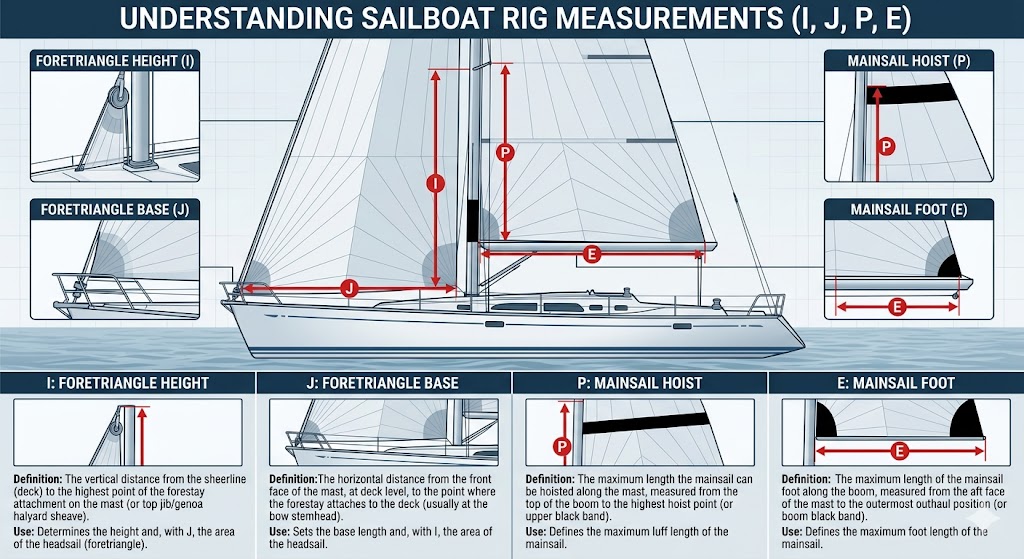
Rig Dimensions
I (Foretriangle Height) 50.58 ft / 15.42 m
J (Foretriangle Base) 16.63 ft / 5.07 m
P (Mainsail Luff) 45.87 ft / 13.98 m
E (Mainsail Foot) 16.00 ft / 4.88 m
SA Fore 420.57 ft² / 39.07 m²
SA Main 366.96 ft² / 34.09 m²
SA Total (100%) 787.53 ft² / 73.16 m²
Est. Forestay Length 53.24 ft / 16.23 m
Mast Height (DWL) 56.50 ft / 17.22 m
Engine & Accommodations
Engine Make Perkins
Engine Model 4108
Engine Type Diesel
Fuel Capacity 70 gals / 265 L
Water Capacity 130 gals / 492 L
How It Compares

vs. Dufour 39 Frers, Islander 40, Swan 39

This boat Similar boats
Dimensions
LOA
Passport 40 ★
39.4 ft
Dufour 39 Frers
39.3 ft
Islander 40
39.5 ft
Swan 39
39.3 ft
LWL
Passport 40 ★
33.4 ft
Dufour 39 Frers
30.5 ft
Islander 40
30.8 ft
Swan 39
31.5 ft
Beam
Passport 40 ★
12.7 ft
Dufour 39 Frers
12.5 ft
Islander 40
11.8 ft
Swan 39
12.5 ft
Displacement
Passport 40 ★
22 lbs
Dufour 39 Frers
14 lbs
Islander 40
17 lbs
Swan 39
18 lbs
Ballast
Passport 40 ★
8 lbs
Dufour 39 Frers
6 lbs
Islander 40
7 lbs
Swan 39
7 lbs
Sail Area
Passport 40 ★
762 sq ft
Dufour 39 Frers
669 sq ft
Islander 40
734 sq ft
Swan 39
761 sq ft
Performance
PHRF Rating (lower = faster)
Passport 40 ★
141 s/nm
Dufour 39 Frers
Islander 40
Swan 39
84 s/nm
SA / Displacement (higher = more powerful)
Passport 40 ★
15.2
Dufour 39 Frers
17.7
Islander 40
17.8
Swan 39
17.8
Ballast / Disp (higher = stiffer)
Passport 40 ★
37.3 %
Dufour 39 Frers
46.6 %
Islander 40
Swan 39
43.9 %
Comfort Ratio (higher = more comfortable offshore)
Passport 40 ★
34.0
Dufour 39 Frers
24.3
Islander 40
29.3
Swan 39
28.5
Capsize Screening (lower = safer)
Passport 40 ★
1.79
Dufour 39 Frers
2.03
Islander 40
1.84
Swan 39
1.91
Displacement / Length (lower = lighter)
Passport 40 ★
272
Dufour 39 Frers
235
Islander 40
Swan 39
257
Hull Speed
Passport 40 ★
7.8 kts
Dufour 39 Frers
7.4 kts
Islander 40
7.4 kts
Swan 39
7.5 kts
Speed Number (higher = faster)
Passport 40 ★
1.9
Dufour 39 Frers
2.4
Islander 40
2.2
Swan 39
2.2
Resources & Community
Find a Passport 40 For Sale