Back to Search
Hunter 355 Legend
 ·  Builder: Hunter Marine (Usa)  ·  First built: 1989
+ Add to Compare
Videos
About the Hunter 355 Legend

Built from 1989 to 1995, Hunter Marine's 355 Legend represents the company's commitment to accessible cruising sailboats during the late 1980s and early 1990s boom. This fractional sloop configuration delivers a balanced sail plan across its 569 square feet of working canvas, making it manageable for couples or small crews while providing enough power for spirited coastal sailing. The 355 Legend's wing keel design offers several practical advantages for cruising sailors. Drawing just 4.5 feet, it opens up shallow anchorages and reduces marina slip fees while providing excellent stability through its wide stance. With 4,800 pounds of ballast in a 13,000-pound displacement, the boat achieves a healthy balance between performance and comfort. The generous 11.75-foot beam creates spacious accommodation below while contributing to initial stability. This model suits coastal cruising and weekend getaways particularly well, with enough capability for protected offshore passages in experienced hands. The moderate comfort ratio of 23.97 suggests reasonable motion at sea without sacrificing performance entirely. Hunter's reputation for practical, well-equipped interiors likely continues with the 355 Legend, making it an attractive option for sailors seeking comfortable cruising without premium pricing. The reliable 27-horsepower auxiliary provides adequate power for maneuvering and motorsailing in light conditions.

Core Dimensions
LOA (Length Overall) 35.58 ft / 10.84 m
LWL (Waterline Length) 29.75 ft / 9.07 m
Beam 11.75 ft / 3.58 m
Max Draft 4.50 ft / 1.37 m
Displacement 13,000.00 lb / 5,897 kg
Ballast 4,800.00 lb / 2,177 kg
Ballast Type Lead
Sail Area (Reported) 569.00 ft² / 52.86 m²
Design & Construction
Hull Type Wing Keel
Rigging Type Fractional Sloop
Construction FG
Builder Hunter Marine (USA)
First Built 1989
Last Built 1995
Owner Reviews

No owner reviews yet — be the first to share your experience with this boat.

Known Issues & What to Watch For
High Keel
The wing keel attachment on this era of Hunter uses a relatively narrow keel stub with keel bolts that are prone to weeping and corrosion. Inspect the bilge area around the keel sump carefully for rust staining, soft laminate, or wet core material indicating keel bolt failure or movement.
High Keel
Wing keels on this model are known to collect and trap debris and marine growth in the wing recesses, accelerating corrosion of the cast iron keel. Buyers should inspect the keel-to-hull joint closely for cracking or separation, which can indicate keel movement under load.
Medium Hull/Deck
Hunter used a deck-to-hull joint with an outward-turned flange through-bolted and covered with rub rail during this production era. This joint is known to allow water intrusion, and the rub rail attachment screws often back out over time, making the joint a common source of leaks into the interior.
Medium Hull/Deck
The balsa-cored deck used by Hunter in this period is prone to moisture intrusion around deck hardware, chainplates, and stanchion bases. Soft or spongy deck areas near fittings are common and should be sounded carefully during survey.
High Rigging
Chainplate attachment on this model runs through the balsa-cored deck without adequate backing or sealing in many examples, leading to both core rot at the penetration point and potential structural compromise of the chainplate foundation over time.
Low Accommodations
The interior joinery on Hunter 355s of this era used lightweight stapled and glued construction rather than through-bolted or screwed assemblies, making furniture and bulkhead delamination a common finding in older examples, particularly in the V-berth and galley areas.
Medium Electrical
Hunter's wiring practice during this period often used undersized wire runs and minimal chafe protection, with wiring bundled behind panels in ways that make inspection and repair difficult. Corrosion at terminal blocks and junction points is frequently found in boats of this age.

Own or have surveyed a Hunter 355 Legend? Submit a known issue
Performance Ratios
SA/Displacement Sail Area to Displacement ratio measures how much sail power a boat has relative to its weight. Higher values mean more performance and speed.
Under 14 — Heavy cruiser, slow14–18 — Cruising sailboat18–22 — Cruiser/racerOver 22 — Performance racer
16.53
Ballast/Displacement Ballast to Displacement ratio shows what percentage of the boat's total weight is ballast. Higher values generally mean better initial stability and stiffer sail carrying.
30–35% — Typical cruiser35–45% — Stiff performance boatOver 45% — Racing oriented
36.92
Displacement/Length Displacement to Length ratio measures how heavy a boat is relative to its waterline length. Lower values mean a lighter, faster boat.
Under 100 — Ultralight racer100–200 — Light cruiser/racer200–300 — Moderate cruiser300–400 — Heavy cruiserOver 400 — Very heavy
220.41
Comfort Ratio Ted Brewer's Comfort Ratio predicts how comfortable a boat will feel in offshore conditions. Higher values mean a steadier, more comfortable motion in a seaway.
Under 20 — Uncomfortably rough20–30 — Acceptable coastal30–40 — Good offshore comfortOver 40 — Very comfortable offshore
23.97
Capsize Screening Formula The USHS Capsize Screening Formula estimates offshore capsize risk. Lower is safer — values under 2.0 are considered acceptable for offshore sailing.
Under 2.0 — Safe for offshore2.0–2.2 — Borderline offshoreOver 2.2 — Coastal use recommended
2
Hull Speed Hull Speed is the theoretical maximum speed of a displacement hull, calculated from waterline length. Most cruising sailboats reach this speed in moderate conditions. 7.31 kn
S# (Speed Number) The Speed Number (S#) is a quick performance index. Higher values indicate a faster, more powerful design relative to its size.
Under 3.0 — Slow cruiser3.0–5.0 — Average cruiser5.0–7.0 — Performance cruiserOver 7.0 — Racer
2.42
Pounds/Inch Immersion Pounds per Inch Immersion (PPI) tells you how much weight is needed to sink the boat one inch. Useful for calculating how additional gear and stores affect waterline. 1,249.03 pounds/inch
SA/Displacement (Calc) Calculated Sail Area to Displacement ratio using actual measured sail dimensions rather than reported values. More precise than the reported SA/Disp figure. 16.54
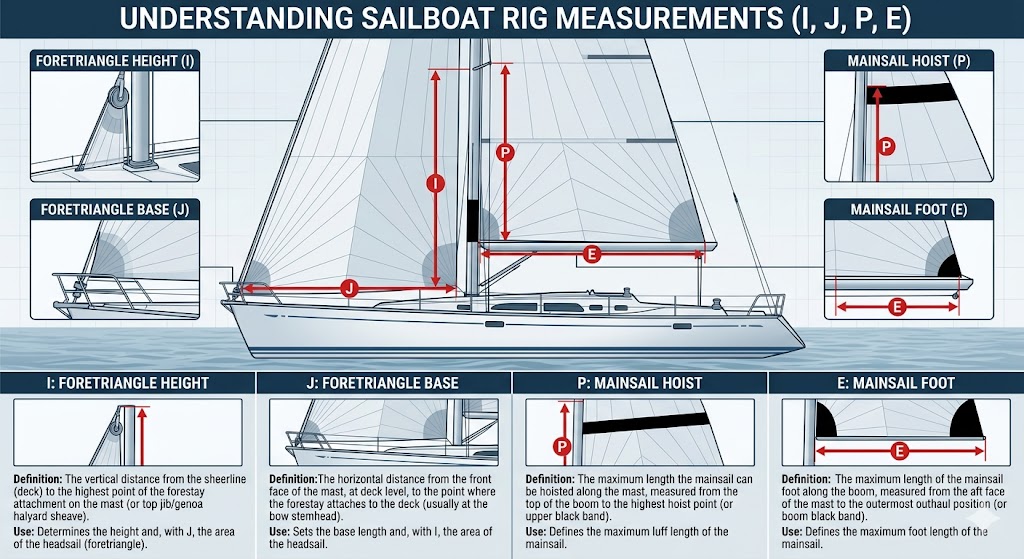
Rig Dimensions
I (Foretriangle Height) 42.00 ft / 12.80 m
J (Foretriangle Base) 12.16 ft / 3.71 m
P (Mainsail Luff) 44.08 ft / 13.44 m
E (Mainsail Foot) 14.25 ft / 4.34 m
SA Fore 255.36 ft² / 23.72 m²
SA Main 314.07 ft² / 29.18 m²
SA Total (100%) 569.43 ft² / 52.90 m²
Est. Forestay Length 43.72 ft / 13.33 m
Engine & Accommodations
Engine Make Yanmar
Engine Model 3GM
Engine Type Diesel
Horsepower 27
Fuel Capacity 22 gals / 83 L
Water Capacity 64 gals / 242 L
How It Compares

vs. Beneteau 343, Catalina 350, Ericson 35 3

This boat Similar boats
Dimensions
LOA
Hunter 355 Legend ★
35.6 ft
Beneteau 343
35.5 ft
Catalina 350
35.5 ft
Ericson 35 3
35.5 ft
LWL
Hunter 355 Legend ★
29.8 ft
Beneteau 343
30.8 ft
Catalina 350
30.5 ft
Ericson 35 3
28.9 ft
Beam
Hunter 355 Legend ★
11.8 ft
Beneteau 343
11.4 ft
Catalina 350
12.5 ft
Ericson 35 3
11.3 ft
Displacement
Hunter 355 Legend ★
13 lbs
Beneteau 343
13 lbs
Catalina 350
13 lbs
Ericson 35 3
13 lbs
Ballast
Hunter 355 Legend ★
4 lbs
Beneteau 343
3 lbs
Catalina 350
5 lbs
Ericson 35 3
5 lbs
Sail Area
Hunter 355 Legend ★
569 sq ft
Beneteau 343
649 sq ft
Catalina 350
566 sq ft
Ericson 35 3
597 sq ft
Performance
PHRF Rating (lower = faster)
Hunter 355 Legend ★
Beneteau 343
150 s/nm
Catalina 350
147 s/nm
Ericson 35 3
SA / Displacement (higher = more powerful)
Hunter 355 Legend ★
16.5
Beneteau 343
18.4
Catalina 350
16.2
Ericson 35 3
17.3
Ballast / Disp (higher = stiffer)
Hunter 355 Legend ★
36.9 %
Beneteau 343
25.3 %
Catalina 350
40.9 %
Ericson 35 3
40.0 %
Comfort Ratio (higher = more comfortable offshore)
Hunter 355 Legend ★
24.0
Beneteau 343
25.2
Catalina 350
21.9
Ericson 35 3
25.7
Capsize Screening (lower = safer)
Hunter 355 Legend ★
2.00
Beneteau 343
1.92
Catalina 350
2.12
Ericson 35 3
1.93
Displacement / Length (lower = lighter)
Hunter 355 Legend ★
220
Beneteau 343
204
Catalina 350
207
Ericson 35 3
241
Hull Speed
Hunter 355 Legend ★
7.3 kts
Beneteau 343
7.4 kts
Catalina 350
7.4 kts
Ericson 35 3
7.2 kts
Speed Number (higher = faster)
Hunter 355 Legend ★
2.4
Beneteau 343
2.5
Catalina 350
Ericson 35 3
2.3
Resources & Community
Find a Hunter 355 Legend For Sale