Back to Search
Ericson 35 3
Designer: Bruce King  ·  Builder: Ericson Yachts (Usa)  ·  First built: 1982
+ Add to Compare
Videos
About the Ericson 35 3

Designed by renowned naval architect Bruce King, this mid-1980s cruiser represents Ericson's commitment to building performance-oriented sailboats that don't sacrifice comfort. The Ericson 35 3 emerged during a golden era of American sailboat manufacturing, produced from 1982 to 1998 when the California-based builder was at its peak. With its fin keel and spade rudder configuration, this 35-footer delivers responsive handling that appeals to sailors who enjoy spirited coastal cruising and weekend racing. The masthead sloop rig provides excellent sail-carrying ability, while the moderate displacement of 13,000 pounds strikes a nice balance between performance and stability. Bruce King's design philosophy shines through in the boat's clean lines and efficient underwater profile, contributing to a respectable hull speed of 7.20 knots. The comfort ratio of 25.68 suggests this boat leans toward the performance end of the spectrum while maintaining reasonable motion at sea. Combined with a capsize screening formula of 1.93, the design indicates good offshore capability for experienced sailors. The substantial ballast-to-displacement ratio provides reassuring stability, making this an excellent choice for sailors seeking a capable coastal cruiser that can handle occasional offshore passages with confidence.

Core Dimensions
LOA (Length Overall) 35.50 ft / 10.82 m
LWL (Waterline Length) 28.87 ft / 8.80 m
Beam 11.33 ft / 3.45 m
Max Draft 6.17 ft / 1.88 m
Displacement 13,000.00 lb / 5,897 kg
Ballast 5,200.00 lb / 2,359 kg
Sail Area (Reported) 597.00 ft² / 55.46 m²
Design & Construction
Hull Type Fin w/spade rudder
Rigging Type Masthead Sloop
Construction FG
Designer Bruce King
Builder Ericson Yachts (USA)
First Built 1982
Last Built 1998
Associations Ericson Yachts Information
Owner Reviews

No owner reviews yet — be the first to share your experience with this boat.

Known Issues & What to Watch For
High Hull/Deck
The balsa-cored deck used throughout production is prone to water intrusion around deck hardware, chainplates, and stanchion bases. Once wet, the balsa core rots and delamination spreads, often invisibly under the fiberglass skin. Tap testing and moisture metering of the entire deck is essential.
Medium Hull/Deck
The hull-to-deck joint on Ericson 35-3 models uses an inward-turning flange bolted and glassed. This joint is known to develop leaks, particularly at the bow and stern corners where sealant fails. Inspect carefully for water intrusion and soft spots in adjacent coring.
High Keel
The encapsulated lead keel attachment relies on a series of keel bolts that can develop weeping rust stains in the bilge. The keel-to-hull joint is also susceptible to cracking and water intrusion, and any signs of movement or soft gelcoat at the keel stub should be investigated thoroughly.
High Rigging
The chainplate knees on this model are glassed to the hull liner and can develop stress cracks or delamination over time. Chainplate-to-deck penetrations are a chronic leak point that allows water to saturate the nearby balsa core and compromise structural integrity.
Medium Rigging
The aluminum mast step and mast base area on deck should be inspected for soft coring resulting from water intrusion around the mast boot and partner, a commonly reported problem on this model.
Medium Hull/Deck
The plastic opening ports used in the cabin trunk on earlier production boats are known to become brittle and crack with UV exposure, leading to leaks into the cabin. Many have been replaced with aftermarket aluminum ports.
1982–1988 models
Medium Accommodations
The interior liner and furniture are glassed or tabbed to the hull and deck, making access to chainplates, hull fittings, and through-hulls difficult. Any repair or inspection of structural components often requires partial demolition of the interior.
Medium Electrical
Wiring in early production boats used undersized wire runs and non-tinned copper conductors that corrode in the marine environment. The DC panel and bilge areas in particular should be inspected for corrosion, chafe, and non-standard alterations from previous owners.
1982–1988 models
Medium Engine
The Yanmar 3GM or 3HM diesel engines commonly fitted in these boats can suffer from a raw water impeller that is difficult to access due to tight engine compartment clearances, leading to deferred maintenance and overheating damage. Verify full service history and check for signs of overheating.

Own or have surveyed a Ericson 35 3? Submit a known issue
Performance Ratios
SA/Displacement Sail Area to Displacement ratio measures how much sail power a boat has relative to its weight. Higher values mean more performance and speed.
Under 14 — Heavy cruiser, slow14–18 — Cruising sailboat18–22 — Cruiser/racerOver 22 — Performance racer
17.34
Ballast/Displacement Ballast to Displacement ratio shows what percentage of the boat's total weight is ballast. Higher values generally mean better initial stability and stiffer sail carrying.
30–35% — Typical cruiser35–45% — Stiff performance boatOver 45% — Racing oriented
40
Displacement/Length Displacement to Length ratio measures how heavy a boat is relative to its waterline length. Lower values mean a lighter, faster boat.
Under 100 — Ultralight racer100–200 — Light cruiser/racer200–300 — Moderate cruiser300–400 — Heavy cruiserOver 400 — Very heavy
241.19
Comfort Ratio Ted Brewer's Comfort Ratio predicts how comfortable a boat will feel in offshore conditions. Higher values mean a steadier, more comfortable motion in a seaway.
Under 20 — Uncomfortably rough20–30 — Acceptable coastal30–40 — Good offshore comfortOver 40 — Very comfortable offshore
25.68
Capsize Screening Formula The USHS Capsize Screening Formula estimates offshore capsize risk. Lower is safer — values under 2.0 are considered acceptable for offshore sailing.
Under 2.0 — Safe for offshore2.0–2.2 — Borderline offshoreOver 2.2 — Coastal use recommended
1.93
Hull Speed Hull Speed is the theoretical maximum speed of a displacement hull, calculated from waterline length. Most cruising sailboats reach this speed in moderate conditions. 7.20 kn
S# (Speed Number) The Speed Number (S#) is a quick performance index. Higher values indicate a faster, more powerful design relative to its size.
Under 3.0 — Slow cruiser3.0–5.0 — Average cruiser5.0–7.0 — Performance cruiserOver 7.0 — Racer
2.29
Pounds/Inch Immersion Pounds per Inch Immersion (PPI) tells you how much weight is needed to sink the boat one inch. Useful for calculating how additional gear and stores affect waterline. 1,168.75 pounds/inch
SA/Displacement (Calc) Calculated Sail Area to Displacement ratio using actual measured sail dimensions rather than reported values. More precise than the reported SA/Disp figure. 17.35
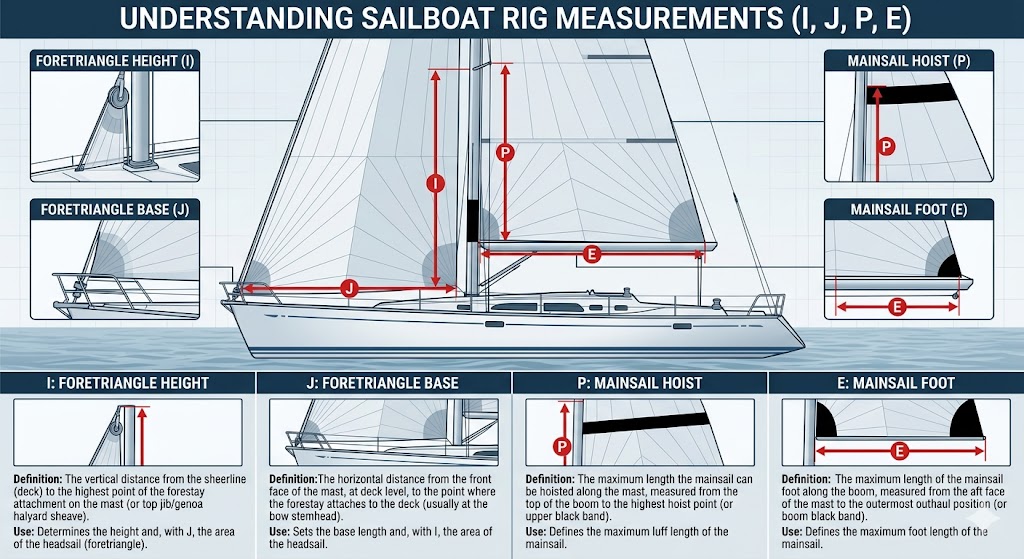
Rig Dimensions
I (Foretriangle Height) 46.00 ft / 14.02 m
J (Foretriangle Base) 15.80 ft / 4.82 m
P (Mainsail Luff) 39.00 ft / 11.89 m
E (Mainsail Foot) 12.00 ft / 3.66 m
SA Fore 363.40 ft² / 33.76 m²
SA Main 234.00 ft² / 21.74 m²
SA Total (100%) 597.40 ft² / 55.50 m²
Est. Forestay Length 48.64 ft / 14.83 m
Engine & Accommodations
Engine Make Universal
Engine Type Diesel
Horsepower 21
Fuel Capacity 40 gals / 151 L
Water Capacity 50 gals / 189 L
How It Compares

vs. Catalina 350, Ericson 36, Hunter 355 Legend

This boat Similar boats
Dimensions
LOA
Ericson 35 3 ★
35.5 ft
Catalina 350
35.5 ft
Ericson 36
35.6 ft
Hunter 355 Legend
35.6 ft
LWL
Ericson 35 3 ★
28.9 ft
Catalina 350
30.5 ft
Ericson 36
29.0 ft
Hunter 355 Legend
29.8 ft
Beam
Ericson 35 3 ★
11.3 ft
Catalina 350
12.5 ft
Ericson 36
11.8 ft
Hunter 355 Legend
11.8 ft
Displacement
Ericson 35 3 ★
13 lbs
Catalina 350
13 lbs
Ericson 36
11 lbs
Hunter 355 Legend
13 lbs
Ballast
Ericson 35 3 ★
5 lbs
Catalina 350
5 lbs
Ericson 36
5 lbs
Hunter 355 Legend
4 lbs
Sail Area
Ericson 35 3 ★
597 sq ft
Catalina 350
566 sq ft
Ericson 36
Hunter 355 Legend
569 sq ft
Performance
PHRF Rating (lower = faster)
Ericson 35 3 ★
Catalina 350
147 s/nm
Ericson 36
111 s/nm
Hunter 355 Legend
SA / Displacement (higher = more powerful)
Ericson 35 3 ★
17.3
Catalina 350
16.2
Ericson 36
Hunter 355 Legend
16.5
Ballast / Disp (higher = stiffer)
Ericson 35 3 ★
40.0 %
Catalina 350
40.9 %
Ericson 36
45.1 %
Hunter 355 Legend
36.9 %
Comfort Ratio (higher = more comfortable offshore)
Ericson 35 3 ★
25.7
Catalina 350
21.9
Ericson 36
Hunter 355 Legend
24.0
Capsize Screening (lower = safer)
Ericson 35 3 ★
1.93
Catalina 350
2.12
Ericson 36
Hunter 355 Legend
2.00
Displacement / Length (lower = lighter)
Ericson 35 3 ★
241
Catalina 350
207
Ericson 36
212
Hunter 355 Legend
220
Hull Speed
Ericson 35 3 ★
7.2 kts
Catalina 350
7.4 kts
Ericson 36
Hunter 355 Legend
7.3 kts
Speed Number (higher = faster)
Ericson 35 3 ★
2.3
Catalina 350
Ericson 36
Hunter 355 Legend
2.4
Find a Ericson 35 3 For Sale