Back to Search
Hunter 280
Designer: Hunter Design Team/R. Mazza  ·  Builder: Hunter Marine (Usa)  ·  First built: 1995
+ Add to Compare
Videos
About the Hunter 280

Built from 1995 to 1999, this 28-footer represents Hunter Marine's approach to affordable cruising sailboats during the mid-1990s. Designed by the Hunter Design Team in collaboration with R. Mazza, the Hunter 280 offers a practical balance of interior space and sailing performance for coastal cruising and weekend adventures. The boat's fin keel with bulb and spade rudder configuration provides responsive handling while maintaining the shallow 5-foot draft that makes it accessible to more harbors and anchorages. At 6,500 pounds displacement with 2,100 pounds of ballast, the Hunter 280 strikes a reasonable balance between stability and performance, though it clearly prioritizes interior volume over pure sailing characteristics. With 428 square feet of sail area driving a 23.58-foot waterline, this boat delivers respectable performance for coastal sailing and light cruising. The B&R rig keeps things simple for easy handling, while the generous 9.63-foot beam maximizes living space below decks—a hallmark of Hunter's design philosophy. The comfort ratio of 19.81 indicates this boat favors motion comfort over pure speed, making it well-suited for relaxed coastal cruising rather than serious offshore passages. The 18-horsepower auxiliary engine provides adequate power for maneuvering in tight quarters and motoring in calm conditions.

Core Dimensions
LOA (Length Overall) 27.75 ft / 8.46 m
LWL (Waterline Length) 23.58 ft / 7.19 m
Beam 9.63 ft / 2.94 m
Max Draft 5.00 ft / 1.52 m
Displacement 6,500.00 lb / 2,948 kg
Ballast 2,100.00 lb / 953 kg
Sail Area (Reported) 428.00 ft² / 39.76 m²
Design & Construction
Hull Type Fin w/bulb & spade rudder
Rigging Type B&R
Construction FG
Designer Hunter Design Team/R. Mazza
Builder Hunter Marine (USA)
First Built 1995
Last Built 1999
Related Sailboats Parker 275 · Dehler 28 · Pogo 850 · Antrim 27 · Lancer 28
Owner Reviews

No owner reviews yet — be the first to share your experience with this boat.

Known Issues & What to Watch For
High Keel
The lead bulb keel on the Hunter 280 is attached via a single cast fitting system that is prone to keel bolt corrosion and joint weeping. The keel-to-hull joint should be carefully inspected for cracking, rust staining, or movement, as early signs of failure can be subtle.
Medium Hull/Deck
The deck-to-hull joint on Hunter 280s is an inward-turning flange joined with adhesive and covered by a rubber rub rail. This joint is known to allow water intrusion when the rub rail adhesive fails, leading to delamination at the flange. The rub rail should be removed or probed during survey.
Medium Hull/Deck
The Hunter 280 uses a balsa-cored deck, and penetrations around stanchion bases, cleats, and chainplates are frequently inadequately sealed at the factory. Water intrusion into the core around these fittings leads to soft deck spots and core rot, particularly around the bow pulpit and stanchion bases.
High Rigging
The chainplate attachment on the Hunter 280 is bolted through a fiberglass shelf rather than a structural bulkhead, and this shelf is known to crack or delaminate under load. Inspect the interior liner near the chainplates for stress cracking or movement.
Medium Accommodations
The interior liner system used by Hunter on this model is fully molded and bonded in place, making it nearly impossible to inspect behind panels for hull-liner delamination or hidden water damage. Moisture trapped between the liner and hull can cause long-term structural degradation without visible warning signs.
Medium Hull/Deck
The rudder on the Hunter 280 uses a fiberglass blade over a stainless steel stock, and the blade is prone to delamination and water intrusion. Tap testing the rudder blade and checking for play in the stock bearings is essential, as bearing wear can develop significant slop affecting steering.
Low Electrical
Factory wiring on Hunter 280s from this production era is known to use undersized wire runs and minimal chafe protection. Connections at the mast base and in the bilge area are particularly prone to corrosion and failure due to poor original installation practices.

Own or have surveyed a Hunter 280? Submit a known issue
Performance Ratios
PHRF Rating PHRF (Performance Handicap Racing Fleet) is a national racing handicap measured in seconds per nautical mile. Lower values indicate faster boats. Ratings are sourced from US Sailing's national database (median across 60+ regional fleets).
Under 0 — Ultralight racer0–90 — Performance racer90–150 — Cruiser/racer150–210 — Typical cruiserOver 210 — Heavy/slow cruiser
210
SA/Displacement Sail Area to Displacement ratio measures how much sail power a boat has relative to its weight. Higher values mean more performance and speed.
Under 14 — Heavy cruiser, slow14–18 — Cruising sailboat18–22 — Cruiser/racerOver 22 — Performance racer
19.72
Ballast/Displacement Ballast to Displacement ratio shows what percentage of the boat's total weight is ballast. Higher values generally mean better initial stability and stiffer sail carrying.
30–35% — Typical cruiser35–45% — Stiff performance boatOver 45% — Racing oriented
32.31
Displacement/Length Displacement to Length ratio measures how heavy a boat is relative to its waterline length. Lower values mean a lighter, faster boat.
Under 100 — Ultralight racer100–200 — Light cruiser/racer200–300 — Moderate cruiser300–400 — Heavy cruiserOver 400 — Very heavy
221.33
Comfort Ratio Ted Brewer's Comfort Ratio predicts how comfortable a boat will feel in offshore conditions. Higher values mean a steadier, more comfortable motion in a seaway.
Under 20 — Uncomfortably rough20–30 — Acceptable coastal30–40 — Good offshore comfortOver 40 — Very comfortable offshore
19.81
Capsize Screening Formula The USHS Capsize Screening Formula estimates offshore capsize risk. Lower is safer — values under 2.0 are considered acceptable for offshore sailing.
Under 2.0 — Safe for offshore2.0–2.2 — Borderline offshoreOver 2.2 — Coastal use recommended
2.07
Hull Speed Hull Speed is the theoretical maximum speed of a displacement hull, calculated from waterline length. Most cruising sailboats reach this speed in moderate conditions. 6.51 kn
S# (Speed Number) The Speed Number (S#) is a quick performance index. Higher values indicate a faster, more powerful design relative to its size.
Under 3.0 — Slow cruiser3.0–5.0 — Average cruiser5.0–7.0 — Performance cruiserOver 7.0 — Racer
2.31
Pounds/Inch Immersion Pounds per Inch Immersion (PPI) tells you how much weight is needed to sink the boat one inch. Useful for calculating how additional gear and stores affect waterline. 811.37 pounds/inch
SA/Displacement (Calc) Calculated Sail Area to Displacement ratio using actual measured sail dimensions rather than reported values. More precise than the reported SA/Disp figure. 15.59
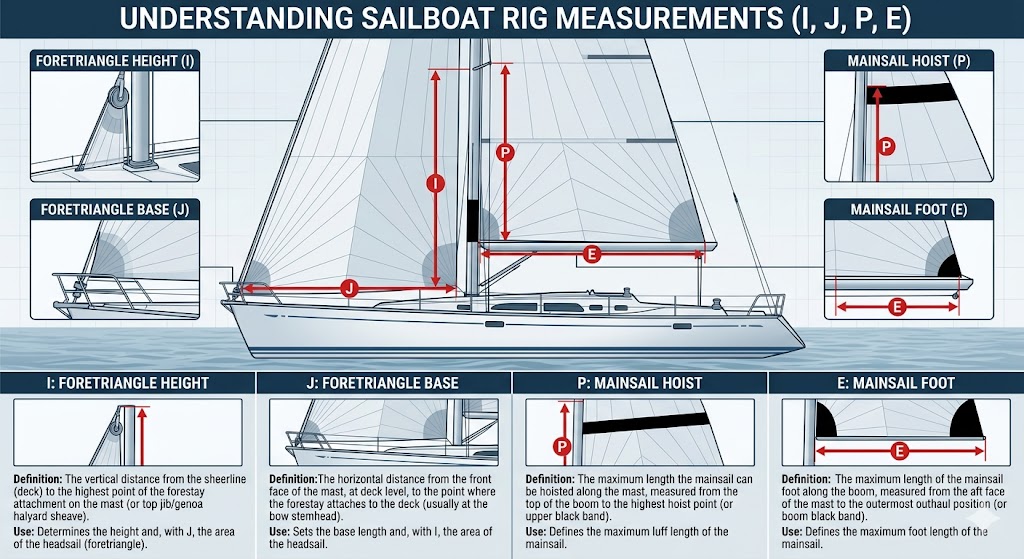
Rig Dimensions
I (Foretriangle Height) 31.50 ft / 9.60 m
J (Foretriangle Base) 9.42 ft / 2.87 m
P (Mainsail Luff) 31.67 ft / 9.65 m
E (Mainsail Foot) 12.00 ft / 3.66 m
SA Fore 148.37 ft² / 13.78 m²
SA Main 190.02 ft² / 17.65 m²
SA Total (100%) 338.39 ft² / 31.44 m²
Est. Forestay Length 32.88 ft / 10.02 m
Engine & Accommodations
Engine Make Yanmar
Engine Type Diesel
Horsepower 18
Fuel Capacity 20 gals / 76 L
Water Capacity 40 gals / 151 L
How It Compares

vs. Antrim 27, Dehler 28, Lancer 28, Parker 275, Pogo 850

This boat Similar boats
Dimensions
LOA
Hunter 280 ★
27.8 ft
Antrim 27
27.8 ft
Dehler 28
27.9 ft
Lancer 28
27.7 ft
Parker 275
27.9 ft
Pogo 850
27.9 ft
LWL
Hunter 280 ★
23.6 ft
Antrim 27
23.8 ft
Dehler 28
22.3 ft
Lancer 28
23.9 ft
Parker 275
24.5 ft
Pogo 850
27.2 ft
Beam
Hunter 280 ★
9.6 ft
Antrim 27
9.3 ft
Dehler 28
9.2 ft
Lancer 28
8.0 ft
Parker 275
9.3 ft
Pogo 850
11.8 ft
Displacement
Hunter 280 ★
6 lbs
Antrim 27
2 lbs
Dehler 28
5 lbs
Lancer 28
4 lbs
Parker 275
5 lbs
Pogo 850
6 lbs
Ballast
Hunter 280 ★
2 lbs
Antrim 27
1 lbs
Dehler 28
2 lbs
Lancer 28
2 lbs
Parker 275
2 lbs
Pogo 850
1 lbs
Sail Area
Hunter 280 ★
428 sq ft
Antrim 27
489 sq ft
Dehler 28
369 sq ft
Lancer 28
309 sq ft
Parker 275
380 sq ft
Pogo 850
560 sq ft
Performance
PHRF Rating (lower = faster)
Hunter 280 ★
210 s/nm
Antrim 27
87 s/nm
Dehler 28
Lancer 28
258 s/nm
Parker 275
Pogo 850
SA / Displacement (higher = more powerful)
Hunter 280 ★
19.7
Antrim 27
41.5
Dehler 28
19.0
Lancer 28
17.2
Parker 275
19.6
Pogo 850
26.7
Ballast / Disp (higher = stiffer)
Hunter 280 ★
32.3 %
Antrim 27
40.4 %
Dehler 28
40.0 %
Lancer 28
44.9 %
Parker 275
Pogo 850
30.4 %
Comfort Ratio (higher = more comfortable offshore)
Hunter 280 ★
19.8
Antrim 27
8.3
Dehler 28
18.5
Lancer 28
18.9
Parker 275
17.2
Pogo 850
13.0
Capsize Screening (lower = safer)
Hunter 280 ★
2.07
Antrim 27
2.69
Dehler 28
2.08
Lancer 28
1.89
Parker 275
2.10
Pogo 850
2.58
Displacement / Length (lower = lighter)
Hunter 280 ★
221
Antrim 27
86
Dehler 28
221
Lancer 28
159
Parker 275
Pogo 850
136
Hull Speed
Hunter 280 ★
6.5 kts
Antrim 27
6.5 kts
Dehler 28
6.3 kts
Lancer 28
6.6 kts
Parker 275
6.6 kts
Pogo 850
7.0 kts
Speed Number (higher = faster)
Hunter 280 ★
2.3
Antrim 27
Dehler 28
2.7
Lancer 28
3.3
Parker 275
3.1
Pogo 850
Find a Hunter 280 For Sale