Photo: Shad Turner/W. D. Schock Corp. / Public domain
About the Santana 20
Designed by Shad Turner and built by W. D. Schock Corporation starting in 1976, this compact 20-footer earned a devoted following among sailors seeking spirited performance in a trailerable package. With 900 hulls produced, the Santana 20 became a popular choice for both competitive racing and recreational sailing.
The boat's fin keel and spade rudder configuration, combined with a relatively light displacement of 1,350 pounds, delivers responsive handling and impressive speed for its size. The fractional sloop rig maximizes sail area efficiency while remaining manageable for small crews. With a sail area to displacement ratio of 26.78, this design emphasizes performance over comfort, making it particularly well-suited for day sailing, club racing, and coastal cruising.
The Santana 20's narrow beam and fine hull lines contribute to its reputation as a fast, close-winded sailboat that rewards skilled helmsmanship. While the low comfort ratio of 7.57 reflects its racing-oriented nature rather than cruising amenities, the boat's solid fiberglass construction and proven design have made it a enduring favorite in one-design fleets. Its modest draft and trailerable size open up shallow waters and easy launching, extending its versatility for exploring various sailing venues.
Market Price Estimate
Beta
Small sample size. This estimate is based on fewer than 5 listings and may not be representative of the true market. Use with caution.
$1,500 – $1,500
typical asking price
Median $1,500 ·
2 listings used
All listings
$1,500 – $1,500 2
Rate a listing price
$
About this estimate
Prices are based on recent asking prices from public listings — not actual sale prices, which are typically lower.
Condition is not factored in. A well-maintained boat with new sails and engine can be worth significantly more than a project boat of the same model.
Location affects price. Boats in landlocked states or areas with fewer buyers often sell for less than those on the coast.
Year of manufacture is not filtered. Older examples of this model will generally be priced lower than newer ones.
Included equipment varies widely. A boat with a full suite of electronics, dodger, and new standing rigging may command a large premium.
Outliers are automatically excluded using statistical filtering to improve accuracy, but some bad data may remain.
PHRF Rating
PHRF (Performance Handicap Racing Fleet) is a national racing handicap measured in seconds per nautical mile. Lower values indicate faster boats. Ratings are sourced from US Sailing's national database (median across 60+ regional fleets).
SA/Displacement
Sail Area to Displacement ratio measures how much sail power a boat has relative to its weight. Higher values mean more performance and speed.
Under 14 — Heavy cruiser, slow14–18 — Cruising sailboat18–22 — Cruiser/racerOver 22 — Performance racer
26.78
Ballast/Displacement
Ballast to Displacement ratio shows what percentage of the boat's total weight is ballast. Higher values generally mean better initial stability and stiffer sail carrying.
Displacement/Length
Displacement to Length ratio measures how heavy a boat is relative to its waterline length. Lower values mean a lighter, faster boat.
Under 100 — Ultralight racer100–200 — Light cruiser/racer200–300 — Moderate cruiser300–400 — Heavy cruiserOver 400 — Very heavy
147.14
Comfort Ratio
Ted Brewer's Comfort Ratio predicts how comfortable a boat will feel in offshore conditions. Higher values mean a steadier, more comfortable motion in a seaway.
Under 20 — Uncomfortably rough20–30 — Acceptable coastal30–40 — Good offshore comfortOver 40 — Very comfortable offshore
7.57
Capsize Screening Formula
The USHS Capsize Screening Formula estimates offshore capsize risk. Lower is safer — values under 2.0 are considered acceptable for offshore sailing.
Under 2.0 — Safe for offshore2.0–2.2 — Borderline offshoreOver 2.2 — Coastal use recommended
2.9
Hull Speed
Hull Speed is the theoretical maximum speed of a displacement hull, calculated from waterline length. Most cruising sailboats reach this speed in moderate conditions.
5.36 kn
S# (Speed Number)
The Speed Number (S#) is a quick performance index. Higher values indicate a faster, more powerful design relative to its size.
Under 3.0 — Slow cruiser3.0–5.0 — Average cruiser5.0–7.0 — Performance cruiserOver 7.0 — Racer
4.39
Pounds/Inch Immersion
Pounds per Inch Immersion (PPI) tells you how much weight is needed to sink the boat one inch. Useful for calculating how additional gear and stores affect waterline.
457.36 pounds/inch
SA/Displacement (Calc)
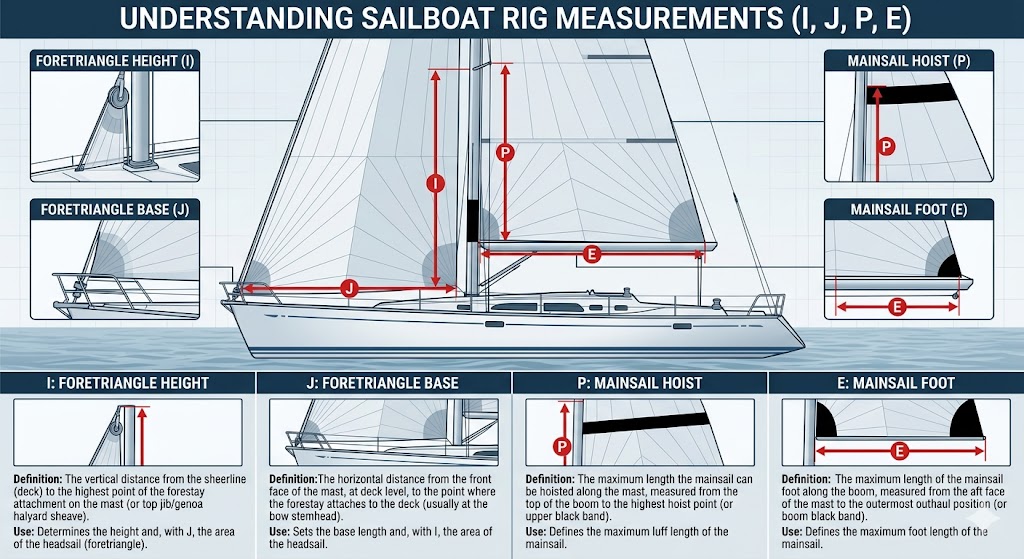
Calculated Sail Area to Displacement ratio using actual measured sail dimensions rather than reported values. More precise than the reported SA/Disp figure.
24.38