Back to Search
Nicholson 32
Designer: Charles A. Nicholson / Peter Nicholson  ·  Builder: Camper & Nicholson/Halmatic Ltd. (Uk)  ·  First built: 1962
+ Add to Compare
About the Nicholson 32

Built by the prestigious Camper & Nicholson yard from 1962 to 1981, this classic masthead sloop represents traditional British yacht design at its finest. With 369 hulls launched over nearly two decades, the Nicholson 32 earned a solid reputation among cruising sailors seeking a robust, seaworthy vessel. The design showcases quintessential long keel characteristics that define classic cruising yachts. Her substantial displacement of 12,200 pounds, combined with 6,800 pounds of ballast, creates exceptional stability and sea-kindly motion in challenging conditions. The long keel configuration provides excellent directional stability and forgiving handling, making her particularly well-suited for offshore passages and extended coastal cruising. Charles and Peter Nicholson's design philosophy emphasized seaworthiness over speed, evident in the boat's impressive comfort ratio of 36.89 and conservative capsize screening value of 1.61. These numbers indicate a yacht that prioritizes safety and crew comfort during long passages. The fiberglass construction ensures durability while maintaining the classic aesthetic lines that Nicholson designs are renowned for. With her moderate sail area and traditional rig, this yacht appeals to sailors who value reliability and sea-keeping ability over racing performance, making her an excellent choice for serious cruising adventures.

Core Dimensions
LOA (Length Overall) 32.00 ft / 9.75 m
LWL (Waterline Length) 24.00 ft / 7.32 m
Beam 9.25 ft / 2.82 m
Max Draft 5.50 ft / 1.68 m
Displacement 12,200.00 lb / 5,534 kg
Ballast 6,800.00 lb / 3,084 kg
Sail Area (Reported) 470.00 ft² / 43.66 m²
Design & Construction
Hull Type Long Keel
Rigging Type Masthead Sloop
Construction FG
Designer Charles A. Nicholson / Peter Nicholson
Builder Camper & Nicholson/Halmatic Ltd. (UK)
First Built 1962
Last Built 1981
Number Built 369
Associations Nicholson 32 Association
Related Sailboats Contessa 32 · Westsail 32 · Bristol 32 · Gulf 32 · Bayfield 32
Owner Reviews

No owner reviews yet — be the first to share your experience with this boat.

Known Issues & What to Watch For
Medium Hull/Deck
Early Nicholson 32s used a relatively thin GRP layup by modern standards, and the deck moulding in particular is prone to delamination and core saturation around chainplates, stanchion bases, and the mast partners area where water ingress has occurred over decades.
1962–1970 models
High Hull/Deck
The deck-to-hull joint on earlier production boats was bonded and bolted but is known to open up and allow persistent water ingress into the topsides, particularly at the bow and stern quarters. This joint should be carefully inspected and probed for movement or soft spots.
pre-1972 models
High Keel
The long keel is integral to the hull on most Nicholson 32s, but the ballast is encapsulated lead or iron. On iron-ballasted versions, internal corrosion of the ballast can cause the hull floor to lift or crack in the bilge area. Check for rust staining in the bilge and any cracking of the GRP over the ballast.
Medium Hull/Deck
The rudder on the Nicholson 32 is hung on a pintle-and-gudgeon arrangement on the back of the long keel. The lower gudgeon in particular is subject to wear and corrosion, and the rudder can develop significant play. Inspect for slop in the rudder bearings and condition of the pintles.
High Rigging
The chainplate knees are glassed into the hull interior and are known to crack or delaminate from the hull skin over time due to the high rig loads on this fractional-rigged or masthead-rigged vessel. Interior liners or joinery often hide the chainplate roots, making inspection difficult.
Medium Rigging
The mast step on deck versions can develop leaks and stress cracking around the partners, as the deck moulding was not always heavily reinforced in this area on earlier builds. Inspect the underside of the deck at the mast for delamination and staining.
1962–1975 models
Low Accommodations
The interior joinery was constructed using teak-faced ply with solid teak trim, and on older boats this woodwork is frequently found to have swollen, delaminated, or gone soft due to chronic low-level water ingress from ports, the companionway, and deck fittings. The quarter berth area and forward cabin are particularly prone.
High Hull/Deck
Bronze seacocks and through-hulls were standard fitment and are now 40–60 years old on earlier boats. Dezincification of older brass fittings (sometimes substituted for bronze) is a known issue; all below-waterline fittings should be confirmed as bronze or replaced.
1962–1975 models
Medium Engine
Boats were fitted with various small diesel auxiliaries over the production run (including Stuart Turner, Bukh, and Volvo Penta units), and engine beds in GRP long-keel boats of this era are prone to softening and delamination under vibration. Check the engine beds for movement and soft GRP, and verify the engine mounts are secure.
High Electrical
Original wiring looms on surviving unrestored examples are now 40–60 years old and frequently found to be brittle, undersized by modern standards, and lacking proper fusing. Many boats have had ad-hoc additions over the years with no circuit protection, creating fire risk.
pre-1980 models

Own or have surveyed a Nicholson 32? Submit a known issue
Performance Ratios
PHRF Rating PHRF (Performance Handicap Racing Fleet) is a national racing handicap measured in seconds per nautical mile. Lower values indicate faster boats. Ratings are sourced from US Sailing's national database (median across 60+ regional fleets).
Under 0 — Ultralight racer0–90 — Performance racer90–150 — Cruiser/racer150–210 — Typical cruiserOver 210 — Heavy/slow cruiser
189
SA/Displacement Sail Area to Displacement ratio measures how much sail power a boat has relative to its weight. Higher values mean more performance and speed.
Under 14 — Heavy cruiser, slow14–18 — Cruising sailboat18–22 — Cruiser/racerOver 22 — Performance racer
14.24
Ballast/Displacement Ballast to Displacement ratio shows what percentage of the boat's total weight is ballast. Higher values generally mean better initial stability and stiffer sail carrying.
30–35% — Typical cruiser35–45% — Stiff performance boatOver 45% — Racing oriented
55.74
Displacement/Length Displacement to Length ratio measures how heavy a boat is relative to its waterline length. Lower values mean a lighter, faster boat.
Under 100 — Ultralight racer100–200 — Light cruiser/racer200–300 — Moderate cruiser300–400 — Heavy cruiserOver 400 — Very heavy
393.98
Comfort Ratio Ted Brewer's Comfort Ratio predicts how comfortable a boat will feel in offshore conditions. Higher values mean a steadier, more comfortable motion in a seaway.
Under 20 — Uncomfortably rough20–30 — Acceptable coastal30–40 — Good offshore comfortOver 40 — Very comfortable offshore
36.89
Capsize Screening Formula The USHS Capsize Screening Formula estimates offshore capsize risk. Lower is safer — values under 2.0 are considered acceptable for offshore sailing.
Under 2.0 — Safe for offshore2.0–2.2 — Borderline offshoreOver 2.2 — Coastal use recommended
1.61
Hull Speed Hull Speed is the theoretical maximum speed of a displacement hull, calculated from waterline length. Most cruising sailboats reach this speed in moderate conditions. 6.56 kn
S# (Speed Number) The Speed Number (S#) is a quick performance index. Higher values indicate a faster, more powerful design relative to its size.
Under 3.0 — Slow cruiser3.0–5.0 — Average cruiser5.0–7.0 — Performance cruiserOver 7.0 — Racer
1.01
Pounds/Inch Immersion Pounds per Inch Immersion (PPI) tells you how much weight is needed to sink the boat one inch. Useful for calculating how additional gear and stores affect waterline. 793.23 pounds/inch
SA/Displacement (Calc) Calculated Sail Area to Displacement ratio using actual measured sail dimensions rather than reported values. More precise than the reported SA/Disp figure. 14.23
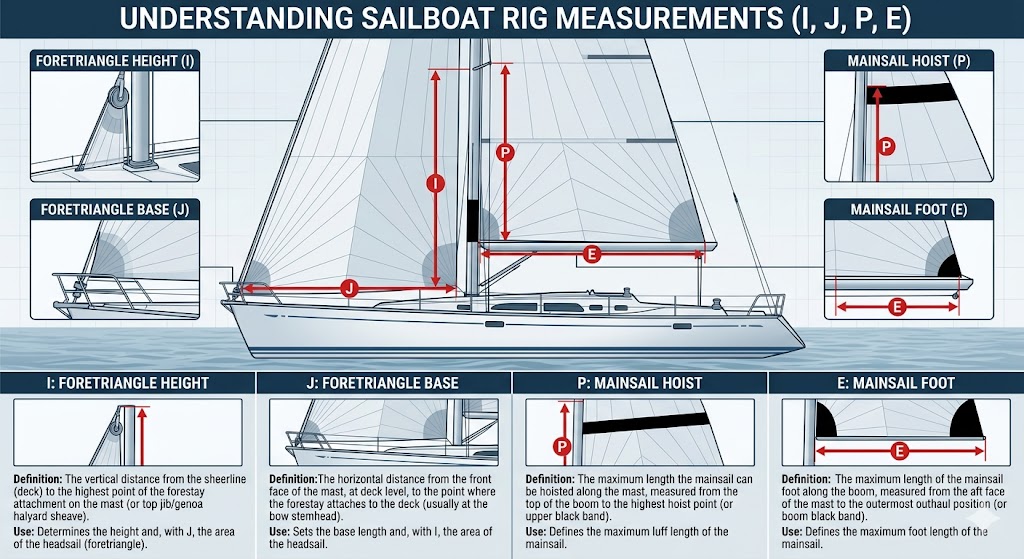
Rig Dimensions
I (Foretriangle Height) 38.30 ft / 11.67 m
J (Foretriangle Base) 12.60 ft / 3.84 m
P (Mainsail Luff) 33.10 ft / 10.09 m
E (Mainsail Foot) 13.80 ft / 4.21 m
SA Fore 241.29 ft² / 22.42 m²
SA Main 228.39 ft² / 21.22 m²
SA Total (100%) 469.68 ft² / 43.63 m²
Est. Forestay Length 40.32 ft / 12.29 m
Engine & Accommodations
Engine Make Watermota
Engine Model Panther
Engine Type Diesel
Fuel Capacity 20 gals / 76 L
Water Capacity 53 gals / 201 L
How It Compares

vs. Bayfield 32, Bristol 32, Contessa 32, Gulf 32, Westsail 32

This boat Similar boats
Dimensions
LOA
Nicholson 32 ★
32.0 ft
Bayfield 32
Bristol 32
32.0 ft
Contessa 32
32.0 ft
Gulf 32
32.0 ft
Westsail 32
32.0 ft
LWL
Nicholson 32 ★
24.0 ft
Bayfield 32
Bristol 32
22.0 ft
Contessa 32
24.0 ft
Gulf 32
25.0 ft
Westsail 32
27.5 ft
Beam
Nicholson 32 ★
9.3 ft
Bayfield 32
Bristol 32
9.5 ft
Contessa 32
9.5 ft
Gulf 32
10.0 ft
Westsail 32
11.0 ft
Displacement
Nicholson 32 ★
12 lbs
Bayfield 32
Bristol 32
10 lbs
Contessa 32
9 lbs
Gulf 32
15 lbs
Westsail 32
19 lbs
Ballast
Nicholson 32 ★
6 lbs
Bayfield 32
Bristol 32
3 lbs
Contessa 32
4 lbs
Gulf 32
6 lbs
Westsail 32
7 lbs
Sail Area
Nicholson 32 ★
470 sq ft
Bayfield 32
Bristol 32
466 sq ft
Contessa 32
433 sq ft
Gulf 32
555 sq ft
Westsail 32
753 sq ft
Performance
PHRF Rating (lower = faster)
Nicholson 32 ★
189 s/nm
Bayfield 32
240 s/nm
Bristol 32
192 s/nm
Contessa 32
174 s/nm
Gulf 32
279 s/nm
Westsail 32
243 s/nm
SA / Displacement (higher = more powerful)
Nicholson 32 ★
14.2
Bayfield 32
Bristol 32
15.3
Contessa 32
15.5
Gulf 32
14.7
Westsail 32
16.7
Ballast / Disp (higher = stiffer)
Nicholson 32 ★
55.7 %
Bayfield 32
Bristol 32
36.1 %
Contessa 32
47.4 %
Gulf 32
43.3 %
Westsail 32
35.9 %
Comfort Ratio (higher = more comfortable offshore)
Nicholson 32 ★
36.9
Bayfield 32
Bristol 32
33.3
Contessa 32
27.7
Gulf 32
39.8
Westsail 32
42.9
Capsize Screening (lower = safer)
Nicholson 32 ★
1.61
Bayfield 32
Bristol 32
1.72
Contessa 32
1.80
Gulf 32
1.62
Westsail 32
1.64
Displacement / Length (lower = lighter)
Nicholson 32 ★
393
Bayfield 32
Bristol 32
452
Contessa 32
306
Gulf 32
428
Westsail 32
418
Hull Speed
Nicholson 32 ★
6.6 kts
Bayfield 32
Bristol 32
6.3 kts
Contessa 32
6.6 kts
Gulf 32
6.7 kts
Westsail 32
7.0 kts
Speed Number (higher = faster)
Nicholson 32 ★
1.0
Bayfield 32
Bristol 32
0.8
Contessa 32
1.6
Gulf 32
0.7
Westsail 32
1.0
Find a Nicholson 32 For Sale