Back to Search

Westsail 32

Designer: William Crealock/W. Atkin  ·  Builder: Westsail Corp. (Usa)  ·  First built: 1971
+ Add to Compare
Videos
Westsail 32
Photo: Johantheghost / CC BY-SA 3.0
About the Westsail 32

Built from 1971 to 1981, this William Crealock-designed cruiser earned legendary status among bluewater sailors for its exceptional seaworthiness and traditional sailing characteristics. With 834 hulls produced by Westsail Corp., the design became synonymous with serious offshore cruising during the 1970s cruising renaissance. The boat's heavy displacement of 19,500 pounds and conservative sail plan create a remarkably stable platform that excels in rough conditions. Its long keel configuration with transom-hung rudder provides excellent directional stability and emergency steering options, while the cutter rig offers tremendous sail handling versatility for shorthanded crews. The substantial ballast-to-displacement ratio contributes to exceptional ultimate stability, making this design particularly well-suited for ocean crossings and extended cruising. While not built for speed, with a hull speed of 7.03 knots, this sailboat compensates with predictable handling and the ability to carry sail in heavy weather when lighter boats would be overpowered. The high comfort ratio of 42.85 reflects the design's seakindly motion, though this translates to slower passages in light air. For sailors prioritizing safety and comfort over performance, particularly those planning offshore adventures, this classic design remains highly regarded in the used boat market.

Featured in Keel Index Articles
Market Price Estimate Beta
$4,000 – $59,900
typical asking price
Median $28,700  ·  14 listings used (2 outliers excluded)
All listings
$4,000 – $59,900 14
Rate a listing price
$
About this estimate
  • Prices are based on recent asking prices from public listings — not actual sale prices, which are typically lower.
  • Condition is not factored in. A well-maintained boat with new sails and engine can be worth significantly more than a project boat of the same model.
  • Location affects price. Boats in landlocked states or areas with fewer buyers often sell for less than those on the coast.
  • Year of manufacture is not filtered. Older examples of this model will generally be priced lower than newer ones.
  • Included equipment varies widely. A boat with a full suite of electronics, dodger, and new standing rigging may command a large premium.
  • Outliers are automatically excluded using statistical filtering to improve accuracy, but some bad data may remain.
Core Dimensions
LOA (Length Overall) 32.00 ft / 9.75 m
LWL (Waterline Length) 27.50 ft / 8.38 m
Beam 11.00 ft / 3.35 m
Max Draft 5.00 ft / 1.52 m
Displacement 19,500.00 lb / 8,845 kg
Ballast 7,000.00 lb / 3,175 kg
Ballast Type Lead
Sail Area (Reported) 753.00 ft² / 69.96 m²
Headroom 6.17 ft / 1.88 m
Design & Construction
Hull Type Long keel w/trans. hung rudder
Rigging Type Cutter
Construction FG
Designer William Crealock/W. Atkin
Builder Westsail Corp. (USA)
First Built 1971
Last Built 1981
Number Built 834
Associations Westsail Owners Association
Related Sailboats Contessa 32 · Bayfield 32 · Bristol 32 · Downeaster 32 · Gulf 32
Owner Reviews

No owner reviews yet — be the first to share your experience with this boat.

Known Issues & What to Watch For
High Hull/Deck
Early Westsail 32s were sold as kits or partially completed hulls, resulting in highly variable build quality. Deck hardware backing plates, through-hull installations, and bulkhead tabbing are often owner-completed and may be structurally inadequate or non-standard.
1971–1976 models
High Hull/Deck
The hull-to-deck joint on many Westsail 32s was completed by owners or small finishing shops and frequently shows poor bonding, inadequate fastening, and water intrusion. This joint should be carefully inspected for separation and leaking, particularly at the bow and stern.
High Hull/Deck
Deck core material, typically balsa or plywood, was used in owner-finished or yard-finished boats with inconsistent quality control. Core rot around chainplates, stanchion bases, and deck hardware is common and widespread.
Medium Hull/Deck
The hollow fiberglass bowsprit used on many boats is prone to cracking at its root fitting and can trap water internally, leading to delamination. Inspect the base carefully for cracks and check for water ingress.
High Keel
The full-length keel was bonded and glassed differently depending on who finished the hull. Keel-to-hull joint integrity is highly variable; some examples show cracking or separation at the garboard area that may indicate structural compromise or ongoing flexing.
High Rigging
Chainplate installations are often owner-completed and vary widely in structural backing and attachment to bulkheads. Many chainplates pass through the deck without adequate sealing, causing chronic leaks and potential rot in wooden backing structures below.
Medium Rigging
The original sail plan uses a cutter rig with a long bowsprit that places significant compression loads on the stem fitting. Stem fitting attachment and the surrounding laminate should be carefully inspected for cracking and delamination.
Medium Engine
Factory-installed engines were typically the Universal Atomic 4 gasoline engine, which is now very old and difficult to source parts for. Many have been replaced with diesel conversions of varying quality; verify engine mounts, exhaust routing, and fuel tank compatibility when a diesel conversion is present.
1971–1978 models
Medium Engine
The engine compartment in the Westsail 32 is notoriously tight and poorly ventilated, a known complaint with the design. Heat buildup and difficult access complicate routine maintenance and can accelerate hose and belt deterioration.
Medium Accommodations
Interior joinery in kit-built or owner-finished boats is frequently non-structural and may have been built with inadequate fastening to hull and bulkheads. Bulkhead tabbing should be checked for delamination, as these connections are critical to overall hull stiffness.
High Electrical
Wiring in owner-finished boats is often non-standard, multi-generation, and potentially unsafe. It is common to find mixed wire gauges, no circuit protection on some runs, and improper connections that predate ABYC standards.
Medium Hull/Deck
The original portlight and hatch installations on early production and kit boats frequently leak chronically, and replacements have often been through-bolted through cored deck sections without proper core sealing, accelerating core deterioration around all openings.

Own or have surveyed a Westsail 32? Submit a known issue
Performance Ratios
PHRF Rating PHRF (Performance Handicap Racing Fleet) is a national racing handicap measured in seconds per nautical mile. Lower values indicate faster boats. Ratings are sourced from US Sailing's national database (median across 60+ regional fleets).
Under 0 — Ultralight racer0–90 — Performance racer90–150 — Cruiser/racer150–210 — Typical cruiserOver 210 — Heavy/slow cruiser
243
SA/Displacement Sail Area to Displacement ratio measures how much sail power a boat has relative to its weight. Higher values mean more performance and speed.
Under 14 — Heavy cruiser, slow14–18 — Cruising sailboat18–22 — Cruiser/racerOver 22 — Performance racer
16.69
Ballast/Displacement Ballast to Displacement ratio shows what percentage of the boat's total weight is ballast. Higher values generally mean better initial stability and stiffer sail carrying.
30–35% — Typical cruiser35–45% — Stiff performance boatOver 45% — Racing oriented
35.9
Displacement/Length Displacement to Length ratio measures how heavy a boat is relative to its waterline length. Lower values mean a lighter, faster boat.
Under 100 — Ultralight racer100–200 — Light cruiser/racer200–300 — Moderate cruiser300–400 — Heavy cruiserOver 400 — Very heavy
418.59
Comfort Ratio Ted Brewer's Comfort Ratio predicts how comfortable a boat will feel in offshore conditions. Higher values mean a steadier, more comfortable motion in a seaway.
Under 20 — Uncomfortably rough20–30 — Acceptable coastal30–40 — Good offshore comfortOver 40 — Very comfortable offshore
42.85
Capsize Screening Formula The USHS Capsize Screening Formula estimates offshore capsize risk. Lower is safer — values under 2.0 are considered acceptable for offshore sailing.
Under 2.0 — Safe for offshore2.0–2.2 — Borderline offshoreOver 2.2 — Coastal use recommended
1.64
Hull Speed Hull Speed is the theoretical maximum speed of a displacement hull, calculated from waterline length. Most cruising sailboats reach this speed in moderate conditions. 7.03 kn
S# (Speed Number) The Speed Number (S#) is a quick performance index. Higher values indicate a faster, more powerful design relative to its size.
Under 3.0 — Slow cruiser3.0–5.0 — Average cruiser5.0–7.0 — Performance cruiserOver 7.0 — Racer
0.98
Pounds/Inch Immersion Pounds per Inch Immersion (PPI) tells you how much weight is needed to sink the boat one inch. Useful for calculating how additional gear and stores affect waterline. 1,080.87 pounds/inch
SA/Displacement (Calc) Calculated Sail Area to Displacement ratio using actual measured sail dimensions rather than reported values. More precise than the reported SA/Disp figure. 15.64
Rig Dimensions
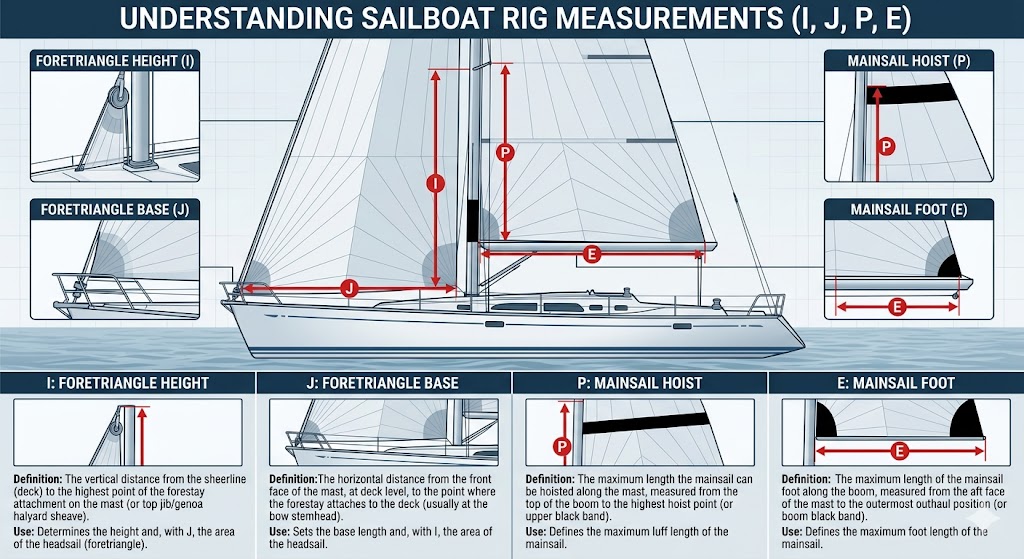
I (Foretriangle Height) 44.00 ft / 13.41 m
J (Foretriangle Base) 18.30 ft / 5.58 m
P (Mainsail Luff) 38.25 ft / 11.66 m
E (Mainsail Foot) 15.83 ft / 4.82 m
SA Fore 402.60 ft² / 37.40 m²
SA Main 302.75 ft² / 28.13 m²
SA Total (100%) 705.35 ft² / 65.53 m²
Est. Forestay Length 47.65 ft / 14.52 m
Engine & Accommodations
Engine Make Volvo or Perkins
Engine Type Diesel
Horsepower 36
Fuel Capacity 42 gals / 159 L
Water Capacity 80 gals / 303 L
How It Compares

vs. Bayfield 32, Bristol 32, Contessa 32, Downeaster 32, Gulf 32

This boat Similar boats
Dimensions
LOA
Westsail 32 ★
32.0 ft
Bayfield 32
Bristol 32
32.0 ft
Contessa 32
32.0 ft
Downeaster 32
32.0 ft
Gulf 32
32.0 ft
LWL
Westsail 32 ★
27.5 ft
Bayfield 32
Bristol 32
22.0 ft
Contessa 32
24.0 ft
Downeaster 32
25.8 ft
Gulf 32
25.0 ft
Beam
Westsail 32 ★
11.0 ft
Bayfield 32
Bristol 32
9.5 ft
Contessa 32
9.5 ft
Downeaster 32
11.0 ft
Gulf 32
10.0 ft
Displacement
Westsail 32 ★
19 lbs
Bayfield 32
Bristol 32
10 lbs
Contessa 32
9 lbs
Downeaster 32
17 lbs
Gulf 32
15 lbs
Ballast
Westsail 32 ★
7 lbs
Bayfield 32
Bristol 32
3 lbs
Contessa 32
4 lbs
Downeaster 32
5 lbs
Gulf 32
6 lbs
Sail Area
Westsail 32 ★
753 sq ft
Bayfield 32
Bristol 32
466 sq ft
Contessa 32
433 sq ft
Downeaster 32
602 sq ft
Gulf 32
555 sq ft
Performance
PHRF Rating (lower = faster)
Westsail 32 ★
243 s/nm
Bayfield 32
240 s/nm
Bristol 32
192 s/nm
Contessa 32
174 s/nm
Downeaster 32
Gulf 32
279 s/nm
SA / Displacement (higher = more powerful)
Westsail 32 ★
16.7
Bayfield 32
Bristol 32
15.3
Contessa 32
15.5
Downeaster 32
14.6
Gulf 32
14.7
Ballast / Disp (higher = stiffer)
Westsail 32 ★
35.9 %
Bayfield 32
Bristol 32
36.1 %
Contessa 32
47.4 %
Downeaster 32
32.4 %
Gulf 32
43.3 %
Comfort Ratio (higher = more comfortable offshore)
Westsail 32 ★
42.9
Bayfield 32
Bristol 32
33.3
Contessa 32
27.7
Downeaster 32
38.9
Gulf 32
39.8
Capsize Screening (lower = safer)
Westsail 32 ★
1.64
Bayfield 32
Bristol 32
1.72
Contessa 32
1.80
Downeaster 32
1.71
Gulf 32
1.62
Displacement / Length (lower = lighter)
Westsail 32 ★
418
Bayfield 32
Bristol 32
452
Contessa 32
306
Downeaster 32
440
Gulf 32
428
Hull Speed
Westsail 32 ★
7.0 kts
Bayfield 32
Bristol 32
6.3 kts
Contessa 32
6.6 kts
Downeaster 32
6.8 kts
Gulf 32
6.7 kts
Speed Number (higher = faster)
Westsail 32 ★
1.0
Bayfield 32
Bristol 32
0.8
Contessa 32
1.6
Downeaster 32
0.8
Gulf 32
0.7
Resources & Community
Recommended Reading
Find a Westsail 32 For Sale