Back to Search
Morgan Out Island 415
Designer: Charles Morgan  ·  Builder: Morgan Yachts (Usa)  ·  First built: 1975
+ Add to Compare
Videos
About the Morgan Out Island 415

Designed by Charles Morgan and built from 1975 to 1981, this substantial cruising sailboat represents the classic American approach to offshore sailing. With 300 hulls produced during its six-year production run, the Out Island 415 established itself as a serious bluewater cruiser for sailors seeking traditional sailing characteristics and robust construction. The boat's long keel configuration and conservative design ratios reflect Morgan's commitment to seaworthiness over speed. At 41 feet overall with a 27,000-pound displacement, this is a heavy, stable platform that prioritizes comfort and safety in challenging conditions. The impressive comfort ratio of 34.97 indicates exceptional motion comfort at sea, while the conservative capsize screening formula of 1.85 demonstrates excellent stability characteristics for offshore passages. Morgan's fiberglass construction was well-regarded during this era, and the masthead sloop rig provides straightforward sail handling. The generous beam of nearly 14 feet creates spacious accommodations below, making extended cruising comfortable for couples or small families. While not built for speed, with a hull speed of 7.81 knots, the Out Island 415 offers the dependable, predictable sailing qualities that made Morgan yachts popular among serious cruising sailors of the late 1970s.

Core Dimensions
LOA (Length Overall) 41.00 ft / 12.50 m
LWL (Waterline Length) 34.00 ft / 10.36 m
Beam 13.83 ft / 4.22 m
Max Draft 4.20 ft / 1.28 m
Displacement 27,000.00 lb / 12,247 kg
Ballast 9,000.00 lb / 4,082 kg
Sail Area (Reported) 754.00 ft² / 70.05 m²
Design & Construction
Hull Type Long Keel
Rigging Type Masthead Sloop
Construction FG
Designer Charles Morgan
Builder Morgan Yachts (USA)
First Built 1975
Last Built 1981
Number Built 300
Owner Reviews

No owner reviews yet — be the first to share your experience with this boat.

Known Issues & What to Watch For
High Hull/Deck
The deck-to-hull joint on Morgan Out Island series boats uses an outward-turned flange that is vulnerable to separation and water intrusion, particularly at the bow and stern quarters. This joint was often secured with screws and sealant rather than a robust structural bond, and failures here can allow significant water into the laminate.
Medium Hull/Deck
The large cockpit lockers on the OI 415 frequently have poor or absent drainage, allowing water to pool against the fiberglass and any wood framing below. Inspect the locker floors and structural members underneath for rot and delamination.
High Hull/Deck
Balsa core decking was used extensively throughout the OI 415, and any fastener penetrations that lost their sealant over the decades are common water entry points. Widespread soft or delaminated deck sections are a frequent finding on survey, particularly around winch bases, stanchion bases, and deck hardware.
High Keel
The full-length keel on the OI 415 uses encapsulated ballast, and the external keel-to-hull joint is prone to cracking and weeping, allowing water intrusion into the ballast cavity over time. This can lead to internal rust staining and structural softening in the keel-hull bond area.
Medium Accommodations
The OI 415 used substantial teak and mahogany interior joinery and plywood structural bulkheads that are prone to delamination and rot when any deck leaks go unaddressed. Inspect all bulkhead-to-hull tabbing and the bases of major structural bulkheads for soft spots and failed glassing.
Medium Accommodations
The large aft cabin design incorporates a separate access hatch and portlights that are known sources of water intrusion. Many boats of this vintage have water damage in the aft cabin headliner, cabinetry, and subfloor due to failed seals on these openings.
High Rigging
The OI 415 was typically fitted with an aluminum deck-stepped mast on a tabernacle or keel-stepped arrangement depending on variant. The mast partners and compression post below deck should be carefully inspected for rot (if wooden) or cracking of the supporting fiberglass structure, as this area was not heavily reinforced from the factory.
Medium Engine
The OI 415 was commonly fitted with a Perkins 4-108 or Westerbeke diesel, both of which are aged beyond typical service life on surviving boats. The engine beds on this model are fiberglass and can show cracking or separation; inspect carefully for movement or soft engine stringers before relying on engine alignment.
Medium Electrical
Factory wiring from the late 1970s production is typically undersized by modern standards and uses older insulation that has become brittle and cracked after 40+ years. The OI 415 is old enough that a full rewire should be considered rather than piecemeal repairs to the original harness.

Own or have surveyed a Morgan Out Island 415? Submit a known issue
Performance Ratios
SA/Displacement Sail Area to Displacement ratio measures how much sail power a boat has relative to its weight. Higher values mean more performance and speed.
Under 14 — Heavy cruiser, slow14–18 — Cruising sailboat18–22 — Cruiser/racerOver 22 — Performance racer
13.46
Ballast/Displacement Ballast to Displacement ratio shows what percentage of the boat's total weight is ballast. Higher values generally mean better initial stability and stiffer sail carrying.
30–35% — Typical cruiser35–45% — Stiff performance boatOver 45% — Racing oriented
33.33
Displacement/Length Displacement to Length ratio measures how heavy a boat is relative to its waterline length. Lower values mean a lighter, faster boat.
Under 100 — Ultralight racer100–200 — Light cruiser/racer200–300 — Moderate cruiser300–400 — Heavy cruiserOver 400 — Very heavy
306.68
Comfort Ratio Ted Brewer's Comfort Ratio predicts how comfortable a boat will feel in offshore conditions. Higher values mean a steadier, more comfortable motion in a seaway.
Under 20 — Uncomfortably rough20–30 — Acceptable coastal30–40 — Good offshore comfortOver 40 — Very comfortable offshore
34.97
Capsize Screening Formula The USHS Capsize Screening Formula estimates offshore capsize risk. Lower is safer — values under 2.0 are considered acceptable for offshore sailing.
Under 2.0 — Safe for offshore2.0–2.2 — Borderline offshoreOver 2.2 — Coastal use recommended
1.85
Hull Speed Hull Speed is the theoretical maximum speed of a displacement hull, calculated from waterline length. Most cruising sailboats reach this speed in moderate conditions. 7.81 kn
S# (Speed Number) The Speed Number (S#) is a quick performance index. Higher values indicate a faster, more powerful design relative to its size.
Under 3.0 — Slow cruiser3.0–5.0 — Average cruiser5.0–7.0 — Performance cruiserOver 7.0 — Racer
1.41
Pounds/Inch Immersion Pounds per Inch Immersion (PPI) tells you how much weight is needed to sink the boat one inch. Useful for calculating how additional gear and stores affect waterline. 1,680.15 pounds/inch
SA/Displacement (Calc) Calculated Sail Area to Displacement ratio using actual measured sail dimensions rather than reported values. More precise than the reported SA/Disp figure. 13.47
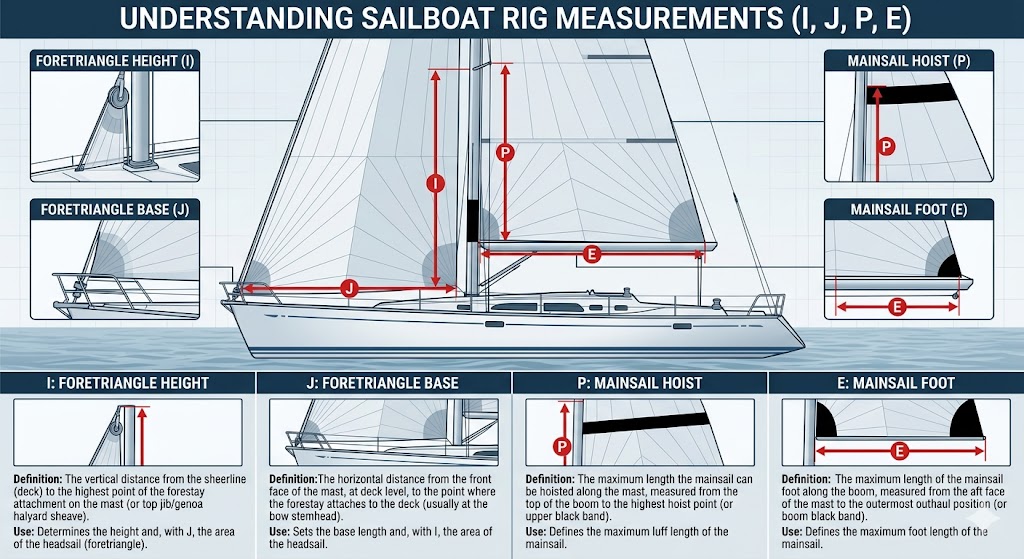
Rig Dimensions
I (Foretriangle Height) 49.00 ft / 14.94 m
J (Foretriangle Base) 17.00 ft / 5.18 m
P (Mainsail Luff) 42.25 ft / 12.88 m
E (Mainsail Foot) 16.00 ft / 4.88 m
SA Fore 416.50 ft² / 38.69 m²
SA Main 338.00 ft² / 31.40 m²
SA Total (100%) 754.50 ft² / 70.10 m²
Est. Forestay Length 51.87 ft / 15.81 m
Engine & Accommodations
Engine Make Perkins
Engine Type Diesel
Fuel Capacity 138 gals / 522 L
Water Capacity 170 gals / 644 L
How It Compares

vs. Ct 41, Dickerson 41, Freeport 41 Islander, Gulfstar 41, Hallberg Rassy 41

This boat Similar boats
Dimensions
LOA
Morgan Out Island 415 ★
41.0 ft
Ct 41
41.0 ft
Dickerson 41
41.0 ft
Freeport 41 Islander
41.0 ft
Gulfstar 41
41.0 ft
Hallberg Rassy 41
41.0 ft
LWL
Morgan Out Island 415 ★
34.0 ft
Ct 41
32.5 ft
Dickerson 41
31.5 ft
Freeport 41 Islander
32.5 ft
Gulfstar 41
33.0 ft
Hallberg Rassy 41
34.2 ft
Beam
Morgan Out Island 415 ★
13.8 ft
Ct 41
12.1 ft
Dickerson 41
12.5 ft
Freeport 41 Islander
13.2 ft
Gulfstar 41
12.0 ft
Hallberg Rassy 41
11.8 ft
Displacement
Morgan Out Island 415 ★
27 lbs
Ct 41
27 lbs
Dickerson 41
24 lbs
Freeport 41 Islander
22 lbs
Gulfstar 41
22 lbs
Hallberg Rassy 41
21 lbs
Ballast
Morgan Out Island 415 ★
9 lbs
Ct 41
9 lbs
Dickerson 41
8 lbs
Freeport 41 Islander
7 lbs
Gulfstar 41
7 lbs
Hallberg Rassy 41
8 lbs
Sail Area
Morgan Out Island 415 ★
754 sq ft
Ct 41
792 sq ft
Dickerson 41
Freeport 41 Islander
Gulfstar 41
691 sq ft
Hallberg Rassy 41
771 sq ft
Performance
PHRF Rating (lower = faster)
Morgan Out Island 415 ★
Ct 41
204 s/nm
Dickerson 41
180 s/nm
Freeport 41 Islander
Gulfstar 41
153 s/nm
Hallberg Rassy 41
SA / Displacement (higher = more powerful)
Morgan Out Island 415 ★
13.5
Ct 41
14.0
Dickerson 41
Freeport 41 Islander
Gulfstar 41
14.1
Hallberg Rassy 41
15.9
Ballast / Disp (higher = stiffer)
Morgan Out Island 415 ★
33.3 %
Ct 41
32.7 %
Dickerson 41
34.7 %
Freeport 41 Islander
31.8 %
Gulfstar 41
Hallberg Rassy 41
38.4 %
Comfort Ratio (higher = more comfortable offshore)
Morgan Out Island 415 ★
35.0
Ct 41
43.8
Dickerson 41
Freeport 41 Islander
Gulfstar 41
35.1
Hallberg Rassy 41
34.7
Capsize Screening (lower = safer)
Morgan Out Island 415 ★
1.85
Ct 41
1.61
Dickerson 41
Freeport 41 Islander
Gulfstar 41
1.72
Hallberg Rassy 41
1.70
Displacement / Length (lower = lighter)
Morgan Out Island 415 ★
306
Ct 41
357
Dickerson 41
349
Freeport 41 Islander
286
Gulfstar 41
Hallberg Rassy 41
244
Hull Speed
Morgan Out Island 415 ★
7.8 kts
Ct 41
7.6 kts
Dickerson 41
Freeport 41 Islander
Gulfstar 41
7.7 kts
Hallberg Rassy 41
7.8 kts
Speed Number (higher = faster)
Morgan Out Island 415 ★
1.4
Ct 41
1.2
Dickerson 41
Freeport 41 Islander
Gulfstar 41
1.7
Hallberg Rassy 41
2.1
Find a Morgan Out Island 415 For Sale