Back to Search
Irwin 40 Mkii
Designer: Ted Irwin  ·  Builder: Irwin Yachts (Usa)  ·  First built: 1980
+ Add to Compare
Videos
About the Irwin 40 Mkii

Built from 1980 by Irwin Yachts, this 40-footer represents the Florida builder's focus on creating affordable cruising sailboats for American sailors. Designer Ted Irwin crafted a practical coastal cruiser that prioritizes comfort and ease of handling over racing performance. The fiberglass construction features a fin keel with spade rudder configuration, providing good maneuverability in tight quarters while maintaining adequate directional stability. With a displacement of 16,890 pounds and 6,500 pounds of ballast, the boat offers a reassuring feel underfoot without being overly heavy. The masthead sloop rig keeps sail handling straightforward, making this an appealing choice for couples or small crews. Her comfort ratio of 27.47 indicates a motion that favors relaxed cruising over spirited sailing, while the capsize screening value of 1.9 suggests reasonable stability for coastal and near-offshore passages. The generous beam of over 12 feet translates to spacious accommodations below, a hallmark of Irwin's designs. This boat excels as a coastal cruiser for sailors seeking value and practicality. While not built for serious offshore passages or racing, the Mark II provides a solid platform for weekend cruising, extended coastal voyages, and learning the ropes of sailboat ownership without breaking the budget.

Core Dimensions
LOA (Length Overall) 40.83 ft / 12.44 m
LWL (Waterline Length) 31.17 ft / 9.50 m
Beam 12.17 ft / 3.71 m
Max Draft 6.25 ft / 1.91 m
Displacement 16,890.00 lb / 7,661 kg
Ballast 6,500.00 lb / 2,948 kg
Ballast Type Lead
Sail Area (Reported) 737.00 ft² / 68.47 m²
Design & Construction
Hull Type Fin w/spade rudder
Rigging Type Masthead Sloop
Construction FG
Designer Ted Irwin
Builder Irwin Yachts (USA)
First Built 1980
Associations Irwin Facebook Group
Owner Reviews

No owner reviews yet — be the first to share your experience with this boat.

Known Issues & What to Watch For
High Hull/Deck
Irwin boats of this era are known for relatively thin hull layups with minimal secondary bonding of interior furniture and bulkheads to the hull. Bulkhead-to-hull tabbing can crack and separate, particularly in the forward cabin area, leading to structural looseness and water intrusion.
High Hull/Deck
The deck-to-hull joint on Irwin 40s uses an outward-turned flange that is through-bolted and bedded, but the bedding compound frequently fails, allowing water to migrate into the joint and cause core delamination in the toerail area. Check the entire perimeter for soft spots and separation.
High Hull/Deck
Irwin used balsa core extensively in decks during this period. Chainplate and hardware deck penetrations were often inadequately resealed, leading to widespread balsa core rot, especially around the mast base, stanchion bases, and chainplate areas. Probe all hardware mounting locations for soft or wet core.
High Keel
The fin keel attachment on the Irwin 40 Mk II uses keel bolts that pass through a relatively shallow keel sump. Keel bolt corrosion and loosening is a documented problem; check for rust weeping at the bolt heads in the bilge and any movement or cracking of the keel-to-hull joint.
High Rigging
Irwin's deck-stepped mast design on the 40 Mk II relies on a compression post that transmits loads to the keel structure. Verify the compression post base is sound and that the mast step on deck shows no cracking or deflection, as inadequate support here is a known weakness.
Medium Rigging
Chainplate backing plates on Irwin 40s were sometimes undersized relative to the rig loads. Inspect backing plates under the forward cabin liner and settee areas for deformation, elongated bolt holes, or cracked fiberglass, as liner access can make inspection difficult.
High Hull/Deck
The spade rudder on this model is supported by a single rudder post with a fiberglass blade laminated around an internal armature. Delamination of the rudder blade from the stock and internal core rot are known issues; check for any play at the rudder bearing and knock the blade with a mallet to detect voids.
Medium Electrical
Irwin Yachts' factory wiring from this era was often undersized and used lower-quality connections that are now 40+ years old. Original wiring runs are frequently found corroded, chafed, or improperly spliced by subsequent owners; a full rewire is common on boats that have not already had it done.
Medium Accommodations
Interior teak and holly sole boards and cabin furniture were bonded and fastened to the hull liner, and liner-to-hull gaps are common. The main saloon floor area can feel soft or show movement if the underlying structure has degraded, and the liner itself can crack at stress points near bulkheads.
Medium Engine
The engine bed on Irwin 40s of this era was glassed into the hull, and engine bed delamination or cracking at the bed-to-hull joint is a known issue, particularly on boats with high-torque diesel retrofits. Inspect the engine mounts and beds carefully for movement, cracking, or soft laminate.

Own or have surveyed a Irwin 40 Mkii? Submit a known issue
Performance Ratios
SA/Displacement Sail Area to Displacement ratio measures how much sail power a boat has relative to its weight. Higher values mean more performance and speed.
Under 14 — Heavy cruiser, slow14–18 — Cruising sailboat18–22 — Cruiser/racerOver 22 — Performance racer
17.98
Ballast/Displacement Ballast to Displacement ratio shows what percentage of the boat's total weight is ballast. Higher values generally mean better initial stability and stiffer sail carrying.
30–35% — Typical cruiser35–45% — Stiff performance boatOver 45% — Racing oriented
38.48
Displacement/Length Displacement to Length ratio measures how heavy a boat is relative to its waterline length. Lower values mean a lighter, faster boat.
Under 100 — Ultralight racer100–200 — Light cruiser/racer200–300 — Moderate cruiser300–400 — Heavy cruiserOver 400 — Very heavy
248.98
Comfort Ratio Ted Brewer's Comfort Ratio predicts how comfortable a boat will feel in offshore conditions. Higher values mean a steadier, more comfortable motion in a seaway.
Under 20 — Uncomfortably rough20–30 — Acceptable coastal30–40 — Good offshore comfortOver 40 — Very comfortable offshore
27.47
Capsize Screening Formula The USHS Capsize Screening Formula estimates offshore capsize risk. Lower is safer — values under 2.0 are considered acceptable for offshore sailing.
Under 2.0 — Safe for offshore2.0–2.2 — Borderline offshoreOver 2.2 — Coastal use recommended
1.9
Hull Speed Hull Speed is the theoretical maximum speed of a displacement hull, calculated from waterline length. Most cruising sailboats reach this speed in moderate conditions. 7.48 kn
S# (Speed Number) The Speed Number (S#) is a quick performance index. Higher values indicate a faster, more powerful design relative to its size.
Under 3.0 — Slow cruiser3.0–5.0 — Average cruiser5.0–7.0 — Performance cruiserOver 7.0 — Racer
2.28
Pounds/Inch Immersion Pounds per Inch Immersion (PPI) tells you how much weight is needed to sink the boat one inch. Useful for calculating how additional gear and stores affect waterline. 1,355.42 pounds/inch
SA/Displacement (Calc) Calculated Sail Area to Displacement ratio using actual measured sail dimensions rather than reported values. More precise than the reported SA/Disp figure. 17.98
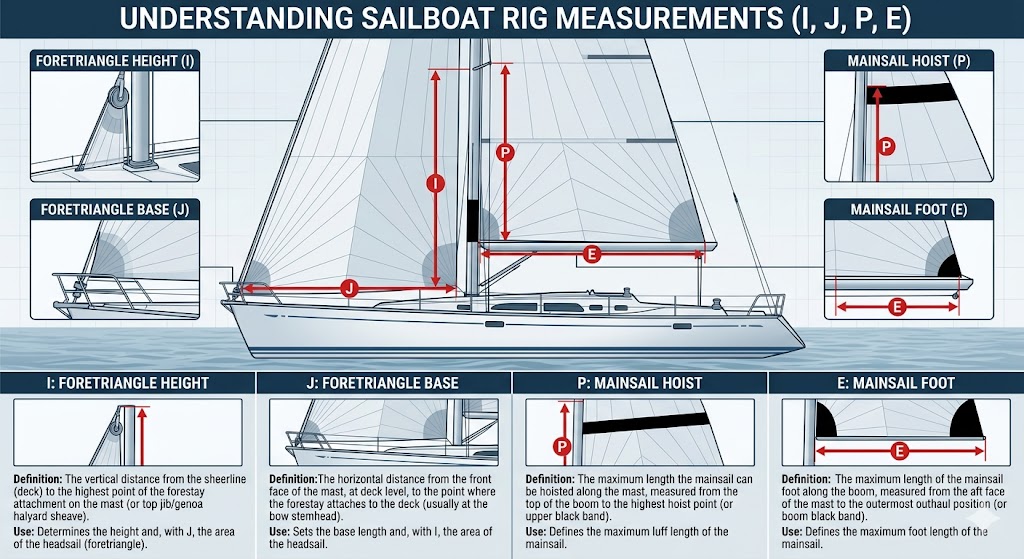
Rig Dimensions
I (Foretriangle Height) 50.00 ft / 15.24 m
J (Foretriangle Base) 16.50 ft / 5.03 m
P (Mainsail Luff) 44.00 ft / 13.41 m
E (Mainsail Foot) 14.75 ft / 4.50 m
SA Fore 412.50 ft² / 38.32 m²
SA Main 324.50 ft² / 30.15 m²
SA Total (100%) 737.00 ft² / 68.47 m²
Est. Forestay Length 52.65 ft / 16.05 m
Engine & Accommodations
Engine Make Yanmar
Engine Model 2QM20
Engine Type Diesel
Fuel Capacity 40 gals / 151 L
Water Capacity 100 gals / 379 L
How It Compares

vs. Caliber 40 Lrc, Irwin 41 Citation, Offshore 41 Cheoy Lee

This boat Similar boats
Dimensions
LOA
Irwin 40 Mkii ★
40.8 ft
Caliber 40 Lrc
40.9 ft
Irwin 41 Citation
40.8 ft
Offshore 41 Cheoy Lee
40.9 ft
LWL
Irwin 40 Mkii ★
31.2 ft
Caliber 40 Lrc
32.5 ft
Irwin 41 Citation
33.3 ft
Offshore 41 Cheoy Lee
32.5 ft
Beam
Irwin 40 Mkii ★
12.2 ft
Caliber 40 Lrc
12.7 ft
Irwin 41 Citation
13.0 ft
Offshore 41 Cheoy Lee
12.8 ft
Displacement
Irwin 40 Mkii ★
16 lbs
Caliber 40 Lrc
21 lbs
Irwin 41 Citation
17 lbs
Offshore 41 Cheoy Lee
21 lbs
Ballast
Irwin 40 Mkii ★
6 lbs
Caliber 40 Lrc
9 lbs
Irwin 41 Citation
9 lbs
Offshore 41 Cheoy Lee
8 lbs
Sail Area
Irwin 40 Mkii ★
737 sq ft
Caliber 40 Lrc
739 sq ft
Irwin 41 Citation
787 sq ft
Offshore 41 Cheoy Lee
833 sq ft
Performance
PHRF Rating (lower = faster)
Irwin 40 Mkii ★
Caliber 40 Lrc
129 s/nm
Irwin 41 Citation
84 s/nm
Offshore 41 Cheoy Lee
SA / Displacement (higher = more powerful)
Irwin 40 Mkii ★
18.0
Caliber 40 Lrc
15.3
Irwin 41 Citation
18.8
Offshore 41 Cheoy Lee
17.5
Ballast / Disp (higher = stiffer)
Irwin 40 Mkii ★
38.5 %
Caliber 40 Lrc
44.0 %
Irwin 41 Citation
54.3 %
Offshore 41 Cheoy Lee
42.1 %
Comfort Ratio (higher = more comfortable offshore)
Irwin 40 Mkii ★
27.5
Caliber 40 Lrc
32.4
Irwin 41 Citation
24.9
Offshore 41 Cheoy Lee
31.4
Capsize Screening (lower = safer)
Irwin 40 Mkii ★
1.90
Caliber 40 Lrc
1.82
Irwin 41 Citation
2.01
Offshore 41 Cheoy Lee
1.85
Displacement / Length (lower = lighter)
Irwin 40 Mkii ★
248
Caliber 40 Lrc
280
Irwin 41 Citation
211
Offshore 41 Cheoy Lee
274
Hull Speed
Irwin 40 Mkii ★
7.5 kts
Caliber 40 Lrc
7.6 kts
Irwin 41 Citation
7.7 kts
Offshore 41 Cheoy Lee
7.6 kts
Speed Number (higher = faster)
Irwin 40 Mkii ★
2.3
Caliber 40 Lrc
1.8
Irwin 41 Citation
2.8
Offshore 41 Cheoy Lee
1.9
Find a Irwin 40 Mkii For Sale