Back to Search
Irwin 41 Citation
Designer: Ted Irwin  ·  Builder: Irwin Yachts (Usa)  ·  First built: 1982
+ Add to Compare
Videos
About the Irwin 41 Citation

Designed by Ted Irwin and built by Irwin Yachts beginning in 1982, this 41-foot sailboat represents a relatively rare find with only four hulls ever constructed. The Citation combines performance-oriented design elements with cruising practicality, featuring a fin keel with spade rudder configuration that delivers responsive handling and good upwind performance. With a displacement of 17,500 pounds and substantial ballast ratio courtesy of its 9,500-pound keel, the Citation offers reassuring stability for coastal and offshore passages. The masthead sloop rig carries 787 square feet of sail area, providing a sail-area-to-displacement ratio of 18.75 that strikes a balance between spirited performance and manageable sail handling. Her comfort ratio of 24.9 suggests motion characteristics well-suited for extended cruising, while the capsize screening value of 2.01 indicates good stability margins for offshore work. The fiberglass construction and moderate beam of just over 13 feet make this boat well-suited for sailors seeking a performance cruiser capable of both coastal exploration and longer passages. Her 7.73-knot hull speed potential and 30-horsepower auxiliary engine provide reliable progress under both sail and power, making the Citation an intriguing choice for experienced sailors who appreciate exclusive designs with proven seaworthiness.

Core Dimensions
LOA (Length Overall) 40.77 ft / 12.43 m
LWL (Waterline Length) 33.28 ft / 10.14 m
Beam 13.04 ft / 3.97 m
Max Draft 7.25 ft / 2.21 m
Displacement 17,500.00 lb / 7,938 kg
Ballast 9,500.00 lb / 4,309 kg
Ballast Type Lead
Sail Area (Reported) 787.00 ft² / 73.11 m²
Design & Construction
Hull Type Fin w/spade rudder
Rigging Type Masthead Sloop
Construction FG
Designer Ted Irwin
Builder Irwin Yachts (USA)
First Built 1982
Number Built 4
Associations Irwin Facebook Group
Owner Reviews

No owner reviews yet — be the first to share your experience with this boat.

Known Issues & What to Watch For
Medium Hull/Deck
Irwin boats of this era are known for thin, flexible hull layups. The Irwin 41 Citation hull can exhibit significant flex under load, leading to stress cracking in the gelcoat, particularly along the topsides and at stress concentration points near chainplates.
High Hull/Deck
The deck-to-hull joint on Irwin boats of this period was often poorly bonded and fastened, relying heavily on sealant. Water intrusion at this joint is a chronic problem, leading to delamination of the deck core (typically balsa or foam) and soft spots across the deck.
High Hull/Deck
Balsa-cored decks on Irwin 41s are highly prone to water saturation, particularly around any deck hardware where bedding has failed. Widespread soft deck areas are common on boats of this age and should be thoroughly sounded during survey.
High Keel
The fin keel attachment on Irwin 41s has been reported to suffer from inadequate keel-to-hull bonding and keel bolt corrosion. The sump area should be carefully inspected for rust weeping, movement, or cracking of the tabbing around the keel stub.
High Rigging
Chainplate backing plates on Irwin 41s are often undersized and bolted into cored deck areas without proper through-backing, leading to pull-through failure risk. Chainplate knees and backing plates should be inspected for corrosion, movement, and structural integrity.
Medium Rigging
The Irwin 41 Citation uses a fractional rig with an internal forestay arrangement in some configurations; the mast step and partners area should be inspected for compression cracking in the fiberglass structure, as Irwin's mast support structures were sometimes lightly built.
Medium Hull/Deck
Portlight and hull window frames on Irwin boats of this era are often original bronze or aluminum framed units that have leaked chronically, leading to water intrusion into surrounding hull laminate and interior joinery rot.
Medium Accommodations
Interior joinery in Irwin 41s of this period used luan mahogany plywood with teak veneers, which is highly susceptible to delamination and rot when exposed to repeated moisture intrusion from deck leaks or portlights. Inspect all interior headliners and cabinetry for soft or delaminated panels.
Medium Electrical
Irwin yachts from the early 1980s often left the factory with undersized wiring harnesses and minimal overcurrent protection. Original wiring is likely deteriorated and should be considered a full replacement candidate rather than a repair project.
High Engine
Engine stringers and the engine bed in Irwin 41s are often wet-cored or inadequately glassed, leading to soft or delaminated stringers under the engine mounts. This can result in misalignment and vibration; the engine beds should be carefully inspected for delamination and movement.

Own or have surveyed a Irwin 41 Citation? Submit a known issue
Performance Ratios
PHRF Rating PHRF (Performance Handicap Racing Fleet) is a national racing handicap measured in seconds per nautical mile. Lower values indicate faster boats. Ratings are sourced from US Sailing's national database (median across 60+ regional fleets).
Under 0 — Ultralight racer0–90 — Performance racer90–150 — Cruiser/racer150–210 — Typical cruiserOver 210 — Heavy/slow cruiser
84
SA/Displacement Sail Area to Displacement ratio measures how much sail power a boat has relative to its weight. Higher values mean more performance and speed.
Under 14 — Heavy cruiser, slow14–18 — Cruising sailboat18–22 — Cruiser/racerOver 22 — Performance racer
18.75
Ballast/Displacement Ballast to Displacement ratio shows what percentage of the boat's total weight is ballast. Higher values generally mean better initial stability and stiffer sail carrying.
30–35% — Typical cruiser35–45% — Stiff performance boatOver 45% — Racing oriented
54.29
Displacement/Length Displacement to Length ratio measures how heavy a boat is relative to its waterline length. Lower values mean a lighter, faster boat.
Under 100 — Ultralight racer100–200 — Light cruiser/racer200–300 — Moderate cruiser300–400 — Heavy cruiserOver 400 — Very heavy
211.95
Comfort Ratio Ted Brewer's Comfort Ratio predicts how comfortable a boat will feel in offshore conditions. Higher values mean a steadier, more comfortable motion in a seaway.
Under 20 — Uncomfortably rough20–30 — Acceptable coastal30–40 — Good offshore comfortOver 40 — Very comfortable offshore
24.9
Capsize Screening Formula The USHS Capsize Screening Formula estimates offshore capsize risk. Lower is safer — values under 2.0 are considered acceptable for offshore sailing.
Under 2.0 — Safe for offshore2.0–2.2 — Borderline offshoreOver 2.2 — Coastal use recommended
2.01
Hull Speed Hull Speed is the theoretical maximum speed of a displacement hull, calculated from waterline length. Most cruising sailboats reach this speed in moderate conditions. 7.73 kn
S# (Speed Number) The Speed Number (S#) is a quick performance index. Higher values indicate a faster, more powerful design relative to its size.
Under 3.0 — Slow cruiser3.0–5.0 — Average cruiser5.0–7.0 — Performance cruiserOver 7.0 — Racer
2.76
Pounds/Inch Immersion Pounds per Inch Immersion (PPI) tells you how much weight is needed to sink the boat one inch. Useful for calculating how additional gear and stores affect waterline. 1,550.63 pounds/inch
SA/Displacement (Calc) Calculated Sail Area to Displacement ratio using actual measured sail dimensions rather than reported values. More precise than the reported SA/Disp figure. 18.76
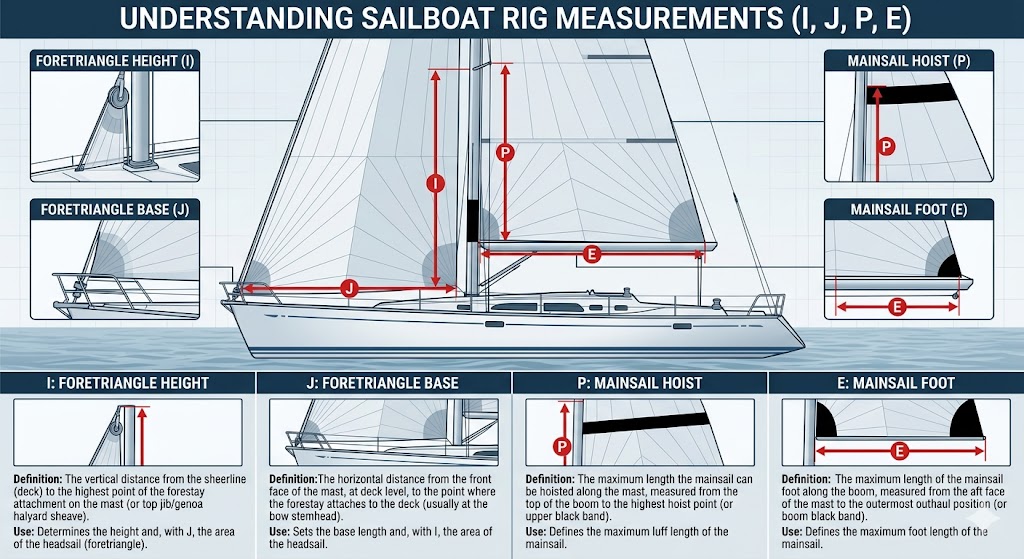
Rig Dimensions
I (Foretriangle Height) 54.90 ft / 16.73 m
J (Foretriangle Base) 17.00 ft / 5.18 m
P (Mainsail Luff) 47.50 ft / 14.48 m
E (Mainsail Foot) 13.50 ft / 4.11 m
SA Fore 466.65 ft² / 43.35 m²
SA Main 320.63 ft² / 29.79 m²
SA Total (100%) 787.28 ft² / 73.14 m²
Est. Forestay Length 57.47 ft / 17.52 m
Mast Height (DWL) 58.25 ft / 17.75 m
Engine & Accommodations
Engine Make Yanmar
Engine Type Diesel
Horsepower 30
Fuel Capacity 20 gals / 76 L
Water Capacity 40 gals / 151 L
How It Compares

vs. Irwin 40 Citation, J/40, Tartan 412

This boat Similar boats
Dimensions
LOA
Irwin 41 Citation ★
40.8 ft
Irwin 40 Citation
40.8 ft
J/40
40.9 ft
Tartan 412
40.6 ft
LWL
Irwin 41 Citation ★
33.3 ft
Irwin 40 Citation
31.2 ft
J/40
35.5 ft
Tartan 412
31.4 ft
Beam
Irwin 41 Citation ★
13.0 ft
Irwin 40 Citation
12.2 ft
J/40
13.2 ft
Tartan 412
12.7 ft
Displacement
Irwin 41 Citation ★
17 lbs
Irwin 40 Citation
16 lbs
J/40
18 lbs
Tartan 412
18 lbs
Ballast
Irwin 41 Citation ★
9 lbs
Irwin 40 Citation
J/40
7 lbs
Tartan 412
8 lbs
Sail Area
Irwin 41 Citation ★
787 sq ft
Irwin 40 Citation
738 sq ft
J/40
780 sq ft
Tartan 412
756 sq ft
Performance
PHRF Rating (lower = faster)
Irwin 41 Citation ★
84 s/nm
Irwin 40 Citation
122 s/nm
J/40
78 s/nm
Tartan 412
SA / Displacement (higher = more powerful)
Irwin 41 Citation ★
18.8
Irwin 40 Citation
18.0
J/40
17.1
Tartan 412
17.4
Ballast / Disp (higher = stiffer)
Irwin 41 Citation ★
54.3 %
Irwin 40 Citation
J/40
41.7 %
Tartan 412
Comfort Ratio (higher = more comfortable offshore)
Irwin 41 Citation ★
24.9
Irwin 40 Citation
27.5
J/40
33.6
Tartan 412
28.4
Capsize Screening (lower = safer)
Irwin 41 Citation ★
2.01
Irwin 40 Citation
1.90
J/40
1.60
Tartan 412
1.92
Displacement / Length (lower = lighter)
Irwin 41 Citation ★
211
Irwin 40 Citation
J/40
162
Tartan 412
Hull Speed
Irwin 41 Citation ★
7.7 kts
Irwin 40 Citation
7.5 kts
J/40
9.6 kts
Tartan 412
7.5 kts
Speed Number (higher = faster)
Irwin 41 Citation ★
2.8
Irwin 40 Citation
2.3
J/40
Tartan 412
2.1
Find a Irwin 41 Citation For Sale