Back to Search
Hunter 27
Designer: John Cherubini  ·  Builder: Hunter Marine (Usa)  ·  First built: 1974
+ Add to Compare
📖
Buyer's Guide Available
Hunter 27 Buyer's Guide
History, what years to buy, common problems & live price data
Read →
Videos
Hunter 27
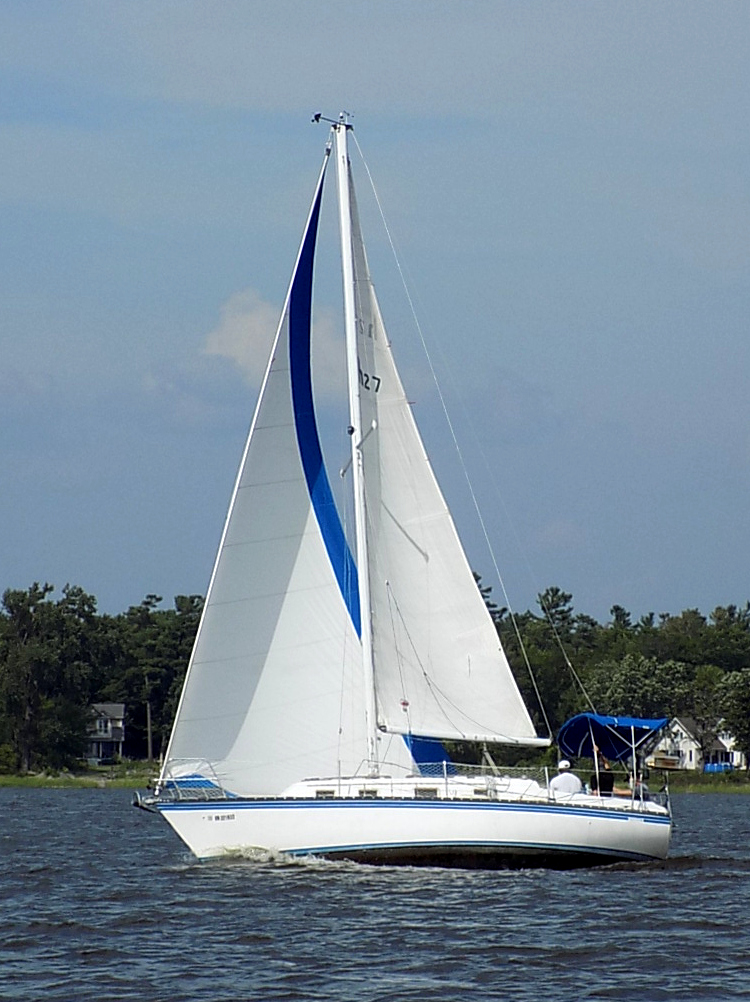
About the Hunter 27

Designed as an affordable entry point into cruising sailboats, this 27-footer from Hunter Marine represents the builder's commitment to accessible sailing. The Hunter 27 appeals primarily to coastal cruisers and weekend sailors seeking a manageable boat that won't overwhelm novice crews or strain maintenance budgets. Built with Hunter's characteristic focus on interior volume and ease of handling, the boat features a roomy cabin that maximizes living space relative to its length. The cockpit is designed for comfortable day sailing, with straightforward sail controls that make single-handed operation feasible for experienced sailors. Like many boats in this size range from the era, the Hunter 27 strikes a balance between performance and comfort, though it leans decidedly toward the latter. The boat's moderate displacement and beam provide stability in typical coastal conditions while maintaining reasonable sailing characteristics in light to moderate winds. This model suits sailors looking for their first cruising boat or those downsizing from larger vessels. Its size makes it trailerable in many configurations, opening up cruising opportunities beyond a single home port. The Hunter 27 represents practical sailing for those prioritizing affordability and ease of use over racing performance.

Featured in Keel Index Articles
Market Price Estimate Beta
$6,800 – $39,800
typical asking price
Median $15,000  ·  11 listings used
All listings
$6,800 – $39,800 11
Rate a listing price
$
About this estimate
  • Prices are based on recent asking prices from public listings — not actual sale prices, which are typically lower.
  • Condition is not factored in. A well-maintained boat with new sails and engine can be worth significantly more than a project boat of the same model.
  • Location affects price. Boats in landlocked states or areas with fewer buyers often sell for less than those on the coast.
  • Year of manufacture is not filtered. Older examples of this model will generally be priced lower than newer ones.
  • Included equipment varies widely. A boat with a full suite of electronics, dodger, and new standing rigging may command a large premium.
  • Outliers are automatically excluded using statistical filtering to improve accuracy, but some bad data may remain.
Core Dimensions
LOA (Length Overall) 27.17 ft / 8.28 m
LWL (Waterline Length) 22.00 ft / 6.71 m
Beam 9.17 ft / 2.79 m
Max Draft 4.25 ft / 1.30 m
Displacement 7,000 lb / 3,175 kg
Ballast 3,000 lb / 1,361 kg
Sail Area (Reported) 303 ft² / 28.15 m²
Headroom 6.08 ft / 1.85 m
Design & Construction
Hull Type Fin w/spade rudder
Rigging Type Masthead Sloop
Construction FG
Designer John Cherubini
Builder Hunter Marine (USA)
First Built 1974
Last Built 1984
Number Built 2000
Owner Reviews

No owner reviews yet — be the first to share your experience with this boat.

Known Issues & What to Watch For
Medium Hull/Deck
The deck-to-hull joint on early Hunter 27s uses an outward-turning flange bonded and through-bolted, but the joint is prone to weeping and separation, particularly at the bow and stern corners where stress concentrates. Water intrusion into the joint can saturate the balsa core in the deck.
1974–1979 models
Medium Hull/Deck
The deck is cored with balsa wood, and areas around chainplates, stanchion bases, and deck hardware are frequently found to be wet or delaminated due to inadequate bedding from the factory. Tap-testing the entire deck surface is essential.
High Keel
The fin keel attachment uses keel bolts that pass through a relatively shallow internal grid. The bilge sump area around the keel stub is prone to standing water, accelerating keel bolt corrosion. Surveying keel bolt integrity and checking for any movement or stress cracking at the keel-to-hull junction is critical.
High Hull/Deck
Chainplate backing plates were often undersized or inadequately glassed into the hull, and the chainplates themselves are prone to crevice corrosion where they pass through the deck. Leaking chainplates are extremely common on this model.
Medium Rigging
The mast step on deck models concentrates compression loads on a cored deck section that was not always adequately reinforced at the factory, leading to compression failure and core crushing beneath the mast base over time.
Medium Hull/Deck
The spade rudder is hung on a single stainless rudder shaft that passes through a fiberglass tube; the bearing surfaces wear significantly over time, resulting in excessive rudder slop. Inspect for play and check the rudder shaft for bending or corrosion at the hull exit point.
Medium Accommodations
Interior tabbing of bulkheads to the hull was done with relatively narrow fiberglass tape in early production, and bulkhead-to-hull delamination is commonly found, particularly on the main structural bulkhead forward of the mast.
1974–1980 models
Medium Engine
Early Hunter 27s were fitted with the Universal Atomic 4 gasoline inboard. Many of these engines are now 40+ years old and suffer from worn carburetors, deteriorated fuel lines, and weak raw water cooling impeller housings. Verify whether the engine has been converted to diesel, as many owners have done so.
1974–1981 models

Own or have surveyed a Hunter 27? Submit a known issue
Performance Ratios
PHRF Rating PHRF (Performance Handicap Racing Fleet) is a national racing handicap measured in seconds per nautical mile. Lower values indicate faster boats. Ratings are sourced from US Sailing's national database (median across 60+ regional fleets).
Under 0 — Ultralight racer0–90 — Performance racer90–150 — Cruiser/racer150–210 — Typical cruiserOver 210 — Heavy/slow cruiser
213
SA/Displacement Sail Area to Displacement ratio measures how much sail power a boat has relative to its weight. Higher values mean more performance and speed.
Under 14 — Heavy cruiser, slow14–18 — Cruising sailboat18–22 — Cruiser/racerOver 22 — Performance racer
13.23
Ballast/Displacement Ballast to Displacement ratio shows what percentage of the boat's total weight is ballast. Higher values generally mean better initial stability and stiffer sail carrying.
30–35% — Typical cruiser35–45% — Stiff performance boatOver 45% — Racing oriented
42.86
Displacement/Length Displacement to Length ratio measures how heavy a boat is relative to its waterline length. Lower values mean a lighter, faster boat.
Under 100 — Ultralight racer100–200 — Light cruiser/racer200–300 — Moderate cruiser300–400 — Heavy cruiserOver 400 — Very heavy
293.48
Pounds/Inch Immersion Pounds per Inch Immersion (PPI) tells you how much weight is needed to sink the boat one inch. Useful for calculating how additional gear and stores affect waterline. 4.32 pounds/inch
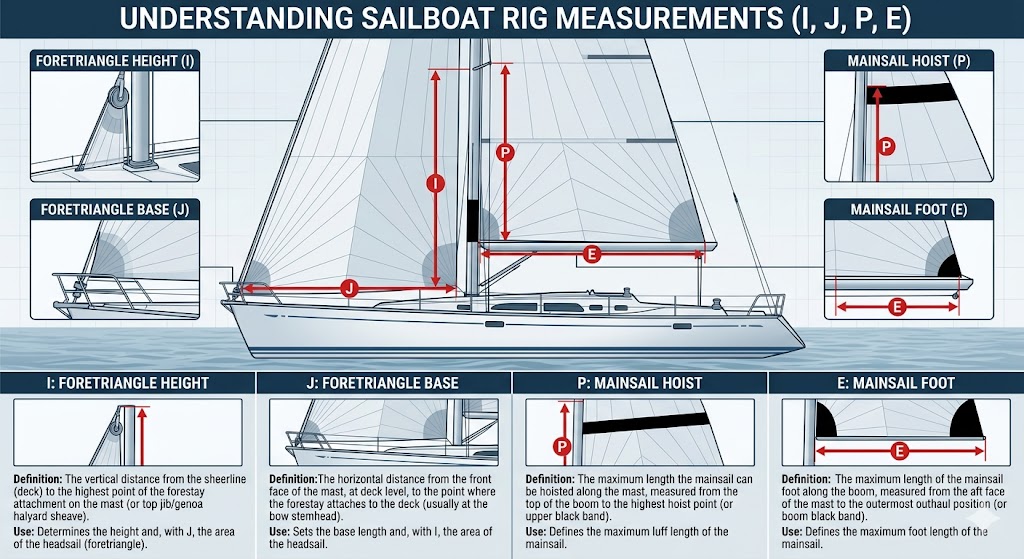
Rig Dimensions
I (Foretriangle Height) 15.04
J (Foretriangle Base) 11.25 ft / 3.43 m
P (Mainsail Luff) 343.00 ft² / 31.87 m²
E (Mainsail Foot) Renault
Engine & Accommodations
Horsepower 8
Fuel Capacity 12 gals / 45 L
Water Capacity 35 gals / 132 L
Resources & Community
📖
Hunter 27 Buyer's Guide History, versions, what to inspect, and real price data from active listings
Read Guide →
Find a Hunter 27 For Sale