Back to Search
Farr 50 Pilot House
Designer: Bruce Farr  ·  Builder: Bsi Marine Sweden A.b.  ·  First built: 1998
+ Add to Compare
About the Farr 50 Pilot House

Bruce Farr's design philosophy of combining performance with practicality shines through in this distinctive pilot house variant of his acclaimed 50-footer. Built by Bsi Marine Sweden A.B. starting in 1998, this cutter-rigged cruiser represents a thoughtful evolution of the proven Farr 50 platform, offering enhanced comfort and protection without sacrificing the sailing characteristics that made the original design so respected. The pilot house configuration transforms the boat's livability, providing a protected helm station and improved visibility while maintaining the sleek lines characteristic of Farr's work. With its fin keel and spade rudder arrangement, the boat delivers responsive handling and solid upwind performance, while the moderate displacement keeps it lively in lighter conditions. The substantial ballast ratio contributes to excellent stability and a reassuring feel in challenging conditions. This design excels as a serious offshore cruiser for couples or small crews who appreciate both comfort and performance. The protective pilot house makes it particularly appealing for higher-latitude sailing or extended passages where weather protection is paramount. While not a pure racing machine like some Farr designs, it maintains enough performance capability to satisfy sailors who refuse to compromise speed entirely for comfort, making it an ideal choice for adventurous cruising in demanding conditions.

Core Dimensions
LOA (Length Overall) 50.46 ft / 15.38 m
LWL (Waterline Length) 43.86 ft / 13.37 m
Beam 15.42 ft / 4.70 m
Max Draft 7.55 ft / 2.30 m
Displacement 37,478.58 lb / 17,000 kg
Ballast 13,227.74 lb / 6,000 kg
Ballast Type Lead
Design & Construction
Hull Type Fin w/spade rudder
Rigging Type Cutter
Construction GRP
Designer Bruce Farr
Builder BSI Marine Sweden A.B.
First Built 1998
Owner Reviews

No owner reviews yet — be the first to share your experience with this boat.
Performance Ratios
Ballast/Displacement Ballast to Displacement ratio shows what percentage of the boat's total weight is ballast. Higher values generally mean better initial stability and stiffer sail carrying.
30–35% — Typical cruiser35–45% — Stiff performance boatOver 45% — Racing oriented
35.29
Displacement/Length Displacement to Length ratio measures how heavy a boat is relative to its waterline length. Lower values mean a lighter, faster boat.
Under 100 — Ultralight racer100–200 — Light cruiser/racer200–300 — Moderate cruiser300–400 — Heavy cruiserOver 400 — Very heavy
198.3
Comfort Ratio Ted Brewer's Comfort Ratio predicts how comfortable a boat will feel in offshore conditions. Higher values mean a steadier, more comfortable motion in a seaway.
Under 20 — Uncomfortably rough20–30 — Acceptable coastal30–40 — Good offshore comfortOver 40 — Very comfortable offshore
33.07
Capsize Screening Formula The USHS Capsize Screening Formula estimates offshore capsize risk. Lower is safer — values under 2.0 are considered acceptable for offshore sailing.
Under 2.0 — Safe for offshore2.0–2.2 — Borderline offshoreOver 2.2 — Coastal use recommended
1.85
Hull Speed Hull Speed is the theoretical maximum speed of a displacement hull, calculated from waterline length. Most cruising sailboats reach this speed in moderate conditions. 8.87 kn
S# (Speed Number) The Speed Number (S#) is a quick performance index. Higher values indicate a faster, more powerful design relative to its size.
Under 3.0 — Slow cruiser3.0–5.0 — Average cruiser5.0–7.0 — Performance cruiserOver 7.0 — Racer
2.82
Pounds/Inch Immersion Pounds per Inch Immersion (PPI) tells you how much weight is needed to sink the boat one inch. Useful for calculating how additional gear and stores affect waterline. 2,416.57 pounds/inch
SA/Displacement (Calc) Calculated Sail Area to Displacement ratio using actual measured sail dimensions rather than reported values. More precise than the reported SA/Disp figure. 17.76
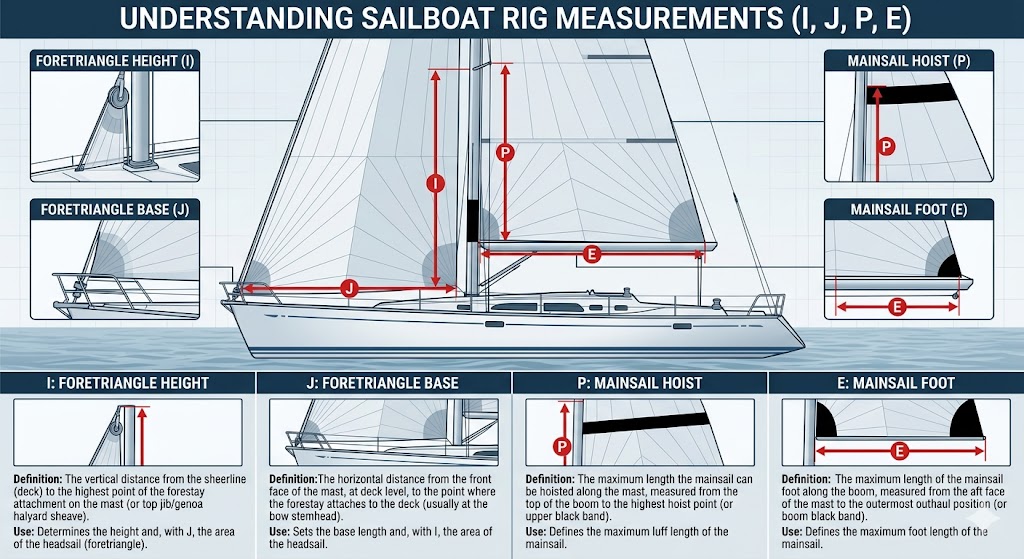
Rig Dimensions
I (Foretriangle Height) 65.62 ft / 20.00 m
J (Foretriangle Base) 20.01 ft / 6.10 m
P (Mainsail Luff) 58.07 ft / 17.70 m
E (Mainsail Foot) 20.01 ft / 6.10 m
SA Fore 656.53 ft² / 60.99 m²
SA Main 580.99 ft² / 53.98 m²
SA Total (100%) 1,237.52 ft² / 114.97 m²
Est. Forestay Length 68.60 ft / 20.91 m
Engine & Accommodations
LOD 43.90 ft / 13.38 m
How It Compares

vs. Alden 50, Centurion 49, Little Harbor 51

This boat Similar boats
Dimensions
LOA
Farr 50 Pilot House ★
50.5 ft
Alden 50
50.3 ft
Centurion 49
50.6 ft
Little Harbor 51
50.6 ft
LWL
Farr 50 Pilot House ★
43.9 ft
Alden 50
37.1 ft
Centurion 49
40.3 ft
Little Harbor 51
41.0 ft
Beam
Farr 50 Pilot House ★
15.4 ft
Alden 50
13.5 ft
Centurion 49
14.7 ft
Little Harbor 51
15.3 ft
Displacement
Farr 50 Pilot House ★
37 lbs
Alden 50
38 lbs
Centurion 49
30 lbs
Little Harbor 51
45 lbs
Ballast
Farr 50 Pilot House ★
13 lbs
Alden 50
16 lbs
Centurion 49
12 lbs
Little Harbor 51
18 lbs
Sail Area
Farr 50 Pilot House ★
Alden 50
Centurion 49
1 sq ft
Little Harbor 51
1 sq ft
Performance
PHRF Rating (lower = faster)
Farr 50 Pilot House ★
Alden 50
102 s/nm
Centurion 49
69 s/nm
Little Harbor 51
SA / Displacement (higher = more powerful)
Farr 50 Pilot House ★
Alden 50
Centurion 49
18.3
Little Harbor 51
15.3
Ballast / Disp (higher = stiffer)
Farr 50 Pilot House ★
35.3 %
Alden 50
42.9 %
Centurion 49
41.4 %
Little Harbor 51
Comfort Ratio (higher = more comfortable offshore)
Farr 50 Pilot House ★
33.1
Alden 50
Centurion 49
30.8
Little Harbor 51
42.8
Capsize Screening (lower = safer)
Farr 50 Pilot House ★
1.85
Alden 50
Centurion 49
1.87
Little Harbor 51
1.71
Displacement / Length (lower = lighter)
Farr 50 Pilot House ★
198
Alden 50
332
Centurion 49
211
Little Harbor 51
Hull Speed
Farr 50 Pilot House ★
8.9 kts
Alden 50
Centurion 49
8.5 kts
Little Harbor 51
8.6 kts
Speed Number (higher = faster)
Farr 50 Pilot House ★
2.8
Alden 50
Centurion 49
2.7
Little Harbor 51
Find a Farr 50 Pilot House For Sale