Back to Search
Concordia 40
Designer: C. Raymond Hunt  ·  Builder: Abeking & Rasmussen (Ger)  ·  First built: 1938
+ Add to Compare
About the Concordia 40

Designed by the legendary C. Raymond Hunt and built by the renowned German yard Abeking & Rasmussen from 1938 to 1966, this classic masthead yawl represents one of sailing's most celebrated offshore cruising designs. With 103 hulls launched over nearly three decades, the Concordia 40 earned an enviable reputation among serious cruising sailors seeking a boat capable of handling demanding ocean passages while maintaining exceptional seaworthiness. Hunt's timeless design features traditional construction with mahogany planking over oak frames, embodying the finest boatbuilding traditions of both American design philosophy and German craftsmanship. The long keel configuration and substantial 7,700-pound ballast provide exceptional stability and directional control, particularly valuable for extended offshore passages. Her masthead yawl rig offers versatility in sail handling, allowing crews to balance the boat effectively in varying conditions. The generous comfort ratio of 39.29 reflects Hunt's priority on seakindly motion and crew comfort during long passages, while the conservative capsize screening formula indicates excellent stability characteristics. These boats excel at serious offshore cruising and have completed countless ocean crossings, earning respect for their ability to handle heavy weather with confidence. The Concordia 40 remains highly sought after by discerning sailors who prioritize seaworthiness over speed.

Core Dimensions
LOA (Length Overall) 39.83 ft / 12.14 m
LWL (Waterline Length) 28.50 ft / 8.69 m
Beam 10.25 ft / 3.12 m
Max Draft 5.67 ft / 1.73 m
Displacement 18,000.00 lb / 8,165 kg
Ballast 7,700.00 lb / 3,493 kg
Ballast Type Iron
Sail Area (Reported) 650.00 ft² / 60.39 m²
Design & Construction
Hull Type Long Keel
Rigging Type Masthead Yawl
Construction Wood planked, (Mahogany, Oak frames)
Designer C. Raymond Hunt
Builder Abeking & Rasmussen (GER)
First Built 1938
Last Built 1966
Number Built 103
Owner Reviews

No owner reviews yet — be the first to share your experience with this boat.

Known Issues & What to Watch For
Medium Hull/Deck
The mahogany planking on Concordia yawls is prone to checking and drying out when boats are left out of the water for extended periods. Seams can open significantly, and the boat must be allowed adequate time to take up when relaunched after storage.
High Hull/Deck
Oak frames are known to develop rot at the turn of the bilge and at frame heads where they meet the deck shelf, particularly where water can collect and ventilation is poor. A thorough survey should include sounding every frame along its full length.
Medium Hull/Deck
Garboard seams on these long-keel wooden hulls are a frequent site of persistent weeping and caulking failure due to the stress concentration at the keel-to-planking junction. Inspect carefully for recent recaulking work that may be masking deeper seam issues.
High Keel
The lead or iron ballast keel attachment bolts pass through the oak keel timber and are susceptible to corrosion and the surrounding wood to rot. Keel bolt integrity is a critical survey item; many boats of this age have never had bolts surveyed or replaced.
High Hull/Deck
Deck canvas or laid teak decking on surviving examples frequently shows separation from the underlying deck structure, and the carlins and deck beams beneath can hold moisture leading to hidden rot. Soft spots anywhere on deck warrant immediate investigation.
High Hull/Deck
Chainplate knees and the wooden structure securing chainplates are a well-documented weak point; decades of rig loading can crack or loosen the internal wooden knees, and rot often develops where the chainplate passes through the deck.
High Accommodations
Interior joinery, particularly in the bilge area, is often affected by rot where bilge water has stood over decades. Floors (floor timbers crossing the keel) should be individually inspected, as rotted floor timbers compromise the hull's transverse strength.
Medium Engine
Engine beds and the surrounding structural timbers are a common site of rot due to chronic bilge water and limited ventilation. Many boats have had engine conversions or repowers over their long lives; verify that any engine installation is properly supported and that the original beds have not been compromised.
Medium Rigging
The original wooden spars (spruce masts and booms) on unrestored examples are prone to hidden internal rot and checking. Many boats have been converted to aluminum spars; if original wooden spars are present, they require careful inspection including probing at all hardware attachment points.

Own or have surveyed a Concordia 40? Submit a known issue
Performance Ratios
PHRF Rating PHRF (Performance Handicap Racing Fleet) is a national racing handicap measured in seconds per nautical mile. Lower values indicate faster boats. Ratings are sourced from US Sailing's national database (median across 60+ regional fleets).
Under 0 — Ultralight racer0–90 — Performance racer90–150 — Cruiser/racer150–210 — Typical cruiserOver 210 — Heavy/slow cruiser
182
SA/Displacement Sail Area to Displacement ratio measures how much sail power a boat has relative to its weight. Higher values mean more performance and speed.
Under 14 — Heavy cruiser, slow14–18 — Cruising sailboat18–22 — Cruiser/racerOver 22 — Performance racer
15.2
Ballast/Displacement Ballast to Displacement ratio shows what percentage of the boat's total weight is ballast. Higher values generally mean better initial stability and stiffer sail carrying.
30–35% — Typical cruiser35–45% — Stiff performance boatOver 45% — Racing oriented
42.78
Displacement/Length Displacement to Length ratio measures how heavy a boat is relative to its waterline length. Lower values mean a lighter, faster boat.
Under 100 — Ultralight racer100–200 — Light cruiser/racer200–300 — Moderate cruiser300–400 — Heavy cruiserOver 400 — Very heavy
347.13
Comfort Ratio Ted Brewer's Comfort Ratio predicts how comfortable a boat will feel in offshore conditions. Higher values mean a steadier, more comfortable motion in a seaway.
Under 20 — Uncomfortably rough20–30 — Acceptable coastal30–40 — Good offshore comfortOver 40 — Very comfortable offshore
39.29
Capsize Screening Formula The USHS Capsize Screening Formula estimates offshore capsize risk. Lower is safer — values under 2.0 are considered acceptable for offshore sailing.
Under 2.0 — Safe for offshore2.0–2.2 — Borderline offshoreOver 2.2 — Coastal use recommended
1.57
Hull Speed Hull Speed is the theoretical maximum speed of a displacement hull, calculated from waterline length. Most cruising sailboats reach this speed in moderate conditions. 7.15 kn
S# (Speed Number) The Speed Number (S#) is a quick performance index. Higher values indicate a faster, more powerful design relative to its size.
Under 3.0 — Slow cruiser3.0–5.0 — Average cruiser5.0–7.0 — Performance cruiserOver 7.0 — Racer
1.27
Pounds/Inch Immersion Pounds per Inch Immersion (PPI) tells you how much weight is needed to sink the boat one inch. Useful for calculating how additional gear and stores affect waterline. 1,043.79 pounds/inch
SA/Displacement (Calc) Calculated Sail Area to Displacement ratio using actual measured sail dimensions rather than reported values. More precise than the reported SA/Disp figure. 14.74
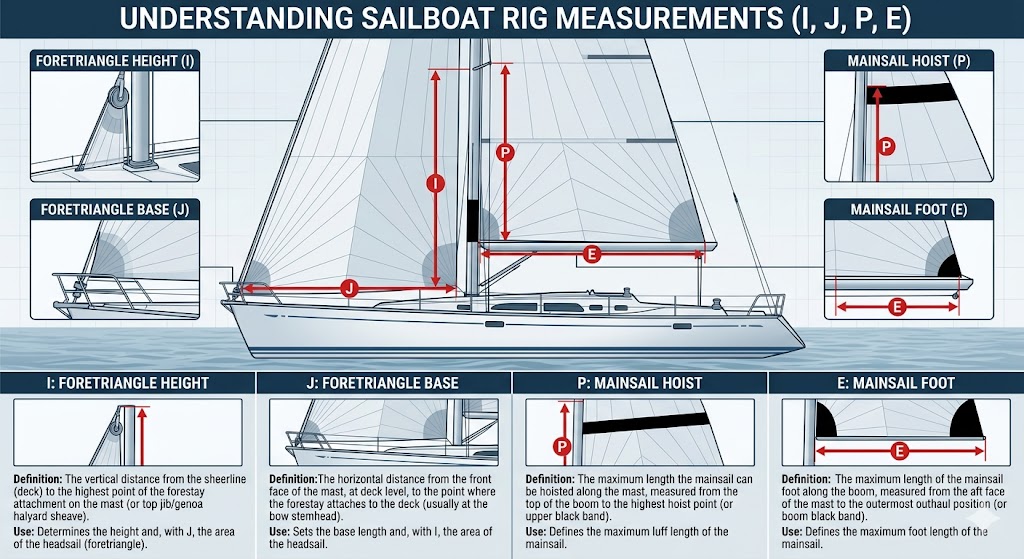
Rig Dimensions
I (Foretriangle Height) 42.75 ft / 13.03 m
J (Foretriangle Base) 13.50 ft / 4.11 m
P (Mainsail Luff) 38.00 ft / 11.58 m
E (Mainsail Foot) 18.00 ft / 5.49 m
SA Fore 288.56 ft² / 26.81 m²
SA Main 342.00 ft² / 31.77 m²
SA Total (100%) 630.56 ft² / 58.58 m²
Est. Forestay Length 44.83 ft / 13.66 m
Engine & Accommodations
Engine Make Gray Marine
Engine Type Gas
Horsepower 30
How It Compares

vs. Bermuda 40 3 Hinckley, Gulf 40 Garden, Mistress 39 Allied, Nevins 40, Offshore 40 Cheoy Lee

This boat Similar boats
Dimensions
LOA
Concordia 40 ★
39.8 ft
Bermuda 40 3 Hinckley
40.0 ft
Gulf 40 Garden
39.8 ft
Mistress 39 Allied
39.7 ft
Nevins 40
40.0 ft
Offshore 40 Cheoy Lee
39.8 ft
LWL
Concordia 40 ★
28.5 ft
Bermuda 40 3 Hinckley
28.8 ft
Gulf 40 Garden
29.0 ft
Mistress 39 Allied
29.8 ft
Nevins 40
27.5 ft
Offshore 40 Cheoy Lee
28.0 ft
Beam
Concordia 40 ★
10.3 ft
Bermuda 40 3 Hinckley
11.8 ft
Gulf 40 Garden
10.8 ft
Mistress 39 Allied
12.0 ft
Nevins 40
11.3 ft
Offshore 40 Cheoy Lee
10.8 ft
Displacement
Concordia 40 ★
18 lbs
Bermuda 40 3 Hinckley
20 lbs
Gulf 40 Garden
21 lbs
Mistress 39 Allied
20 lbs
Nevins 40
22 lbs
Offshore 40 Cheoy Lee
20 lbs
Ballast
Concordia 40 ★
7 lbs
Bermuda 40 3 Hinckley
6 lbs
Gulf 40 Garden
5 lbs
Mistress 39 Allied
5 lbs
Nevins 40
5 lbs
Offshore 40 Cheoy Lee
7 lbs
Sail Area
Concordia 40 ★
650 sq ft
Bermuda 40 3 Hinckley
681 sq ft
Gulf 40 Garden
Mistress 39 Allied
Nevins 40
739 sq ft
Offshore 40 Cheoy Lee
742 sq ft
Performance
PHRF Rating (lower = faster)
Concordia 40 ★
182 s/nm
Bermuda 40 3 Hinckley
Gulf 40 Garden
Mistress 39 Allied
Nevins 40
177 s/nm
Offshore 40 Cheoy Lee
SA / Displacement (higher = more powerful)
Concordia 40 ★
15.2
Bermuda 40 3 Hinckley
14.8
Gulf 40 Garden
Mistress 39 Allied
Nevins 40
15.1
Offshore 40 Cheoy Lee
15.8
Ballast / Disp (higher = stiffer)
Concordia 40 ★
42.8 %
Bermuda 40 3 Hinckley
32.5 %
Gulf 40 Garden
23.8 %
Mistress 39 Allied
26.9 %
Nevins 40
Offshore 40 Cheoy Lee
Comfort Ratio (higher = more comfortable offshore)
Concordia 40 ★
39.3
Bermuda 40 3 Hinckley
36.1
Gulf 40 Garden
Mistress 39 Allied
Nevins 40
43.3
Offshore 40 Cheoy Lee
43.0
Capsize Screening (lower = safer)
Concordia 40 ★
1.57
Bermuda 40 3 Hinckley
1.73
Gulf 40 Garden
Mistress 39 Allied
Nevins 40
1.61
Offshore 40 Cheoy Lee
1.57
Displacement / Length (lower = lighter)
Concordia 40 ★
347
Bermuda 40 3 Hinckley
372
Gulf 40 Garden
384
Mistress 39 Allied
349
Nevins 40
Offshore 40 Cheoy Lee
Hull Speed
Concordia 40 ★
7.2 kts
Bermuda 40 3 Hinckley
7.2 kts
Gulf 40 Garden
Mistress 39 Allied
Nevins 40
7.0 kts
Offshore 40 Cheoy Lee
7.1 kts
Speed Number (higher = faster)
Concordia 40 ★
1.3
Bermuda 40 3 Hinckley
1.2
Gulf 40 Garden
Mistress 39 Allied
Nevins 40
0.7
Offshore 40 Cheoy Lee
1.0
Find a Concordia 40 For Sale