Back to Search
Catalina 400 Mk Ii
Designer: Frank Douglas/Gerry Douglas  ·  Builder: Catalina Yachts (Usa)  ·  First built: 2000
+ Add to Compare
Videos
About the Catalina 400 Mk Ii

Launched in 2000, this refined iteration of Catalina's popular 40-footer represents the Douglas design team's evolution of their successful coastal cruising formula. Frank and Gerry Douglas crafted a vessel that balances comfort with performance, featuring a modern fin keel with bulb and spade rudder configuration that delivers solid upwind performance while maintaining the stability cruising sailors demand. At 41.5 feet overall with a 36.5-foot waterline, the Mk II offers generous interior volume within her 13.5-foot beam, making her well-suited for extended coastal cruising and comfortable liveaboard situations. The moderate displacement of 19,700 pounds paired with 7,200 pounds of ballast creates a reassuring motion at sea, reflected in the comfort ratio of 25.03. Her capsize screening value of 2.0 indicates good stability for coastal and near-offshore passages. The masthead sloop rig carries 808 square feet of working sail area, providing adequate power for various conditions while remaining manageable for short-handed sailing. With a theoretical hull speed of 8.10 knots and an SA/Displacement ratio of 17.79, she offers respectable performance without sacrificing the practical cruising characteristics that have made Catalina a trusted name among coastal cruisers and charter operators worldwide.

Core Dimensions
LOA (Length Overall) 41.50 ft / 12.65 m
LWL (Waterline Length) 36.50 ft / 11.13 m
Beam 13.50 ft / 4.11 m
Max Draft 6.92 ft / 2.11 m
Displacement 19,700.00 lb / 8,936 kg
Ballast 7,200.00 lb / 3,266 kg
Sail Area (Reported) 808.00 ft² / 75.07 m²
Design & Construction
Hull Type Fin w/bulb & spade rudder
Rigging Type Masthead Sloop
Construction FG
Designer Frank Douglas/Gerry Douglas
Builder Catalina Yachts (USA)
First Built 2000
Associations Catalina 400/445
Owner Reviews

No owner reviews yet — be the first to share your experience with this boat.

Known Issues & What to Watch For
High Hull/Deck
The chainplate knees on the Catalina 400/400 MkII are glassed to the hull liner rather than directly to the hull skin, and the liner-to-hull bond can deteriorate over time, allowing chainplate movement and deck stress cracking around the chainplate covers. Inspect the interior liner bond and look for elongated fastener holes or stress cracks on deck.
Medium Hull/Deck
The large opening ports in the hull sides (a distinctive feature of the 400 series) are known to develop leaks at their frames as the sealant ages and the aluminum frames oxidize. Water intrusion can wet the hull liner and lead to hidden moisture accumulation in the cabin side laminate.
Medium Hull/Deck
The molded-in hull liner system used by Catalina creates dead spaces between the liner and hull that trap moisture and are essentially impossible to inspect visually. Moisture meter readings across the bilge and under-berth areas are essential, as saturation can go undetected for years.
Medium Hull/Deck
The anchor locker on the foredeck is not fully drained and sealed from the interior, and water can migrate below into the forward cabin area. Check for staining, soft balsa core, or moisture around the forepeak bulkhead.
High Keel
The lead bulb keel is attached with stainless steel keel bolts that pass through a cast lead stub. Galvanic interaction between the stainless hardware and lead, combined with any standing bilge water, can cause hidden corrosion at the keel-to-hull interface. The joint should be carefully inspected for weeping, staining, or movement.
Medium Rigging
The Catalina 400 MkII uses an in-mast furling mainsail as standard equipment, and the Isomat or Selden in-mast furling systems fitted to these boats are known to jam or furl poorly if the mainsail luff tape stretches or if the foil extrusion warps slightly. Inspect the extrusion for straightness and verify smooth operation through full range.
Medium Rigging
The mast step sits on the keel centerline on a compression post, but the base of the compression post connects to the hull-liner structure rather than directly to the keel floors. Inspect around the mast base and compression post foot for cracking or movement in the liner.
Medium Engine
Early Catalina 400 MkII boats were fitted with the Universal M-35B or M-40B diesel, and later ones with the Yanmar 4JH series. The engine compartment is relatively tight and the raw water impeller housing and heat exchanger are difficult to access, leading to deferred maintenance and overheating problems. Confirm full service history and check for evidence of overheating.
High Engine
The engine exhaust waterlock and wet exhaust hose routing on the 400 series has been reported to allow water siphoning back into the engine when the boat is heeled or when the exhaust outlet is near the waterline at rest. Verify that an anti-siphon valve is correctly installed and functional.
Medium Electrical
Catalina's factory wiring on this era of boats frequently used undersized wire runs and crimped, non-tinned connectors in damp bilge areas, leading to high resistance connections, corrosion, and occasional chafe failures. A full electrical inspection tracing each circuit is strongly recommended.
Medium Accommodations
The holding tank and associated plumbing on the Catalina 400 MkII is located within the hull liner cavity in the aft cabin area, making inspection and replacement extremely difficult. Check for odor permeation in the hoses (which indicates aged sanitation hose) and verify the tank vent and deck pumpout fitting are functional.
Low Sails
The in-mast furling mainsail supplied from the factory is cut with reduced roach and no battens, significantly limiting upwind and downwind performance compared to a conventional main. Many owners replace it with a furling boom system or conventional main; verify what sail inventory exists and budget for potential replacement.

Own or have surveyed a Catalina 400 Mk Ii? Submit a known issue
Performance Ratios
PHRF Rating PHRF (Performance Handicap Racing Fleet) is a national racing handicap measured in seconds per nautical mile. Lower values indicate faster boats. Ratings are sourced from US Sailing's national database (median across 60+ regional fleets).
Under 0 — Ultralight racer0–90 — Performance racer90–150 — Cruiser/racer150–210 — Typical cruiserOver 210 — Heavy/slow cruiser
107
SA/Displacement Sail Area to Displacement ratio measures how much sail power a boat has relative to its weight. Higher values mean more performance and speed.
Under 14 — Heavy cruiser, slow14–18 — Cruising sailboat18–22 — Cruiser/racerOver 22 — Performance racer
17.79
Ballast/Displacement Ballast to Displacement ratio shows what percentage of the boat's total weight is ballast. Higher values generally mean better initial stability and stiffer sail carrying.
30–35% — Typical cruiser35–45% — Stiff performance boatOver 45% — Racing oriented
36.55
Displacement/Length Displacement to Length ratio measures how heavy a boat is relative to its waterline length. Lower values mean a lighter, faster boat.
Under 100 — Ultralight racer100–200 — Light cruiser/racer200–300 — Moderate cruiser300–400 — Heavy cruiserOver 400 — Very heavy
180.86
Comfort Ratio Ted Brewer's Comfort Ratio predicts how comfortable a boat will feel in offshore conditions. Higher values mean a steadier, more comfortable motion in a seaway.
Under 20 — Uncomfortably rough20–30 — Acceptable coastal30–40 — Good offshore comfortOver 40 — Very comfortable offshore
25.03
Capsize Screening Formula The USHS Capsize Screening Formula estimates offshore capsize risk. Lower is safer — values under 2.0 are considered acceptable for offshore sailing.
Under 2.0 — Safe for offshore2.0–2.2 — Borderline offshoreOver 2.2 — Coastal use recommended
2
Hull Speed Hull Speed is the theoretical maximum speed of a displacement hull, calculated from waterline length. Most cruising sailboats reach this speed in moderate conditions. 8.10 kn
S# (Speed Number) The Speed Number (S#) is a quick performance index. Higher values indicate a faster, more powerful design relative to its size.
Under 3.0 — Slow cruiser3.0–5.0 — Average cruiser5.0–7.0 — Performance cruiserOver 7.0 — Racer
3.04
Pounds/Inch Immersion Pounds per Inch Immersion (PPI) tells you how much weight is needed to sink the boat one inch. Useful for calculating how additional gear and stores affect waterline. 1,760.65 pounds/inch
SA/Displacement (Calc) Calculated Sail Area to Displacement ratio using actual measured sail dimensions rather than reported values. More precise than the reported SA/Disp figure. 17.78
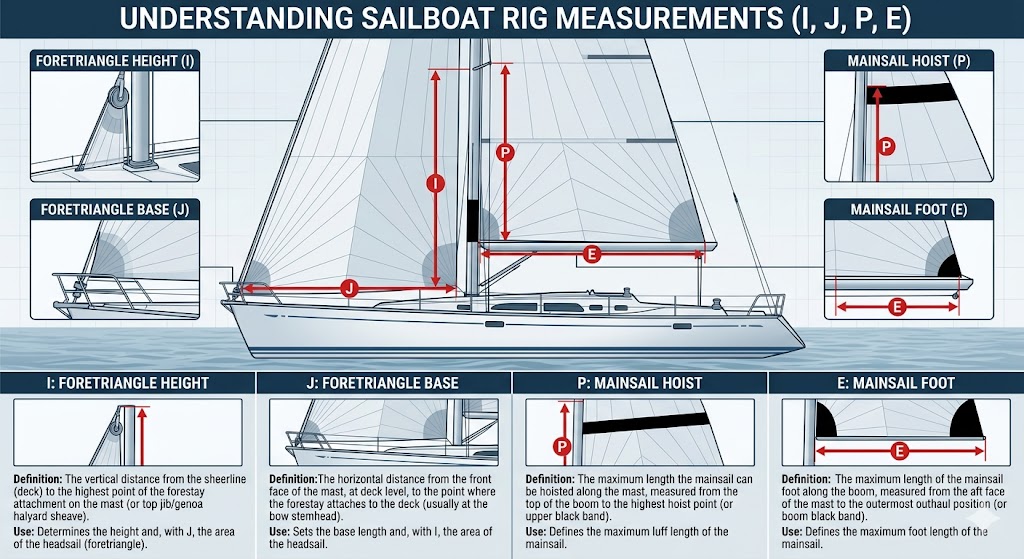
Rig Dimensions
I (Foretriangle Height) 52.67 ft / 16.05 m
J (Foretriangle Base) 15.50 ft / 4.72 m
P (Mainsail Luff) 47.00 ft / 14.33 m
E (Mainsail Foot) 17.00 ft / 5.18 m
SA Fore 408.19 ft² / 37.92 m²
SA Main 399.50 ft² / 37.11 m²
SA Total (100%) 807.69 ft² / 75.04 m²
Est. Forestay Length 54.90 ft / 16.73 m
Mast Height (DWL) 58.00 ft / 17.68 m
Engine & Accommodations
Engine Make Yanmar
Engine Model 4JH3BE
Engine Type Diesel
Horsepower 56
Fuel Capacity 35 gals / 132 L
Water Capacity 110 gals / 416 L
LOD 40.50 ft / 12.34 m
How It Compares

vs. Bavaria 41, Oceanis 40.1 Beneteau, Oceanis 41 Beneteau, Oceanis 411 Beneteau, Sun Fast 41 Jeanneau

This boat Similar boats
Dimensions
LOA
Catalina 400 Mk Ii ★
41.5 ft
Bavaria 41
41.7 ft
Oceanis 40.1 Beneteau
41.3 ft
Oceanis 41 Beneteau
41.7 ft
Oceanis 411 Beneteau
41.3 ft
Sun Fast 41 Jeanneau
41.7 ft
LWL
Catalina 400 Mk Ii ★
36.5 ft
Bavaria 41
36.1 ft
Oceanis 40.1 Beneteau
35.8 ft
Oceanis 41 Beneteau
35.8 ft
Oceanis 411 Beneteau
35.1 ft
Sun Fast 41 Jeanneau
35.8 ft
Beam
Catalina 400 Mk Ii ★
13.5 ft
Bavaria 41
13.8 ft
Oceanis 40.1 Beneteau
14.1 ft
Oceanis 41 Beneteau
13.8 ft
Oceanis 411 Beneteau
13.5 ft
Sun Fast 41 Jeanneau
13.5 ft
Displacement
Catalina 400 Mk Ii ★
19 lbs
Bavaria 41
20 lbs
Oceanis 40.1 Beneteau
20 lbs
Oceanis 41 Beneteau
20 lbs
Oceanis 411 Beneteau
20 lbs
Sun Fast 41 Jeanneau
16 lbs
Ballast
Catalina 400 Mk Ii ★
7 lbs
Bavaria 41
7 lbs
Oceanis 40.1 Beneteau
7 lbs
Oceanis 41 Beneteau
7 lbs
Oceanis 411 Beneteau
7 lbs
Sun Fast 41 Jeanneau
6 lbs
Sail Area
Catalina 400 Mk Ii ★
808 sq ft
Bavaria 41
807 sq ft
Oceanis 40.1 Beneteau
883 sq ft
Oceanis 41 Beneteau
807 sq ft
Oceanis 411 Beneteau
775 sq ft
Sun Fast 41 Jeanneau
925 sq ft
Performance
PHRF Rating (lower = faster)
Catalina 400 Mk Ii ★
107 s/nm
Bavaria 41
108 s/nm
Oceanis 40.1 Beneteau
Oceanis 41 Beneteau
Oceanis 411 Beneteau
Sun Fast 41 Jeanneau
SA / Displacement (higher = more powerful)
Catalina 400 Mk Ii ★
17.8
Bavaria 41
17.2
Oceanis 40.1 Beneteau
18.6
Oceanis 41 Beneteau
17.2
Oceanis 411 Beneteau
16.8
Sun Fast 41 Jeanneau
22.8
Ballast / Disp (higher = stiffer)
Catalina 400 Mk Ii ★
36.6 %
Bavaria 41
35.5 %
Oceanis 40.1 Beneteau
34.7 %
Oceanis 41 Beneteau
35.5 %
Oceanis 411 Beneteau
35.2 %
Sun Fast 41 Jeanneau
40.0 %
Comfort Ratio (higher = more comfortable offshore)
Catalina 400 Mk Ii ★
25.0
Bavaria 41
Oceanis 40.1 Beneteau
25.3
Oceanis 41 Beneteau
25.5
Oceanis 411 Beneteau
26.1
Sun Fast 41 Jeanneau
21.2
Capsize Screening (lower = safer)
Catalina 400 Mk Ii ★
2.00
Bavaria 41
Oceanis 40.1 Beneteau
2.05
Oceanis 41 Beneteau
2.02
Oceanis 411 Beneteau
1.98
Sun Fast 41 Jeanneau
2.12
Displacement / Length (lower = lighter)
Catalina 400 Mk Ii ★
180
Bavaria 41
194
Oceanis 40.1 Beneteau
204
Oceanis 41 Beneteau
200
Oceanis 411 Beneteau
207
Sun Fast 41 Jeanneau
161
Hull Speed
Catalina 400 Mk Ii ★
8.1 kts
Bavaria 41
Oceanis 40.1 Beneteau
8.0 kts
Oceanis 41 Beneteau
8.0 kts
Oceanis 411 Beneteau
7.9 kts
Sun Fast 41 Jeanneau
8.0 kts
Resources & Community
Find a Catalina 400 Mk Ii For Sale