Back to Search
Catalina 22
Designer: Frank V. Butler  ·  Builder: Catalina Yachts (Usa)  ·  First built: 1969
+ Add to Compare
📖
Buyer's Guide Available
Catalina 22 Buyer's Guide
History, what years to buy, common problems & live price data
Read →
Videos
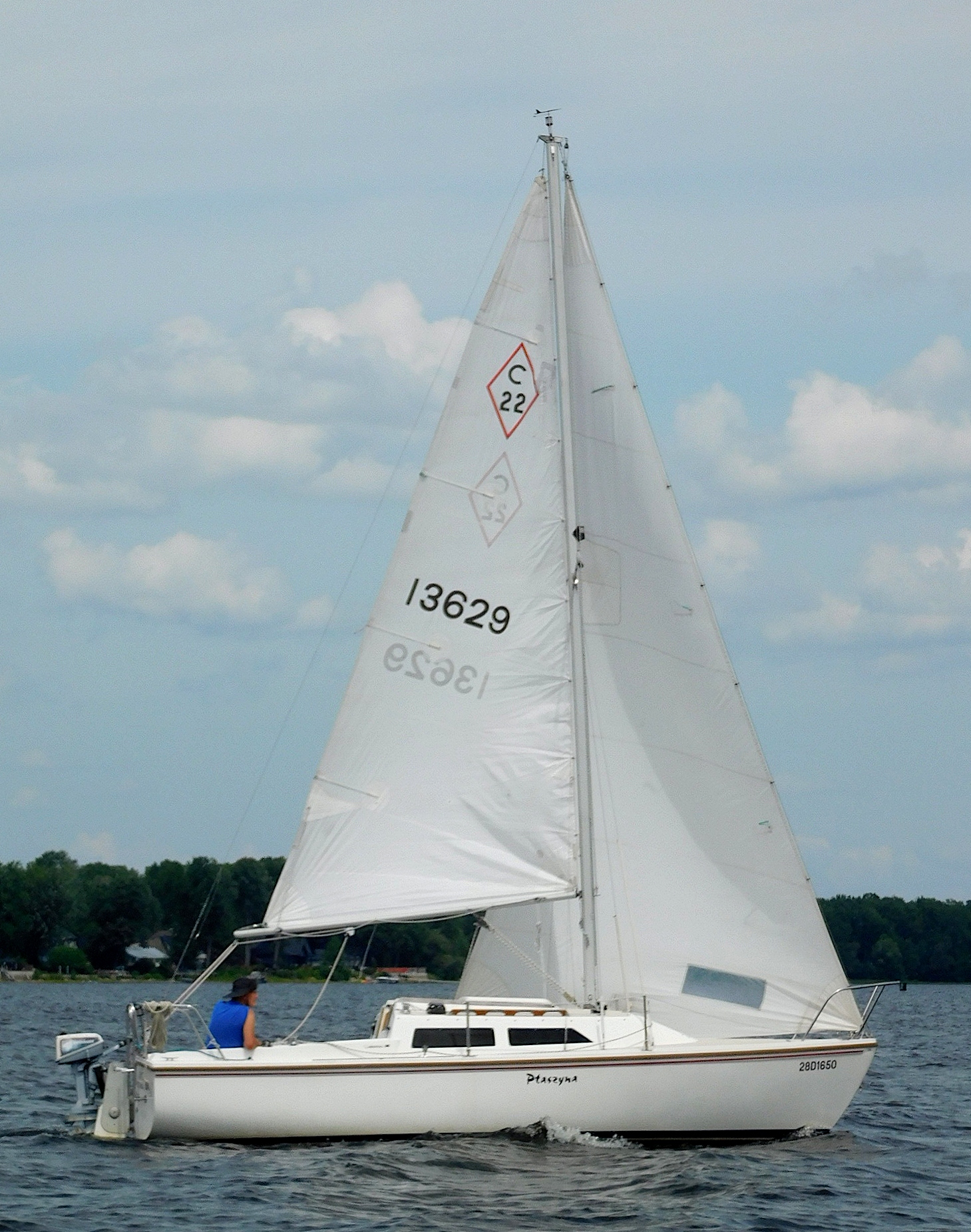
Catalina 22
Photo: Ahunt / CC0
About the Catalina 22

First launched in 1969 and designed by Frank V. Butler, this popular small cruiser has earned its place as one of America's most successful sailboat designs, with over 15,000 hulls produced by Catalina Yachts. The swing keel configuration is the boat's defining feature, allowing the draft to retract for shallow water exploration and easy trailering, making it exceptionally versatile for weekend sailors. With its masthead sloop rig and 212 square feet of sail area driving a displacement of 2,250 pounds, the Catalina 22 offers respectable performance for coastal cruising and daysailing. The swing keel design, while sacrificing some upwind performance compared to fixed-keel boats, opens up countless shallow anchorages and launch ramps that deeper-draft vessels cannot access. The fiberglass construction has proven durable over five decades, and the boat's moderate beam of 7.67 feet provides reasonable interior space while maintaining trailerable width. Its comfortable cockpit accommodates a small crew nicely, and the cabin offers basic overnight accommodations for two adults. Best suited for protected coastal waters, lakes, and bays, this design remains popular among new sailors and those seeking an affordable entry into cruising sailboats that can be easily transported and launched.

Featured in Keel Index Articles
Market Price Estimate Beta
$1,000 – $8,500
typical asking price · boat only
Median $4,500  ·  48 listings used (2 outliers excluded)
Boat only
$1,000 – $8,500 48
With trailer
$3,300 – $9,800 8
Rate a listing price
$
About this estimate
  • Prices are based on recent asking prices from public listings — not actual sale prices, which are typically lower.
  • Condition is not factored in. A well-maintained boat with new sails and engine can be worth significantly more than a project boat of the same model.
  • Location affects price. Boats in landlocked states or areas with fewer buyers often sell for less than those on the coast.
  • Year of manufacture is not filtered. Older examples of this model will generally be priced lower than newer ones.
  • Included equipment varies widely. A boat with a full suite of electronics, dodger, and new standing rigging may command a large premium.
  • Outliers are automatically excluded using statistical filtering to improve accuracy, but some bad data may remain.
Core Dimensions
LOA (Length Overall) 23.83 ft / 7.26 m
LWL (Waterline Length) 19.33 ft / 5.89 m
Beam 7.67 ft / 2.34 m
Max Draft 5.00 ft / 1.52 m
Min Draft 2.00 ft / 0.61 m
Displacement 2,250.00 lb / 1,021 kg
Ballast 550.00 lb / 249 kg
Sail Area (Reported) 212.00 ft² / 19.70 m²
Design & Construction
Hull Type Swing Keel
Rigging Type Masthead Sloop
Construction FG
Designer Frank V. Butler
Builder Catalina Yachts (USA)
First Built 1969
Number Built 15000
Associations Catalina 22 National Association
Related Sailboats Catalina 22 Mkii
Owner Reviews

No owner reviews yet — be the first to share your experience with this boat.

Known Issues & What to Watch For
High Keel
The swing keel pivot bolt is a chronic problem point. The steel pivot pin corrodes and can seize or fail, making the keel impossible to raise or lower. In severe cases the pin shears, creating a safety hazard. Inspection and replacement of the pivot hardware is critical.
High Keel
The swing keel trunk (centerboard trunk) is notorious for leaking at the hull joint. Water intrusion into the trunk area can cause delamination of the surrounding fiberglass and persistent bilge flooding underway.
High Keel
The keel cable or lifting mechanism (rod or wire depending on year) stretches, frays, or corrodes. A failed cable drops the keel uncontrollably and leaves the boat unable to deploy the keel for stability.
Medium Hull/Deck
The tabbing that bonds the interior liner and bulkheads to the hull is thin and prone to cracking or separating, particularly at the mast step area, due to the compression loads from the deck-stepped mast.
High Hull/Deck
The deck-stepped mast compresses directly onto the fiberglass cabin top without always having adequate reinforcement beneath. Over time this causes crazing, cracking, and deflection of the cabin top around the mast partner.
Medium Hull/Deck
Balsa core was used in the deck on many production years. Leaking hardware fittings — especially stanchion bases, cleats, and chainplates — allow water into the balsa, causing widespread soft deck areas.
Low Hull/Deck
The pop-top cabin hatch mechanism on models so equipped is a frequent source of leaks and wear. The hinge and latch hardware corrodes and the foam seal degrades, allowing water into the cabin.
High Rigging
Chainplate attachment points on the hull sides are glassed-in straps of relatively light construction. Older boats show chainplate pull-through or delamination of the surrounding laminate, especially if the rig has been highly loaded.
Medium Accommodations
The interior liner is a single molded unit that traps moisture between the liner and the hull shell. This hidden void is difficult to inspect and can harbor long-term moisture, mildew, and hidden delamination.
Medium Hull/Deck
Early production hulls used a relatively thin fiberglass layup. Stress cracking around the keel trunk and at the hull-to-deck joint is common on high-hours or older boats that have been repeatedly trailered.
pre-1985 models

Own or have surveyed a Catalina 22? Submit a known issue
Performance Ratios
SA/Displacement Sail Area to Displacement ratio measures how much sail power a boat has relative to its weight. Higher values mean more performance and speed.
Under 14 — Heavy cruiser, slow14–18 — Cruising sailboat18–22 — Cruiser/racerOver 22 — Performance racer
19.8
Ballast/Displacement Ballast to Displacement ratio shows what percentage of the boat's total weight is ballast. Higher values generally mean better initial stability and stiffer sail carrying.
30–35% — Typical cruiser35–45% — Stiff performance boatOver 45% — Racing oriented
24.44
Displacement/Length Displacement to Length ratio measures how heavy a boat is relative to its waterline length. Lower values mean a lighter, faster boat.
Under 100 — Ultralight racer100–200 — Light cruiser/racer200–300 — Moderate cruiser300–400 — Heavy cruiserOver 400 — Very heavy
139.07
Comfort Ratio Ted Brewer's Comfort Ratio predicts how comfortable a boat will feel in offshore conditions. Higher values mean a steadier, more comfortable motion in a seaway.
Under 20 — Uncomfortably rough20–30 — Acceptable coastal30–40 — Good offshore comfortOver 40 — Very comfortable offshore
11.14
Capsize Screening Formula The USHS Capsize Screening Formula estimates offshore capsize risk. Lower is safer — values under 2.0 are considered acceptable for offshore sailing.
Under 2.0 — Safe for offshore2.0–2.2 — Borderline offshoreOver 2.2 — Coastal use recommended
2.34
Hull Speed Hull Speed is the theoretical maximum speed of a displacement hull, calculated from waterline length. Most cruising sailboats reach this speed in moderate conditions. 5.89 kn
S# (Speed Number) The Speed Number (S#) is a quick performance index. Higher values indicate a faster, more powerful design relative to its size.
Under 3.0 — Slow cruiser3.0–5.0 — Average cruiser5.0–7.0 — Performance cruiserOver 7.0 — Racer
3.85
Pounds/Inch Immersion Pounds per Inch Immersion (PPI) tells you how much weight is needed to sink the boat one inch. Useful for calculating how additional gear and stores affect waterline. 529.75 pounds/inch
SA/Displacement (Calc) Calculated Sail Area to Displacement ratio using actual measured sail dimensions rather than reported values. More precise than the reported SA/Disp figure. 19.13
Rig Dimensions
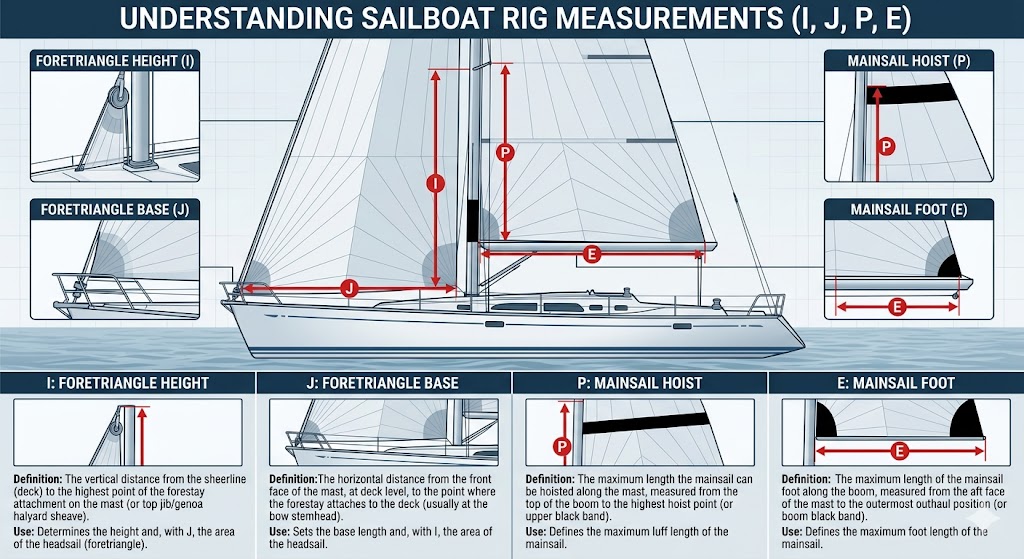
I (Foretriangle Height) 25.83 ft / 7.87 m
J (Foretriangle Base) 8.00 ft / 2.44 m
P (Mainsail Luff) 21.00 ft / 6.40 m
E (Mainsail Foot) 9.67 ft / 2.95 m
SA Fore 103.32 ft² / 9.60 m²
SA Main 101.54 ft² / 9.43 m²
SA Total (100%) 204.86 ft² / 19.03 m²
Est. Forestay Length 27.04 ft / 8.24 m
Mast Height (DWL) 25.00 ft / 7.62 m
Engine & Accommodations
Engine Type Outboard
Horsepower Recommended 5 - 7
LOD 21.50 ft / 6.55 m
Resources & Community
📖
Catalina 22 Buyer's Guide History, versions, what to inspect, and real price data from active listings
Read Guide →
Find a Catalina 22 For Sale