Back to Search
Yankee One Design
Designer: W. Starling Burgess  ·  Builder: Quincy Adams Yacht Yard  ·  First built: 1937
+ Add to Compare
About the Yankee One Design

Originally developed as a strict one-design class, this sailboat represents a classic approach to competitive fleet racing where identical boats ensure that sailing skill, rather than equipment advantages, determines the winner. The Yankee One Design emerged from the tradition of northeastern sailing clubs that valued close, tactical racing among evenly matched vessels. Built for sailors who appreciate the pure sport of racing, this design emphasizes consistent performance characteristics that reward crew work and tactical expertise. The boat's proportions suggest it was intended primarily for day sailing and club racing rather than extended cruising, with accommodations likely kept minimal to maintain racing weight and performance. The one-design concept means every hull shares identical specifications, creating a level playing field that has sustained active racing fleets over the years. This approach appeals to competitive sailors who want to test their skills against others without the complexity and expense of constantly upgrading equipment. For potential buyers, the Yankee One Design offers an entry into organized fleet racing with the camaraderie that comes from sailing identical boats. The design's longevity speaks to its success in creating exciting, close competition that keeps sailors coming back season after season.

Core Dimensions
LOA (Length Overall) 30.50 ft / 9.30 m
LWL (Waterline Length) 24.00 ft / 7.32 m
Beam 6.50 ft / 1.98 m
Max Draft 4.50 ft / 1.37 m
Displacement 4,775.00 lb / 2,166 kg
Ballast 2,550.00 lb / 1,157 kg
Ballast Type Lead
Design & Construction
Hull Type Fin Keel
Rigging Type Fractional Sloop
Construction Wood
Designer W. Starling Burgess
Builder Quincy Adams Yacht Yard
First Built 1937
Last Built 1960
Number Built 42
Owner Reviews

No owner reviews yet — be the first to share your experience with this boat.
Performance Ratios
PHRF Rating PHRF (Performance Handicap Racing Fleet) is a national racing handicap measured in seconds per nautical mile. Lower values indicate faster boats. Ratings are sourced from US Sailing's national database (median across 60+ regional fleets).
Under 0 — Ultralight racer0–90 — Performance racer90–150 — Cruiser/racer150–210 — Typical cruiserOver 210 — Heavy/slow cruiser
203
Ballast/Displacement Ballast to Displacement ratio shows what percentage of the boat's total weight is ballast. Higher values generally mean better initial stability and stiffer sail carrying.
30–35% — Typical cruiser35–45% — Stiff performance boatOver 45% — Racing oriented
53.4
Displacement/Length Displacement to Length ratio measures how heavy a boat is relative to its waterline length. Lower values mean a lighter, faster boat.
Under 100 — Ultralight racer100–200 — Light cruiser/racer200–300 — Moderate cruiser300–400 — Heavy cruiserOver 400 — Very heavy
154.2
Pounds/Inch Immersion Pounds per Inch Immersion (PPI) tells you how much weight is needed to sink the boat one inch. Useful for calculating how additional gear and stores affect waterline. 3.34 pounds/inch
Rig Dimensions
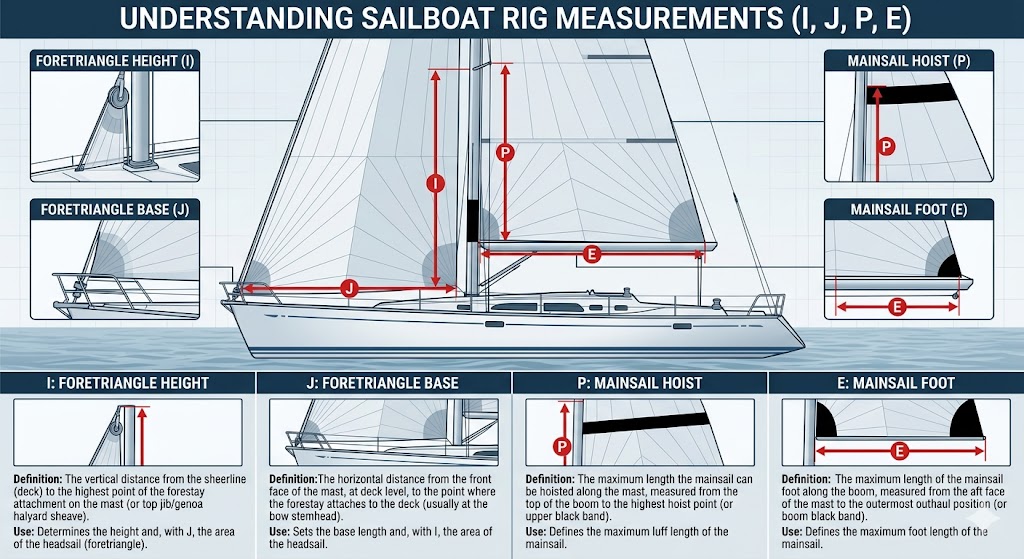
I (Foretriangle Height) 18.33
J (Foretriangle Base) 7.00 ft / 2.13 m
P (Mainsail Luff) 324.00 ft² / 30.10 m²
E (Mainsail Foot) 154.20
Find a Yankee One Design For Sale