Back to Search
Whitby 42
Designer: Edward S. Brewer  ·  Builder: Whitby Boatworks/Ft. Meyers Yacht And Shipbuilding  ·  First built: 1972
+ Add to Compare
About the Whitby 42

Designed for serious bluewater cruising, the Whitby 42 has earned a devoted following among offshore sailors seeking a capable and dependable passage-maker. Built by Whitby Boat Works in Ontario, Canada, this ketch-rigged cruiser gained a strong reputation during the 1970s and 1980s as a well-constructed vessel ready to take on ocean passages with confidence. Known for its robust build quality and sea-kindly hull design, the Whitby 42 strikes a balance between offshore performance and comfortable liveaboard cruising. Its ketch rig makes sail handling manageable for short-handed crews, a practical consideration for couples or solo sailors tackling long passages. The boat is frequently praised for its sturdy construction and thoughtful layout, reflecting the priorities of cruisers who valued reliability and safety above all else. Owners often speak highly of its seakeeping ability and the sense of security it inspires in challenging conditions. For anyone researching a proven bluewater cruiser with a respected pedigree and a loyal owner community, the Whitby 42 remains a compelling option worth serious consideration.

Core Dimensions
LOA (Length Overall) 42.00 ft / 12.80 m
LWL (Waterline Length) 32.67 ft / 9.96 m
Beam 13.00 ft / 3.96 m
Max Draft 5.00 ft / 1.52 m
Displacement 23,500.00 lb / 10,659 kg
Ballast 8,000.00 lb / 3,629 kg
Sail Area (Reported) 875.00 ft² / 81.29 m²
Design & Construction
Hull Type Long Keel
Rigging Type Masthead Ketch
Construction FG
Designer Edward S. Brewer
Builder Whitby Boatworks/Ft. Meyers Yacht and Shipbuilding
First Built 1972
Last Built 1988
Owner Reviews

No owner reviews yet — be the first to share your experience with this boat.

Known Issues & What to Watch For
Medium Hull/Deck
The deck-to-hull joint on early Whitby 42s uses an inward-turning flange that is bolted and bedded but not glassed on many hulls. This joint is notorious for weeping leaks, particularly along the toerail, and can allow water intrusion into the hull-deck laminate over many years.
1972–1979 models
High Hull/Deck
The chainplates are inboard-mounted and pass through the deck with individual deck plates. The bedding around these penetrations fails frequently, allowing water to track down the chainplate straps and into the settee or hanging locker cabinetry, often causing hidden rot in the surrounding wooden structure.
Medium Hull/Deck
The balsa-cored deck sections, particularly in the side decks and cockpit surrounds, are prone to core saturation and delamination resulting from fastener penetrations and port frame leaks. Tap testing often reveals extensive soft areas that are not visible from the surface.
High Hull/Deck
The rudder on the Whitby 42 is a full-length skeg-hung design with an internal steel armature. The armature is known to rust internally, causing the rudder foam core to delaminate from the fiberglass skin and producing a spongy or sloppy helm feel. Inspection should include probing the rudder for voids and checking for any weeping rust stains.
High Keel
The external lead or cast iron keel is attached with stainless or mild steel keel bolts that pass through a solid glass sump. Keel bolt corrosion and weeping at the keel-to-hull joint is commonly reported; the bilge area around the keel sump should be inspected for rust staining, soft laminate, or movement under load.
High Rigging
The Whitby 42 uses a ketch rig with a relatively heavy displacement-to-sail-area ratio. The original chainplate backing plates are often undersized wooden pads that compress and rot over time, reducing the structural integrity of the shroud attachment points. Backing plate condition should be verified by opening the interior liners.
Medium Accommodations
The interior joinery is largely teak-framed with plywood panels, and many boats suffer from softening or delamination of the plywood substrates due to chronic low-level leaks from ports, deck hardware, and chainplates over decades. The overhead liner panels in particular frequently hide saturated or rotted backing material.
Medium Accommodations
The opening bronze portlights used throughout the hull sides are original Bomar or similar cast units whose frames are bedded into the hull. The bedding deteriorates and the portlight frames develop hairline cracks, allowing water ingress directly into the hull sides and settee areas below.
Medium Engine
Earlier production Whitby 42s were fitted with Perkins 4-108 diesels, while later boats received Westerbeke or Universal units. The engine beds on many boats show cracking or delamination of the fiberglass tabbing due to the heavy displacement and vibration loads over years of use; engine bed integrity should be verified as part of any survey.
Medium Electrical
Most Whitby 42s have original or multiple-generation-old wiring that does not meet current ABYC standards. The original harnesses frequently run behind fixed cabinetry and liners, making inspection and replacement difficult. Overloaded circuits and undersized wire gauges added during owner upgrades are commonly found.

Own or have surveyed a Whitby 42? Submit a known issue
Performance Ratios
PHRF Rating PHRF (Performance Handicap Racing Fleet) is a national racing handicap measured in seconds per nautical mile. Lower values indicate faster boats. Ratings are sourced from US Sailing's national database (median across 60+ regional fleets).
Under 0 — Ultralight racer0–90 — Performance racer90–150 — Cruiser/racer150–210 — Typical cruiserOver 210 — Heavy/slow cruiser
153
SA/Displacement Sail Area to Displacement ratio measures how much sail power a boat has relative to its weight. Higher values mean more performance and speed.
Under 14 — Heavy cruiser, slow14–18 — Cruising sailboat18–22 — Cruiser/racerOver 22 — Performance racer
17.13
Comfort Ratio Ted Brewer's Comfort Ratio predicts how comfortable a boat will feel in offshore conditions. Higher values mean a steadier, more comfortable motion in a seaway.
Under 20 — Uncomfortably rough20–30 — Acceptable coastal30–40 — Good offshore comfortOver 40 — Very comfortable offshore
33.63
Capsize Screening Formula The USHS Capsize Screening Formula estimates offshore capsize risk. Lower is safer — values under 2.0 are considered acceptable for offshore sailing.
Under 2.0 — Safe for offshore2.0–2.2 — Borderline offshoreOver 2.2 — Coastal use recommended
1.82
Hull Speed Hull Speed is the theoretical maximum speed of a displacement hull, calculated from waterline length. Most cruising sailboats reach this speed in moderate conditions. 7.66
S# (Speed Number) The Speed Number (S#) is a quick performance index. Higher values indicate a faster, more powerful design relative to its size.
Under 3.0 — Slow cruiser3.0–5.0 — Average cruiser5.0–7.0 — Performance cruiserOver 7.0 — Racer
1.48
Pounds/Inch Immersion Pounds per Inch Immersion (PPI) tells you how much weight is needed to sink the boat one inch. Useful for calculating how additional gear and stores affect waterline. 1.0
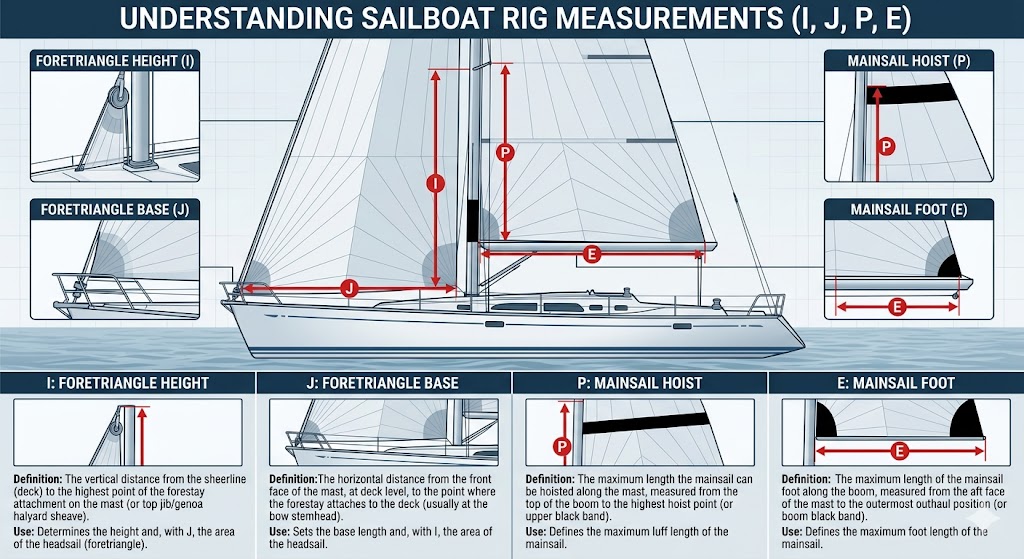
Rig Dimensions
I (Foretriangle Height) 49.0
J (Foretriangle Base) 15.5
P (Mainsail Luff) 43.0
E (Mainsail Foot) 15.0
SA Fore 379.75
SA Main 322.5
How It Compares

vs. Cascade 42, Irwin 42, Valiant 42

This boat Similar boats
Dimensions
LOA
Whitby 42 ★
42.0 ft
Cascade 42
42.0 ft
Irwin 42
42.0 ft
Valiant 42
42.0 ft
LWL
Whitby 42 ★
32.7 ft
Cascade 42
34.0 ft
Irwin 42
35.1 ft
Valiant 42
34.5 ft
Beam
Whitby 42 ★
13.0 ft
Cascade 42
11.9 ft
Irwin 42
13.3 ft
Valiant 42
12.8 ft
Displacement
Whitby 42 ★
23 lbs
Cascade 42
18 lbs
Irwin 42
29 lbs
Valiant 42
24 lbs
Ballast
Whitby 42 ★
8 lbs
Cascade 42
6 lbs
Irwin 42
12 lbs
Valiant 42
9 lbs
Sail Area
Whitby 42 ★
875 sq ft
Cascade 42
Irwin 42
899 sq ft
Valiant 42
849 sq ft
Performance
PHRF Rating (lower = faster)
Whitby 42 ★
153 s/nm
Cascade 42
102 s/nm
Irwin 42
168 s/nm
Valiant 42
138 s/nm
SA / Displacement (higher = more powerful)
Whitby 42 ★
17.1
Cascade 42
Irwin 42
15.3
Valiant 42
16.1
Comfort Ratio (higher = more comfortable offshore)
Whitby 42 ★
33.6
Cascade 42
28.2
Irwin 42
38.3
Valiant 42
34.9
Capsize Screening (lower = safer)
Whitby 42 ★
1.82
Cascade 42
1.82
Irwin 42
1.74
Valiant 42
1.76
Hull Speed
Whitby 42 ★
7.7 kts
Cascade 42
7.8 kts
Irwin 42
7.9 kts
Valiant 42
7.9 kts
Speed Number (higher = faster)
Whitby 42 ★
1.5
Cascade 42
Irwin 42
1.6
Valiant 42
1.9
Find a Whitby 42 For Sale