Back to Search
Vancouver 27
Designer: Robert B Harris  ·  Builder: Pheon Yachts Ltd. /Northshore Yachts Ltd.  ·  First built: 1973
+ Add to Compare
About the Vancouver 27

Designed with serious offshore passagemaking in mind, the Vancouver 27 is a compact bluewater cruiser with a devoted following among sailors who prioritize seaworthiness over speed. Built by Bluewater Boats in Canada, the design emerged from the tradition of heavily built, full-keel cruising yachts intended to handle challenging ocean conditions with confidence and reliability. The Vancouver 27 carries the hallmarks of classic bluewater design philosophy — a deep, long keel for directional stability, a sturdy hull built to take a beating in rough seas, and a layout focused on safety and self-sufficiency rather than racing performance. These qualities make her particularly well suited to coastal cruising, extended offshore passages, and voyaging in high-latitude or demanding environments where structural integrity matters most. Her modest size belies a capable, go-anywhere character that appeals to singlehanders and couples looking for an affordable entry into bluewater sailing. While she won't win any races, the Vancouver 27 rewards patient sailors who value dependability and sea-kindly behavior, earning a quiet but lasting reputation as a trustworthy little ship.

Core Dimensions
LOA (Length Overall) 27.00 ft / 8.23 m
LWL (Waterline Length) 22.92 ft / 6.99 m
Beam 8.67 ft / 2.64 m
Max Draft 4.50 ft / 1.37 m
Displacement 8,960.00 lb / 4,064 kg
Ballast 3,465.00 lb / 1,572 kg
Sail Area (Reported) 381.00 ft² / 35.40 m²
Headroom 6.17 ft / 1.88 m
Design & Construction
Hull Type Long keel w/trans. hung rudder
Rigging Type Cutter
Construction GRP
Designer Robert B Harris
Builder Pheon Yachts Ltd. /Northshore Yachts Ltd.
First Built 1973
Owner Reviews

No owner reviews yet — be the first to share your experience with this boat.
Performance Ratios
PHRF Rating PHRF (Performance Handicap Racing Fleet) is a national racing handicap measured in seconds per nautical mile. Lower values indicate faster boats. Ratings are sourced from US Sailing's national database (median across 60+ regional fleets).
Under 0 — Ultralight racer0–90 — Performance racer90–150 — Cruiser/racer150–210 — Typical cruiserOver 210 — Heavy/slow cruiser
258
SA/Displacement Sail Area to Displacement ratio measures how much sail power a boat has relative to its weight. Higher values mean more performance and speed.
Under 14 — Heavy cruiser, slow14–18 — Cruising sailboat18–22 — Cruiser/racerOver 22 — Performance racer
14.18
Comfort Ratio Ted Brewer's Comfort Ratio predicts how comfortable a boat will feel in offshore conditions. Higher values mean a steadier, more comfortable motion in a seaway.
Under 20 — Uncomfortably rough20–30 — Acceptable coastal30–40 — Good offshore comfortOver 40 — Very comfortable offshore
32.29
Capsize Screening Formula The USHS Capsize Screening Formula estimates offshore capsize risk. Lower is safer — values under 2.0 are considered acceptable for offshore sailing.
Under 2.0 — Safe for offshore2.0–2.2 — Borderline offshoreOver 2.2 — Coastal use recommended
1.67
Hull Speed Hull Speed is the theoretical maximum speed of a displacement hull, calculated from waterline length. Most cruising sailboats reach this speed in moderate conditions. 6.42
S# (Speed Number) The Speed Number (S#) is a quick performance index. Higher values indicate a faster, more powerful design relative to its size.
Under 3.0 — Slow cruiser3.0–5.0 — Average cruiser5.0–7.0 — Performance cruiserOver 7.0 — Racer
1.32
Pounds/Inch Immersion Pounds per Inch Immersion (PPI) tells you how much weight is needed to sink the boat one inch. Useful for calculating how additional gear and stores affect waterline. 710.04
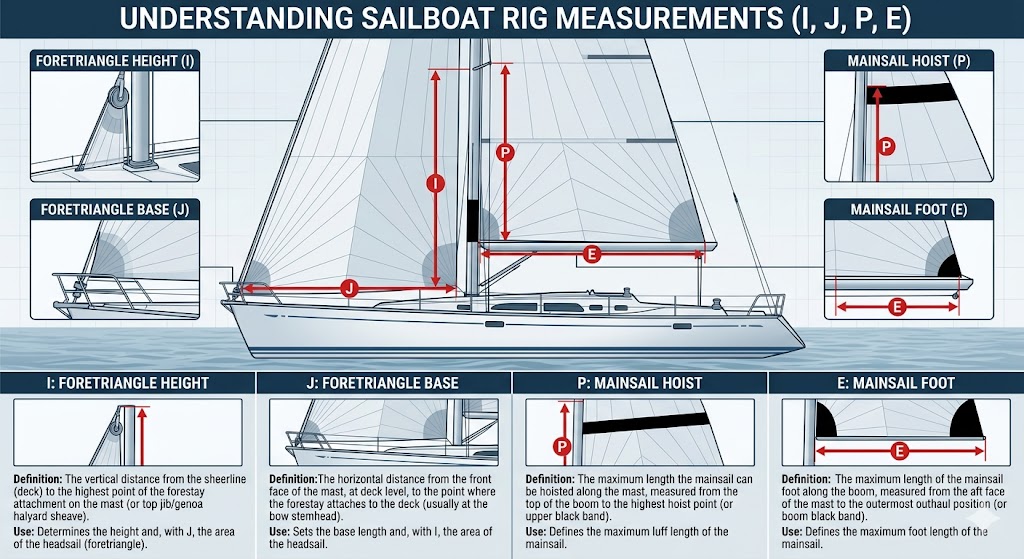
Rig Dimensions
I (Foretriangle Height) 36.0
J (Foretriangle Base) 13.0
P (Mainsail Luff) 30.0
E (Mainsail Foot) 9.8
SA Fore 234.0
SA Main 147.0
Find a Vancouver 27 For Sale