Back to Search
Thunderbird
Designer: Ben Seaborn  ·  First built: 1958
+ Add to Compare
About the Thunderbird

Designed for competitive one-design racing and spirited daysailing, the Thunderbird is a well-regarded keelboat with a loyal following in the Pacific Northwest, where it was developed and gained much of its reputation. Introduced in the early 1960s, the design quickly attracted a devoted fleet of sailors drawn to its lively performance and accessible racing format, and class associations remain active to this day. Built with a low-slung, sporty profile, the Thunderbird is known for its responsive handling and exciting sailing characteristics, rewarding skilled helmsmanship and attentive crew work. It performs best in sheltered coastal and inland waters, making it a natural fit for bay racing, lake sailing, and weekend regattas rather than extended offshore passages. The boat's competitive one-design nature means that class rules have kept fleets relatively equal over the decades, placing the emphasis squarely on sailor skill rather than equipment advantages. For those drawn to active, hands-on sailing with a strong sense of community, the Thunderbird offers an engaging platform with a rich class history and a welcoming network of fellow enthusiasts — a combination that continues to attract new sailors to the design.

Core Dimensions
LOA (Length Overall) 25.98 ft / 7.92 m
LWL (Waterline Length) 20.25 ft / 6.17 m
Beam 7.54 ft / 2.30 m
Max Draft 4.79 ft / 1.46 m
Displacement 3,650.00 lb / 1,656 kg
Ballast 1,530.00 lb / 694 kg
Sail Area (Reported) 309.00 ft² / 28.71 m²
Design & Construction
Hull Type Fin w/spade rudder
Rigging Type Fractional Sloop
Construction Plywood/FG
Designer Ben Seaborn
First Built 1958
Owner Reviews

No owner reviews yet — be the first to share your experience with this boat.

Known Issues & What to Watch For

No known issues documented for this model yet.

Own or have surveyed a Thunderbird? Submit a known issue
Performance Ratios
PHRF Rating PHRF (Performance Handicap Racing Fleet) is a national racing handicap measured in seconds per nautical mile. Lower values indicate faster boats. Ratings are sourced from US Sailing's national database (median across 60+ regional fleets).
Under 0 — Ultralight racer0–90 — Performance racer90–150 — Cruiser/racer150–210 — Typical cruiserOver 210 — Heavy/slow cruiser
204
SA/Displacement Sail Area to Displacement ratio measures how much sail power a boat has relative to its weight. Higher values mean more performance and speed.
Under 14 — Heavy cruiser, slow14–18 — Cruising sailboat18–22 — Cruiser/racerOver 22 — Performance racer
20.91
Comfort Ratio Ted Brewer's Comfort Ratio predicts how comfortable a boat will feel in offshore conditions. Higher values mean a steadier, more comfortable motion in a seaway.
Under 20 — Uncomfortably rough20–30 — Acceptable coastal30–40 — Good offshore comfortOver 40 — Very comfortable offshore
17.4
Capsize Screening Formula The USHS Capsize Screening Formula estimates offshore capsize risk. Lower is safer — values under 2.0 are considered acceptable for offshore sailing.
Under 2.0 — Safe for offshore2.0–2.2 — Borderline offshoreOver 2.2 — Coastal use recommended
1.96
Hull Speed Hull Speed is the theoretical maximum speed of a displacement hull, calculated from waterline length. Most cruising sailboats reach this speed in moderate conditions. 6.03
S# (Speed Number) The Speed Number (S#) is a quick performance index. Higher values indicate a faster, more powerful design relative to its size.
Under 3.0 — Slow cruiser3.0–5.0 — Average cruiser5.0–7.0 — Performance cruiserOver 7.0 — Racer
3.19
Pounds/Inch Immersion Pounds per Inch Immersion (PPI) tells you how much weight is needed to sink the boat one inch. Useful for calculating how additional gear and stores affect waterline. 545.56
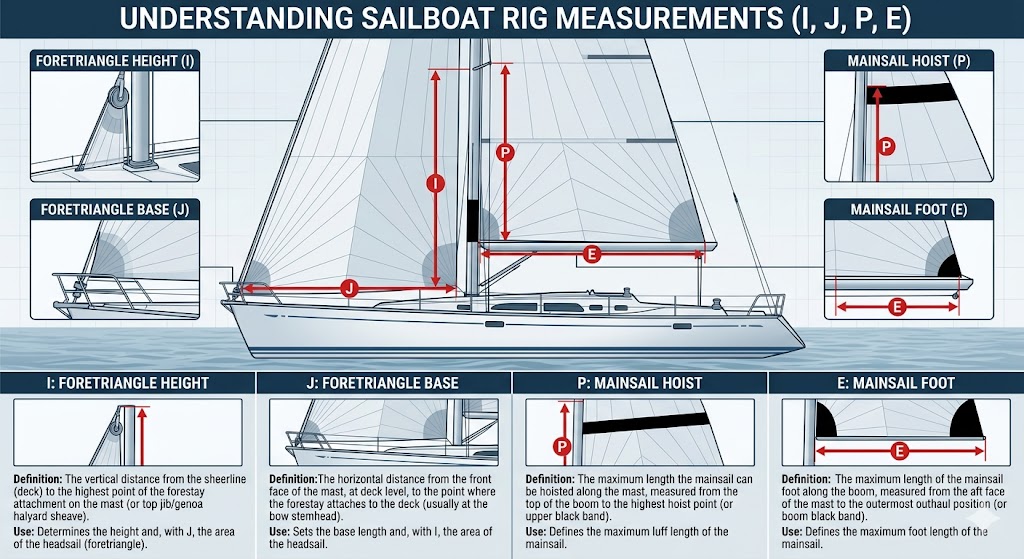
Rig Dimensions
I (Foretriangle Height) 26.75
J (Foretriangle Base) 8.0
P (Mainsail Luff) 31.0
E (Mainsail Foot) 13.0
SA Fore 107.0
SA Main 201.5
Find a Thunderbird For Sale