Back to Search
Tanzer 22
Designer: Johann Tanzer  ·  Builder: Tanzer Industries Ltd. (Can)  ·  First built: 1970
+ Add to Compare
About the Tanzer 22

A Canadian-built classic, the Tanzer 22 earned a loyal following throughout the 1970s and 1980s as an approachable and capable small sailboat. Designed by Johann Tanzer and produced by Tanzer Industries in Quebec, this boat was part of a well-regarded family of sailboats that balanced affordability with genuine sailing performance. Well-suited for inland lakes, protected bays, and coastal daysailing, the Tanzer 22 appeals to sailors looking for a responsive and manageable vessel that doesn't demand an experienced crew. Its design reflects practical sensibilities, offering enough comfort for weekend outings while remaining simple enough for a solo sailor or small family to handle with confidence. The boat developed a strong one-design racing community in parts of Canada, giving it a competitive edge that many similarly sized recreational boats lacked. This racing heritage means the hull is tuned for performance, rewarding attentive sailors who want more than a leisurely drift. For those researching used boat options, the Tanzer 22 represents solid value — a well-built, historically respected design with an active owners community and a reputation for durability that has kept many examples sailing decades after their construction.

Market Price Estimate Beta
Small sample size. This estimate is based on fewer than 5 listings and may not be representative of the true market. Use with caution.
$1,750 – $1,750
typical asking price
Median $1,750  ·  2 listings used
All listings
$1,750 – $1,750 2
Rate a listing price
$
About this estimate
  • Prices are based on recent asking prices from public listings — not actual sale prices, which are typically lower.
  • Condition is not factored in. A well-maintained boat with new sails and engine can be worth significantly more than a project boat of the same model.
  • Location affects price. Boats in landlocked states or areas with fewer buyers often sell for less than those on the coast.
  • Year of manufacture is not filtered. Older examples of this model will generally be priced lower than newer ones.
  • Included equipment varies widely. A boat with a full suite of electronics, dodger, and new standing rigging may command a large premium.
  • Outliers are automatically excluded using statistical filtering to improve accuracy, but some bad data may remain.
Core Dimensions
LOA (Length Overall) 22.50 ft / 6.86 m
LWL (Waterline Length) 19.75 ft / 6.02 m
Beam 7.83 ft / 2.39 m
Max Draft 3.42 ft / 1.04 m
Displacement 2,900.00 lb / 1,315 kg
Ballast 1,250.00 lb / 567 kg
Design & Construction
Hull Type Fin w/transom hung rudder
Rigging Type Masthead Sloop
Construction FG
Designer Johann Tanzer
Builder Tanzer Industries Ltd. (CAN)
First Built 1970
Last Built 1986
Number Built 2271
Owner Reviews

No owner reviews yet — be the first to share your experience with this boat.

Known Issues & What to Watch For
Medium Hull/Deck
The deck-to-hull joint on early Tanzer 22s was secured with a through-bolted external aluminum toe rail acting as the primary fastener. Corrosion of the aluminum extrusion and backing hardware causes the joint to weep, allowing water intrusion into the hull-deck interface and potential delamination of the inner flange.
1970–1978 models
Medium Hull/Deck
The centerline cockpit floor and the area beneath the cockpit sole are prone to stress cracking and delamination due to the relatively thin layup Tanzer used in this region. Check carefully for soft spots underfoot and cracks radiating from cockpit drain fittings.
High Hull/Deck
The tabbing that bonds the interior liner and bulkheads to the hull was applied lightly at the factory. Bulkhead tabbing, particularly at the main bulkhead, commonly separates over time, producing creaking under sail load and allowing movement that can stress the hull.
High Keel
The cast iron fin keel is attached with a small number of keel bolts that are known to corrode, especially where they pass through the shallow sump area. Surface rust staining in the bilge near bolt heads is common and warrants probing to assess remaining bolt diameter before purchase.
Medium Keel
The keel-to-hull joint relies on a relatively narrow mating surface and bedding compound that deteriorates, allowing water to wick up around the bolts and accelerate internal rust. Re-bedding the keel is a recurring maintenance item on this model.
Medium Hull/Deck
The mast partner area on the cabin top was lightly reinforced at the factory. Boats that have been raced hard or rigged with high-tension rigs show compression cracking and sometimes delamination around the mast collar. Inspect for star cracking and soft laminate in this zone.
Medium Rigging
The transom-hung rudder uses a pintle-and-gudgeon arrangement on the transom that suffers from elongated holes over years of use, producing slop in the steering. Inspect gudgeons for wallowed-out fastener holes and cracks in the fiberglass transom around the fittings.
Low Accommodations
The fresh water tank is a flexible bladder or small built-in unit that ages poorly and is difficult to replace given the limited access under the V-berth. Many boats this age have non-functional or removed water systems.
High Hull/Deck
Chainplate backing plates were undersized on many hulls and are prone to pulling or cracking the deck laminate under repeated load. Inspect the interior headliner and deck surface around shroud chainplates for lifted or cracked gelcoat and any signs of movement.

Own or have surveyed a Tanzer 22? Submit a known issue
Performance Ratios
PHRF Rating PHRF (Performance Handicap Racing Fleet) is a national racing handicap measured in seconds per nautical mile. Lower values indicate faster boats. Ratings are sourced from US Sailing's national database (median across 60+ regional fleets).
Under 0 — Ultralight racer0–90 — Performance racer90–150 — Cruiser/racer150–210 — Typical cruiserOver 210 — Heavy/slow cruiser
246
Ballast/Displacement Ballast to Displacement ratio shows what percentage of the boat's total weight is ballast. Higher values generally mean better initial stability and stiffer sail carrying.
30–35% — Typical cruiser35–45% — Stiff performance boatOver 45% — Racing oriented
43.1
Displacement/Length Displacement to Length ratio measures how heavy a boat is relative to its waterline length. Lower values mean a lighter, faster boat.
Under 100 — Ultralight racer100–200 — Light cruiser/racer200–300 — Moderate cruiser300–400 — Heavy cruiserOver 400 — Very heavy
168.05
Pounds/Inch Immersion Pounds per Inch Immersion (PPI) tells you how much weight is needed to sink the boat one inch. Useful for calculating how additional gear and stores affect waterline. 3.31 pounds/inch
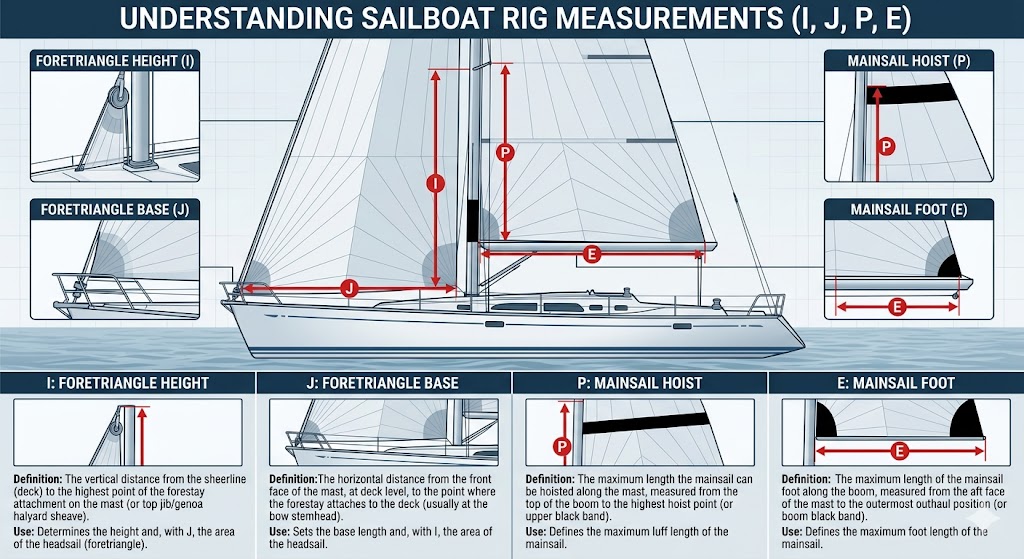
Rig Dimensions
I (Foretriangle Height) 17.75
J (Foretriangle Base) 8.56 ft / 2.61 m
P (Mainsail Luff) 225.00 ft² / 20.90 m²
E (Mainsail Foot) 168.05
Find a Tanzer 22 For Sale