Back to Search
Swan 36
Designer: Sparkman & Stephens  ·  Builder: Nautor  ·  First built: 1967
+ Add to Compare
About the Swan 36

Designed by the legendary Sparkman & Stephens and built by Finland's prestigious Nautor yard, this classic represents the early evolution of the Swan lineage that would become synonymous with elegant performance cruising. Built from 1967 to 1970 with only 80 hulls produced, the Swan 36 established many design principles that would define the marque for decades to come. The hull showcases Sparkman & Stephens' mastery of balanced proportions, with a moderate fin keel and skeg-mounted rudder configuration that delivers both directional stability and responsive handling. The generous ballast-to-displacement ratio of 55% provides substantial stability and seaworthiness, while the masthead sloop rig offers straightforward sail handling and excellent upwind performance. With a comfort ratio of 37.23, this Swan strikes an appealing balance between performance and liveability, making it well-suited for coastal cruising and offshore passages alike. The low capsize screening value of 1.6 reflects inherent stability that inspires confidence in challenging conditions. Her moderate displacement and clean underwater profile deliver respectable speed potential while maintaining the forgiving characteristics that make her accessible to sailors of varying experience levels. This early Swan represents classic yacht design at its finest, combining seaworthiness with the elegance that became the hallmark of Finnish craftsmanship.

Core Dimensions
LOA (Length Overall) 35.73 ft / 10.89 m
LWL (Waterline Length) 25.92 ft / 7.90 m
Beam 9.68 ft / 2.95 m
Max Draft 6.07 ft / 1.85 m
Displacement 14,300.00 lb / 6,486 kg
Ballast 7,936.00 lb / 3,600 kg
Ballast Type Lead
Sail Area (Reported) 546.00 ft² / 50.73 m²
Design & Construction
Hull Type Fin with rudder on skeg
Rigging Type Masthead Sloop
Construction FG
Designer Sparkman & Stephens
Builder Nautor
First Built 1967
Last Built 1970
Number Built 80
Owner Reviews

No owner reviews yet — be the first to share your experience with this boat.
Performance Ratios
PHRF Rating PHRF (Performance Handicap Racing Fleet) is a national racing handicap measured in seconds per nautical mile. Lower values indicate faster boats. Ratings are sourced from US Sailing's national database (median across 60+ regional fleets).
Under 0 — Ultralight racer0–90 — Performance racer90–150 — Cruiser/racer150–210 — Typical cruiserOver 210 — Heavy/slow cruiser
144
SA/Displacement Sail Area to Displacement ratio measures how much sail power a boat has relative to its weight. Higher values mean more performance and speed.
Under 14 — Heavy cruiser, slow14–18 — Cruising sailboat18–22 — Cruiser/racerOver 22 — Performance racer
14.88
Ballast/Displacement Ballast to Displacement ratio shows what percentage of the boat's total weight is ballast. Higher values generally mean better initial stability and stiffer sail carrying.
30–35% — Typical cruiser35–45% — Stiff performance boatOver 45% — Racing oriented
55.5
Displacement/Length Displacement to Length ratio measures how heavy a boat is relative to its waterline length. Lower values mean a lighter, faster boat.
Under 100 — Ultralight racer100–200 — Light cruiser/racer200–300 — Moderate cruiser300–400 — Heavy cruiserOver 400 — Very heavy
366.59
Comfort Ratio Ted Brewer's Comfort Ratio predicts how comfortable a boat will feel in offshore conditions. Higher values mean a steadier, more comfortable motion in a seaway.
Under 20 — Uncomfortably rough20–30 — Acceptable coastal30–40 — Good offshore comfortOver 40 — Very comfortable offshore
37.23
Capsize Screening Formula The USHS Capsize Screening Formula estimates offshore capsize risk. Lower is safer — values under 2.0 are considered acceptable for offshore sailing.
Under 2.0 — Safe for offshore2.0–2.2 — Borderline offshoreOver 2.2 — Coastal use recommended
1.6
Hull Speed Hull Speed is the theoretical maximum speed of a displacement hull, calculated from waterline length. Most cruising sailboats reach this speed in moderate conditions. 6.82 kn
S# (Speed Number) The Speed Number (S#) is a quick performance index. Higher values indicate a faster, more powerful design relative to its size.
Under 3.0 — Slow cruiser3.0–5.0 — Average cruiser5.0–7.0 — Performance cruiserOver 7.0 — Racer
1.18
Pounds/Inch Immersion Pounds per Inch Immersion (PPI) tells you how much weight is needed to sink the boat one inch. Useful for calculating how additional gear and stores affect waterline. 896.51 pounds/inch
SA/Displacement (Calc) Calculated Sail Area to Displacement ratio using actual measured sail dimensions rather than reported values. More precise than the reported SA/Disp figure. 14.93
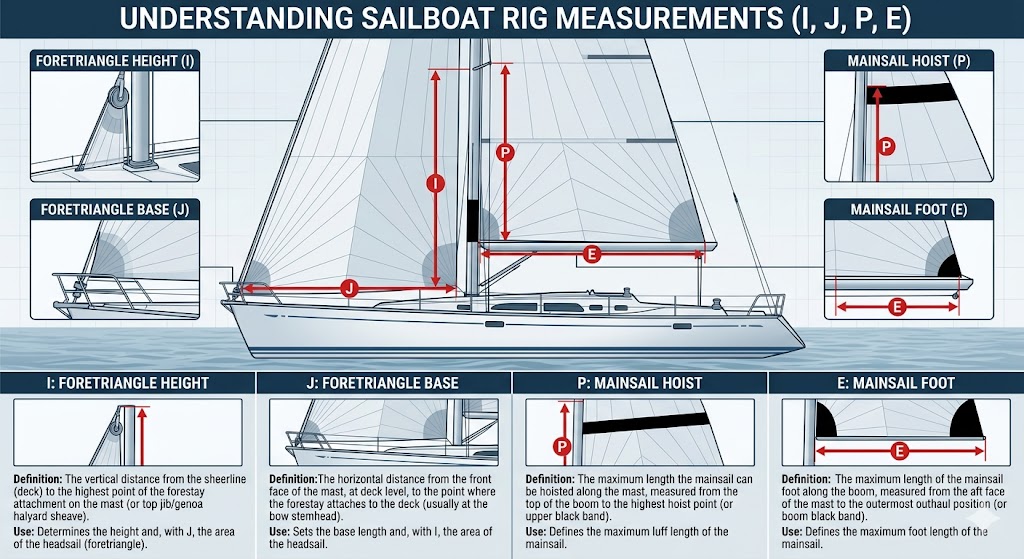
Rig Dimensions
I (Foretriangle Height) 42.65 ft / 13.00 m
J (Foretriangle Base) 14.00 ft / 4.27 m
P (Mainsail Luff) 35.60 ft / 10.85 m
E (Mainsail Foot) 14.00 ft / 4.27 m
SA Fore 298.55 ft² / 27.74 m²
SA Main 249.20 ft² / 23.15 m²
SA Total (100%) 547.75 ft² / 50.89 m²
Est. Forestay Length 44.89 ft / 13.68 m
How It Compares

vs. Cc 36 1, Clipper 36 Cheoy Lee, Columbia 36, Offshore 36 Cheoy Lee, Pilot 35 Hinckley

This boat Similar boats
Dimensions
LOA
Swan 36 ★
35.7 ft
Cc 36 1
35.7 ft
Clipper 36 Cheoy Lee
35.6 ft
Columbia 36
35.8 ft
Offshore 36 Cheoy Lee
35.8 ft
Pilot 35 Hinckley
35.8 ft
LWL
Swan 36 ★
25.9 ft
Cc 36 1
27.8 ft
Clipper 36 Cheoy Lee
25.0 ft
Columbia 36
27.8 ft
Offshore 36 Cheoy Lee
25.6 ft
Pilot 35 Hinckley
25.0 ft
Beam
Swan 36 ★
9.7 ft
Cc 36 1
11.5 ft
Clipper 36 Cheoy Lee
10.8 ft
Columbia 36
10.5 ft
Offshore 36 Cheoy Lee
10.0 ft
Pilot 35 Hinckley
9.5 ft
Displacement
Swan 36 ★
14 lbs
Cc 36 1
12 lbs
Clipper 36 Cheoy Lee
16 lbs
Columbia 36
12 lbs
Offshore 36 Cheoy Lee
15 lbs
Pilot 35 Hinckley
13 lbs
Ballast
Swan 36 ★
7 lbs
Cc 36 1
5 lbs
Clipper 36 Cheoy Lee
5 lbs
Columbia 36
5 lbs
Offshore 36 Cheoy Lee
4 lbs
Pilot 35 Hinckley
4 lbs
Sail Area
Swan 36 ★
546 sq ft
Cc 36 1
599 sq ft
Clipper 36 Cheoy Lee
635 sq ft
Columbia 36
556 sq ft
Offshore 36 Cheoy Lee
546 sq ft
Pilot 35 Hinckley
550 sq ft
Performance
PHRF Rating (lower = faster)
Swan 36 ★
144 s/nm
Cc 36 1
Clipper 36 Cheoy Lee
Columbia 36
162 s/nm
Offshore 36 Cheoy Lee
Pilot 35 Hinckley
SA / Displacement (higher = more powerful)
Swan 36 ★
14.9
Cc 36 1
18.4
Clipper 36 Cheoy Lee
15.9
Columbia 36
17.0
Offshore 36 Cheoy Lee
13.8
Pilot 35 Hinckley
15.4
Ballast / Disp (higher = stiffer)
Swan 36 ★
55.5 %
Cc 36 1
41.7 %
Clipper 36 Cheoy Lee
Columbia 36
Offshore 36 Cheoy Lee
29.5 %
Pilot 35 Hinckley
33.6 %
Comfort Ratio (higher = more comfortable offshore)
Swan 36 ★
37.2
Cc 36 1
23.8
Clipper 36 Cheoy Lee
37.7
Columbia 36
26.8
Offshore 36 Cheoy Lee
40.1
Pilot 35 Hinckley
37.4
Capsize Screening (lower = safer)
Swan 36 ★
1.60
Cc 36 1
2.01
Clipper 36 Cheoy Lee
1.70
Columbia 36
1.84
Offshore 36 Cheoy Lee
1.59
Pilot 35 Hinckley
1.59
Displacement / Length (lower = lighter)
Swan 36 ★
366
Cc 36 1
250
Clipper 36 Cheoy Lee
Columbia 36
Offshore 36 Cheoy Lee
425
Pilot 35 Hinckley
391
Hull Speed
Swan 36 ★
6.8 kts
Cc 36 1
7.1 kts
Clipper 36 Cheoy Lee
6.7 kts
Columbia 36
7.1 kts
Offshore 36 Cheoy Lee
6.8 kts
Pilot 35 Hinckley
6.7 kts
Speed Number (higher = faster)
Swan 36 ★
1.2
Cc 36 1
2.3
Clipper 36 Cheoy Lee
0.8
Columbia 36
2.2
Offshore 36 Cheoy Lee
0.9
Pilot 35 Hinckley
1.1
Find a Swan 36 For Sale