Back to Search
Sr 33
Designer: G. Henderson  ·  Builder: C&C International  ·  First built: 1992
+ Add to Compare
About the Sr 33

A relatively obscure entry in the sailing world, the Sr 33 is a vessel that tends to attract curious researchers looking beyond the mainstream roster of production boats. Without an extensive public record of specifications or a well-documented design history, the Sr 33 remains something of an enigma, making it a challenging but intriguing subject for prospective buyers to investigate. Based on its designation, the Sr 33 falls into the mid-range monohull category — a size class generally well-suited to coastal cruising, weekend sailing, and sheltered offshore passages. Boats in this range typically strike a practical balance between manageable handling for a small crew and enough interior volume to accommodate short-term liveaboard comfort. Whether the Sr 33 leans toward performance or cruising comfort in its design philosophy is difficult to determine without fuller specifications. Anyone seriously considering this boat would be well advised to seek out original builder documentation, class associations, or owner communities that may hold more detailed technical records. A thorough survey by a qualified marine surveyor is especially important when researching a lesser-known vessel like this one.

Core Dimensions
LOA (Length Overall) 33.07 ft / 10.08 m
LWL (Waterline Length) 27.75 ft / 8.46 m
Beam 11.42 ft / 3.48 m
Max Draft 7.00 ft / 2.13 m
Min Draft 3.90 ft / 1.19 m
Displacement 5,372.00 lb / 2,437 kg
Ballast 2,400.00 lb / 1,089 kg
Sail Area (Reported) 541.00 ft² / 50.26 m²
Design & Construction
Hull Type Lifting Keel
Rigging Type Fractional Sloop
Construction FG
Designer G. Henderson
Builder C&C International
First Built 1992
Owner Reviews

No owner reviews yet — be the first to share your experience with this boat.
Performance Ratios
PHRF Rating PHRF (Performance Handicap Racing Fleet) is a national racing handicap measured in seconds per nautical mile. Lower values indicate faster boats. Ratings are sourced from US Sailing's national database (median across 60+ regional fleets).
Under 0 — Ultralight racer0–90 — Performance racer90–150 — Cruiser/racer150–210 — Typical cruiserOver 210 — Heavy/slow cruiser
77
SA/Displacement Sail Area to Displacement ratio measures how much sail power a boat has relative to its weight. Higher values mean more performance and speed.
Under 14 — Heavy cruiser, slow14–18 — Cruising sailboat18–22 — Cruiser/racerOver 22 — Performance racer
28.3
Comfort Ratio Ted Brewer's Comfort Ratio predicts how comfortable a boat will feel in offshore conditions. Higher values mean a steadier, more comfortable motion in a seaway.
Under 20 — Uncomfortably rough20–30 — Acceptable coastal30–40 — Good offshore comfortOver 40 — Very comfortable offshore
11.04
Capsize Screening Formula The USHS Capsize Screening Formula estimates offshore capsize risk. Lower is safer — values under 2.0 are considered acceptable for offshore sailing.
Under 2.0 — Safe for offshore2.0–2.2 — Borderline offshoreOver 2.2 — Coastal use recommended
2.61
Hull Speed Hull Speed is the theoretical maximum speed of a displacement hull, calculated from waterline length. Most cruising sailboats reach this speed in moderate conditions. 7.06
S# (Speed Number) The Speed Number (S#) is a quick performance index. Higher values indicate a faster, more powerful design relative to its size.
Under 3.0 — Slow cruiser3.0–5.0 — Average cruiser5.0–7.0 — Performance cruiserOver 7.0 — Racer
5.64
Pounds/Inch Immersion Pounds per Inch Immersion (PPI) tells you how much weight is needed to sink the boat one inch. Useful for calculating how additional gear and stores affect waterline. 1.0
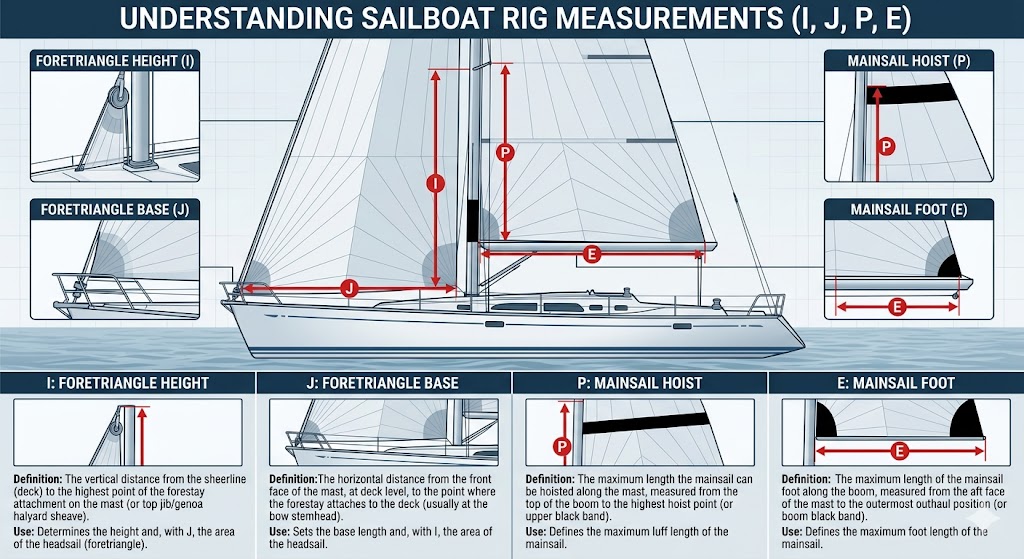
Rig Dimensions
I (Foretriangle Height) 38.9
J (Foretriangle Base) 11.5
P (Mainsail Luff) 40.83
E (Mainsail Foot) 15.54
ISP (Spinnaker Luff) 38.94
SPL/TPS 12.67
SA Fore 223.68
SA Main 317.25
Find a Sr 33 For Sale