Back to Search
Rk 20
Designer: Lyle C. Hess  ·  Builder: Rk Industries (Usa)  ·  First built: 1972
+ Add to Compare
About the Rk 20

A compact Finnish sailboat with a devoted following in Scandinavian waters, the Rk 20 represents the kind of practical, no-nonsense design philosophy that has long characterized Nordic boatbuilding. Built for the often demanding conditions of the Baltic and Finnish archipelago, this small keelboat strikes a balance between accessible daysailing and capable coastal cruising, making it an appealing choice for sailors who want a manageable yet genuinely seaworthy vessel. While detailed specifications are limited in widely available records, the Rk 20 is generally regarded as a solid performer for its size, well-suited to inland lakes, sheltered coastal waters, and protected sea areas where its dimensions are an asset rather than a limitation. Its Finnish heritage suggests a design emphasis on durability and reliability, qualities that matter enormously in northern sailing environments where conditions can change quickly. For those researching an entry-level or weekend keelboat with regional character and a loyal owner community, the Rk 20 deserves a closer look, particularly among sailors based in or familiar with the Scandinavian sailing scene.

Core Dimensions
LOA (Length Overall) 20.00 ft / 6.10 m
LWL (Waterline Length) 17.50 ft / 5.33 m
Beam 7.08 ft / 2.16 m
Max Draft 4.00 ft / 1.22 m
Displacement 1,950.00 lb / 885 kg
Ballast 550.00 lb / 249 kg
Design & Construction
Hull Type Swing Keel
Rigging Type Masthead Sloop
Construction FG
Designer Lyle C. Hess
Builder RK Industries (USA)
First Built 1972
Last Built 1981
Owner Reviews

No owner reviews yet — be the first to share your experience with this boat.

Known Issues & What to Watch For

No known issues documented for this model yet.

Own or have surveyed a Rk 20? Submit a known issue
Performance Ratios
PHRF Rating PHRF (Performance Handicap Racing Fleet) is a national racing handicap measured in seconds per nautical mile. Lower values indicate faster boats. Ratings are sourced from US Sailing's national database (median across 60+ regional fleets).
Under 0 — Ultralight racer0–90 — Performance racer90–150 — Cruiser/racer150–210 — Typical cruiserOver 210 — Heavy/slow cruiser
264
Ballast/Displacement Ballast to Displacement ratio shows what percentage of the boat's total weight is ballast. Higher values generally mean better initial stability and stiffer sail carrying.
30–35% — Typical cruiser35–45% — Stiff performance boatOver 45% — Racing oriented
28.21
Displacement/Length Displacement to Length ratio measures how heavy a boat is relative to its waterline length. Lower values mean a lighter, faster boat.
Under 100 — Ultralight racer100–200 — Light cruiser/racer200–300 — Moderate cruiser300–400 — Heavy cruiserOver 400 — Very heavy
162.43
Pounds/Inch Immersion Pounds per Inch Immersion (PPI) tells you how much weight is needed to sink the boat one inch. Useful for calculating how additional gear and stores affect waterline. 2.66 pounds/inch
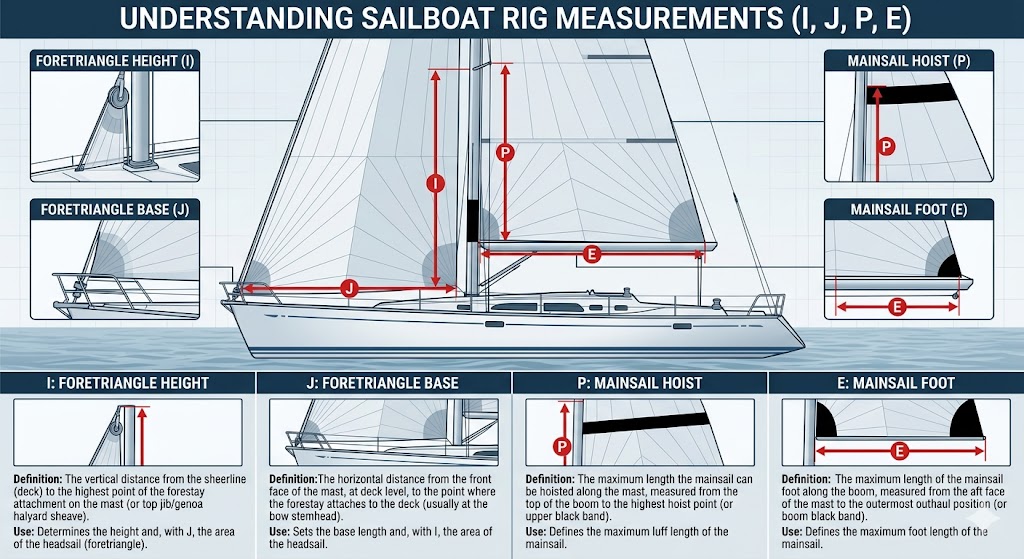
Rig Dimensions
I (Foretriangle Height) 1.75 ft / 0.53 m
J (Foretriangle Base) 8.80 ft / 2.68 m
P (Mainsail Luff) 190.00 ft² / 17.65 m²
E (Mainsail Foot) 162.43
Find a Rk 20 For Sale