Back to Search
Rebel 16
Designer: Ray Greene/Alvin Youngquist  ·  Builder: Ray Greene & Co.(Usa)  ·  First built: 1948
+ Add to Compare
About the Rebel 16

Designed by Ray Greene and Alvin Youngquist in 1948, this compact centerboard dinghy has earned a devoted following among small boat enthusiasts for over seven decades. With its fractional sloop rig and fiberglass construction, the Rebel 16 strikes an appealing balance between traditional sailing characteristics and modern durability. At 16 feet overall with a generous 6.62-foot beam, this boat offers surprising stability and interior space for its size. The centerboard configuration provides versatility, allowing sailors to explore shallow waters while maintaining good windward performance when the board is deployed. Weighing just 700 pounds with 166 square feet of sail area, the Rebel 16 delivers spirited performance in light to moderate conditions. The boat's capsize screening formula of 2.98 indicates excellent stability for protected waters, making it ideal for bay sailing, lake cruising, and daysailing adventures. Its manageable size and straightforward rigging make it particularly appealing to newer sailors or those seeking a simple, reliable boat for weekend outings. The Rebel 16's enduring production run speaks to a proven design that continues to satisfy sailors looking for honest, unpretentious sailing in a trailerable package.

Core Dimensions
LOA (Length Overall) 16.10 ft / 4.91 m
Beam 6.62 ft / 2.02 m
Max Draft 3.50 ft / 1.07 m
Min Draft 0.50 ft / 0.15 m
Displacement 700.00 lb / 318 kg
Sail Area (Reported) 166.00 ft² / 15.42 m²
Design & Construction
Hull Type Centerboard Dinghy
Rigging Type Fractional Sloop
Construction FG
Designer Ray Greene/Alvin Youngquist
Builder Ray Greene & Co.(USA)
First Built 1948
Associations Rebel Class Association (USA)
Owner Reviews

No owner reviews yet — be the first to share your experience with this boat.
Performance Ratios
Displacement/Length Displacement to Length ratio measures how heavy a boat is relative to its waterline length. Lower values mean a lighter, faster boat.
Under 100 — Ultralight racer100–200 — Light cruiser/racer200–300 — Moderate cruiser300–400 — Heavy cruiserOver 400 — Very heavy
121.93
Comfort Ratio Ted Brewer's Comfort Ratio predicts how comfortable a boat will feel in offshore conditions. Higher values mean a steadier, more comfortable motion in a seaway.
Under 20 — Uncomfortably rough20–30 — Acceptable coastal30–40 — Good offshore comfortOver 40 — Very comfortable offshore
6.02
Hull Speed Hull Speed is the theoretical maximum speed of a displacement hull, calculated from waterline length. Most cruising sailboats reach this speed in moderate conditions. 4.96 kn
Pounds/Inch Immersion Pounds per Inch Immersion (PPI) tells you how much weight is needed to sink the boat one inch. Useful for calculating how additional gear and stores affect waterline. 1.94 pounds/inch
SA/Displacement (Calc) Calculated Sail Area to Displacement ratio using actual measured sail dimensions rather than reported values. More precise than the reported SA/Disp figure. 33.28
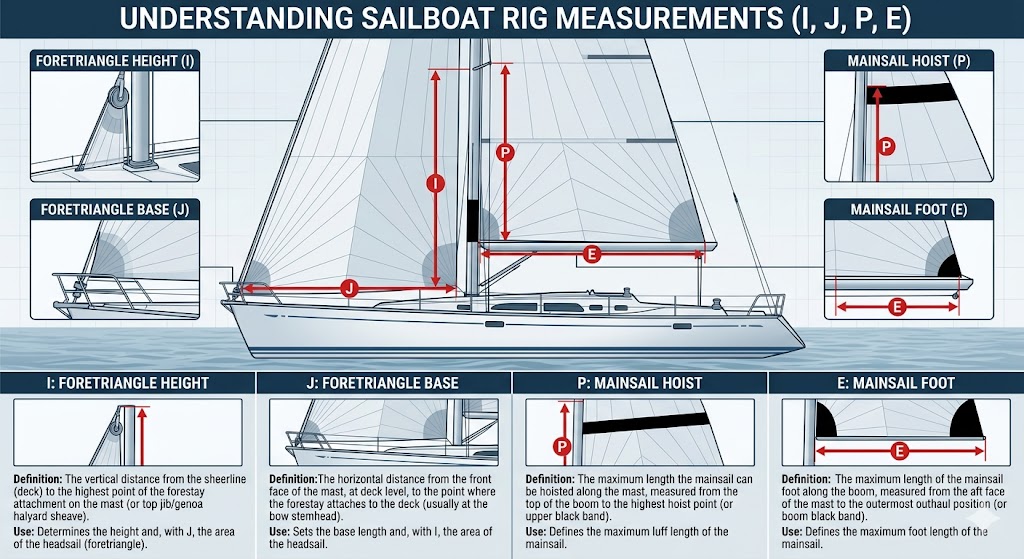
Rig Dimensions
I (Foretriangle Height) 18.00 ft / 5.49 m
J (Foretriangle Base) 4.42 ft / 1.35 m
P (Mainsail Luff) 22.29 ft / 6.79 m
E (Mainsail Foot) 11.12 ft / 3.39 m
SA Fore 39.78 ft² / 3.70 m²
SA Main 123.93 ft² / 11.51 m²
SA Total (100%) 163.71 ft² / 15.21 m²
Est. Forestay Length 18.53 ft / 5.65 m
Find a Rebel 16 For Sale