Back to Search
Quickstep 24
Designer: Ted Brewer  ·  Builder: Stannard Boat Works/C.e. Ryder/Shannon Yachts  ·  First built: 1976
+ Add to Compare
About the Quickstep 24

Designed by renowned naval architect Ted Brewer and built from 1976 to 1989, this compact cruiser represents thoughtful engineering in a trailerable package. With 200 hulls produced across three respected builders—Stannard Boat Works, C.E. Ryder, and Shannon Yachts—the Quickstep 24 earned a solid reputation among small boat cruising enthusiasts. The fiberglass construction features a fin keel with rudder mounted on a skeg, providing good directional stability while maintaining reasonable performance under sail. Brewer's design philosophy emphasized seaworthiness over pure speed, evident in the boat's substantial 4,000-pound displacement and generous 1,900 pounds of ballast. This weight distribution contributes to a reassuring motion in choppy conditions and helps power through moderate seas. The masthead sloop rig with 259 square feet of sail area delivers respectable performance for coastal cruising and weekend adventures. The boat's moderate proportions make it well-suited for small crews or single-handed sailing, while the comfort ratio of 19.17 suggests decent motion characteristics for overnight passages. With a capsize screening formula of 2.0, the Quickstep 24 falls within acceptable parameters for coastal cruising, making it an appealing choice for sailors seeking a manageable boat capable of comfortable short-range cruising with occasional overnight capability.

Market Price Estimate Beta
Small sample size. This estimate is based on fewer than 5 listings and may not be representative of the true market. Use with caution.
$9,500 – $9,500
typical asking price
Median $9,500  ·  2 listings used
All listings
$9,500 – $9,500 2
Rate a listing price
$
About this estimate
  • Prices are based on recent asking prices from public listings — not actual sale prices, which are typically lower.
  • Condition is not factored in. A well-maintained boat with new sails and engine can be worth significantly more than a project boat of the same model.
  • Location affects price. Boats in landlocked states or areas with fewer buyers often sell for less than those on the coast.
  • Year of manufacture is not filtered. Older examples of this model will generally be priced lower than newer ones.
  • Included equipment varies widely. A boat with a full suite of electronics, dodger, and new standing rigging may command a large premium.
  • Outliers are automatically excluded using statistical filtering to improve accuracy, but some bad data may remain.
Core Dimensions
LOA (Length Overall) 23.92 ft / 7.29 m
LWL (Waterline Length) 19.00 ft / 5.79 m
Beam 7.92 ft / 2.41 m
Max Draft 3.37 ft / 1.03 m
Displacement 4,000.00 lb / 1,814 kg
Ballast 1,900.00 lb / 862 kg
Ballast Type Cast lead
Sail Area (Reported) 259.00 ft² / 24.06 m²
Design & Construction
Hull Type Fin with rudder on skeg
Rigging Type Masthead Sloop
Construction FG
Designer Ted Brewer
Builder Stannard Boat Works/C.E. Ryder/Shannon Yachts
First Built 1976
Last Built 1989
Number Built 200
Associations Quickstep Owners Group
Owner Reviews

No owner reviews yet — be the first to share your experience with this boat.
Performance Ratios
PHRF Rating PHRF (Performance Handicap Racing Fleet) is a national racing handicap measured in seconds per nautical mile. Lower values indicate faster boats. Ratings are sourced from US Sailing's national database (median across 60+ regional fleets).
Under 0 — Ultralight racer0–90 — Performance racer90–150 — Cruiser/racer150–210 — Typical cruiserOver 210 — Heavy/slow cruiser
246
SA/Displacement Sail Area to Displacement ratio measures how much sail power a boat has relative to its weight. Higher values mean more performance and speed.
Under 14 — Heavy cruiser, slow14–18 — Cruising sailboat18–22 — Cruiser/racerOver 22 — Performance racer
16.49
Ballast/Displacement Ballast to Displacement ratio shows what percentage of the boat's total weight is ballast. Higher values generally mean better initial stability and stiffer sail carrying.
30–35% — Typical cruiser35–45% — Stiff performance boatOver 45% — Racing oriented
47.5
Displacement/Length Displacement to Length ratio measures how heavy a boat is relative to its waterline length. Lower values mean a lighter, faster boat.
Under 100 — Ultralight racer100–200 — Light cruiser/racer200–300 — Moderate cruiser300–400 — Heavy cruiserOver 400 — Very heavy
260.35
Comfort Ratio Ted Brewer's Comfort Ratio predicts how comfortable a boat will feel in offshore conditions. Higher values mean a steadier, more comfortable motion in a seaway.
Under 20 — Uncomfortably rough20–30 — Acceptable coastal30–40 — Good offshore comfortOver 40 — Very comfortable offshore
19.17
Capsize Screening Formula The USHS Capsize Screening Formula estimates offshore capsize risk. Lower is safer — values under 2.0 are considered acceptable for offshore sailing.
Under 2.0 — Safe for offshore2.0–2.2 — Borderline offshoreOver 2.2 — Coastal use recommended
2
Hull Speed Hull Speed is the theoretical maximum speed of a displacement hull, calculated from waterline length. Most cruising sailboats reach this speed in moderate conditions. 5.84 kn
S# (Speed Number) The Speed Number (S#) is a quick performance index. Higher values indicate a faster, more powerful design relative to its size.
Under 3.0 — Slow cruiser3.0–5.0 — Average cruiser5.0–7.0 — Performance cruiserOver 7.0 — Racer
2.03
Pounds/Inch Immersion Pounds per Inch Immersion (PPI) tells you how much weight is needed to sink the boat one inch. Useful for calculating how additional gear and stores affect waterline. 537.68 pounds/inch
SA/Displacement (Calc) Calculated Sail Area to Displacement ratio using actual measured sail dimensions rather than reported values. More precise than the reported SA/Disp figure. 16.52
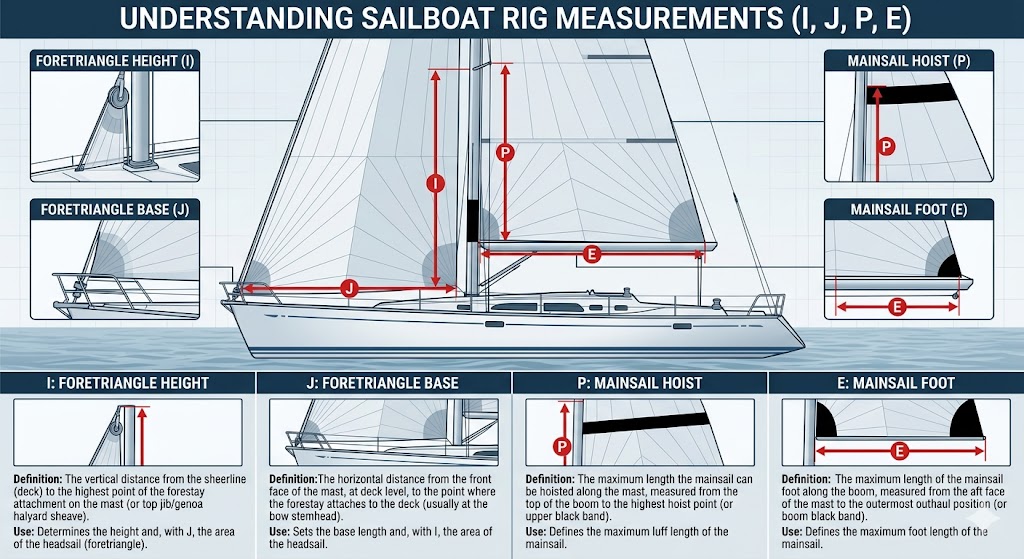
Rig Dimensions
I (Foretriangle Height) 28.30 ft / 8.63 m
J (Foretriangle Base) 9.50 ft / 2.90 m
P (Mainsail Luff) 25.00 ft / 7.62 m
E (Mainsail Foot) 10.00 ft / 3.05 m
SA Fore 134.43 ft² / 12.49 m²
SA Main 125.00 ft² / 11.61 m²
SA Total (100%) 259.43 ft² / 24.10 m²
Est. Forestay Length 29.85 ft / 9.10 m
How It Compares

vs. Cal 2 24, Helms 24, Neptune 24 Fk

This boat Similar boats
Dimensions
LOA
Quickstep 24 ★
23.9 ft
Cal 2 24
24.0 ft
Helms 24
23.9 ft
Neptune 24 Fk
24.0 ft
LWL
Quickstep 24 ★
19.0 ft
Cal 2 24
19.2 ft
Helms 24
20.8 ft
Neptune 24 Fk
21.0 ft
Beam
Quickstep 24 ★
7.9 ft
Cal 2 24
7.8 ft
Helms 24
8.8 ft
Neptune 24 Fk
8.0 ft
Displacement
Quickstep 24 ★
4 lbs
Cal 2 24
3 lbs
Helms 24
4 lbs
Neptune 24 Fk
3 lbs
Ballast
Quickstep 24 ★
1 lbs
Cal 2 24
1 lbs
Helms 24
1 lbs
Neptune 24 Fk
1 lbs
Sail Area
Quickstep 24 ★
259 sq ft
Cal 2 24
271 sq ft
Helms 24
275 sq ft
Neptune 24 Fk
250 sq ft
Performance
PHRF Rating (lower = faster)
Quickstep 24 ★
246 s/nm
Cal 2 24
Helms 24
234 s/nm
Neptune 24 Fk
222 s/nm
SA / Displacement (higher = more powerful)
Quickstep 24 ★
16.5
Cal 2 24
18.2
Helms 24
17.0
Neptune 24 Fk
18.5
Ballast / Disp (higher = stiffer)
Quickstep 24 ★
47.5 %
Cal 2 24
37.8 %
Helms 24
44.1 %
Neptune 24 Fk
Comfort Ratio (higher = more comfortable offshore)
Quickstep 24 ★
19.2
Cal 2 24
18.1
Helms 24
16.4
Neptune 24 Fk
14.2
Capsize Screening (lower = safer)
Quickstep 24 ★
2.00
Cal 2 24
2.01
Helms 24
2.19
Neptune 24 Fk
2.17
Displacement / Length (lower = lighter)
Quickstep 24 ★
260
Cal 2 24
234
Helms 24
207
Neptune 24 Fk
Hull Speed
Quickstep 24 ★
5.8 kts
Cal 2 24
5.9 kts
Helms 24
6.1 kts
Neptune 24 Fk
6.1 kts
Speed Number (higher = faster)
Quickstep 24 ★
2.0
Cal 2 24
2.4
Helms 24
2.6
Neptune 24 Fk
3.3
Find a Quickstep 24 For Sale