Back to Search
Py 23 Paceship
Designer: C. Raymond Hunt Assoc./John Deknatel  ·  Builder: Paceship Yachts (Can)/Amf  ·  First built: 1973
+ Add to Compare
About the Py 23 Paceship

A compact and capable daysailer, the Py 23 Paceship represents the practical tradition of Canadian boat building that Paceship Yachts became known for throughout the mid-twentieth century. Designed with accessibility in mind, this boat appeals to sailors looking for an affordable entry point into keelboat sailing without sacrificing the fundamentals of solid performance on the water. Well suited to protected coastal waters and lake sailing, the Py 23 offers a manageable platform for beginners and intermediate sailors alike. Its modest size makes it easy to single-hand or sail with a small crew, while still providing enough stability and sail area to deliver an engaging experience on the water. Paceship built a reputation for producing well-constructed, no-nonsense sailboats that prioritized reliability and ease of handling, and the Py 23 carries that DNA forward. For buyers researching used boat options in this size range, it represents a practical choice with a proven heritage behind it. Those seeking a low-maintenance weekend sailor for calm coastal cruising or club racing will find the Py 23 worth a closer look.

Core Dimensions
LOA (Length Overall) 22.58 ft / 6.88 m
LWL (Waterline Length) 19.75 ft / 6.02 m
Beam 8.00 ft / 2.44 m
Max Draft 4.75 ft / 1.45 m
Min Draft 1.75 ft / 0.53 m
Displacement 2,460.00 lb / 1,116 kg
Ballast 945.00 lb / 429 kg
Sail Area (Reported) 225.00 ft² / 20.90 m²
Design & Construction
Hull Type Keel/Cbrd.
Rigging Type Masthead Sloop
Construction FG
Designer C. Raymond Hunt Assoc./John Deknatel
Builder Paceship Yachts (CAN)/AMF
First Built 1973
Last Built 1981
Owner Reviews

No owner reviews yet — be the first to share your experience with this boat.
Performance Ratios
SA/Displacement Sail Area to Displacement ratio measures how much sail power a boat has relative to its weight. Higher values mean more performance and speed.
Under 14 — Heavy cruiser, slow14–18 — Cruising sailboat18–22 — Cruiser/racerOver 22 — Performance racer
19.8
Comfort Ratio Ted Brewer's Comfort Ratio predicts how comfortable a boat will feel in offshore conditions. Higher values mean a steadier, more comfortable motion in a seaway.
Under 20 — Uncomfortably rough20–30 — Acceptable coastal30–40 — Good offshore comfortOver 40 — Very comfortable offshore
11.56
Capsize Screening Formula The USHS Capsize Screening Formula estimates offshore capsize risk. Lower is safer — values under 2.0 are considered acceptable for offshore sailing.
Under 2.0 — Safe for offshore2.0–2.2 — Borderline offshoreOver 2.2 — Coastal use recommended
2.37
Hull Speed Hull Speed is the theoretical maximum speed of a displacement hull, calculated from waterline length. Most cruising sailboats reach this speed in moderate conditions. 5.96
S# (Speed Number) The Speed Number (S#) is a quick performance index. Higher values indicate a faster, more powerful design relative to its size.
Under 3.0 — Slow cruiser3.0–5.0 — Average cruiser5.0–7.0 — Performance cruiserOver 7.0 — Racer
3.89
Pounds/Inch Immersion Pounds per Inch Immersion (PPI) tells you how much weight is needed to sink the boat one inch. Useful for calculating how additional gear and stores affect waterline. 564.55
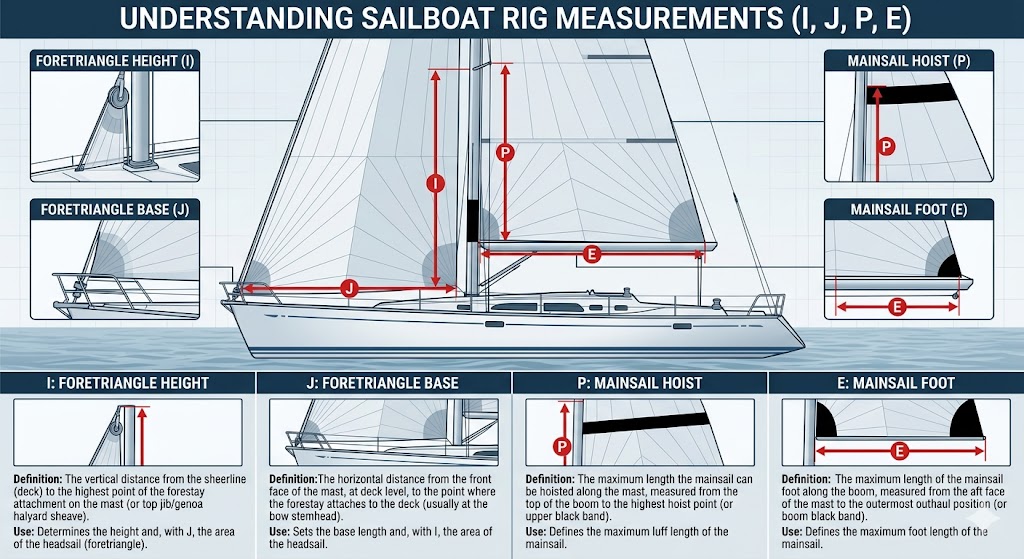
Rig Dimensions
I (Foretriangle Height) 28.0
J (Foretriangle Base) 9.5
P (Mainsail Luff) 24.0
E (Mainsail Foot) 7.7
SA Fore 133.0
SA Main 92.4
Find a Py 23 Paceship For Sale