Back to Search
Pearson 34 2
Designer: William Shaw  ·  Builder: Pearson Yachts  ·  First built: 1989
+ Add to Compare
About the Pearson 34 2

Building on the legacy of Pearson Yachts' original Pearson 34, this evolved design represents the company's continued commitment to practical cruising sailboats during their productive years. Pearson earned a solid reputation for constructing well-built fiberglass vessels that balanced performance with affordability, making sailing accessible to middle-class families throughout the 1970s and 1980s. While detailed specifications remain limited, the Pearson 34 2 likely follows the manufacturer's established philosophy of creating versatile coastal cruisers suitable for weekend adventures and extended cruising alike. Pearson boats typically featured moderate displacement hulls that provided a comfortable motion in varied sea conditions while maintaining respectable sailing performance. The design probably incorporates the practical interior layouts Pearson was known for, maximizing livable space below decks without sacrificing structural integrity. These boats generally appeal to sailors seeking reliable passage-making capabilities rather than cutting-edge racing performance. For prospective buyers researching older production sailboats, the Pearson 34 2 represents the kind of proven platform that many cruising sailors have successfully used for both coastal exploration and longer offshore passages, reflecting the builder's focus on seaworthy, owner-maintainable vessels.

Core Dimensions
LOA (Length Overall) 34.50 ft / 10.52 m
LWL (Waterline Length) 28.17 ft / 8.59 m
Beam 11.50 ft / 3.51 m
Max Draft 4.00 ft / 1.22 m
Displacement 11,800.00 lb / 5,352 kg
Ballast 4,950.00 lb / 2,245 kg
Sail Area (Reported) 550.00 ft² / 51.10 m²
Design & Construction
Hull Type Wing Keel
Rigging Type Masthead Sloop
Construction FG
Designer William Shaw
Builder Pearson Yachts
First Built 1989
Last Built 1991
Owner Reviews

No owner reviews yet — be the first to share your experience with this boat.
Performance Ratios
PHRF Rating PHRF (Performance Handicap Racing Fleet) is a national racing handicap measured in seconds per nautical mile. Lower values indicate faster boats. Ratings are sourced from US Sailing's national database (median across 60+ regional fleets).
Under 0 — Ultralight racer0–90 — Performance racer90–150 — Cruiser/racer150–210 — Typical cruiserOver 210 — Heavy/slow cruiser
146
SA/Displacement Sail Area to Displacement ratio measures how much sail power a boat has relative to its weight. Higher values mean more performance and speed.
Under 14 — Heavy cruiser, slow14–18 — Cruising sailboat18–22 — Cruiser/racerOver 22 — Performance racer
17.04
Comfort Ratio Ted Brewer's Comfort Ratio predicts how comfortable a boat will feel in offshore conditions. Higher values mean a steadier, more comfortable motion in a seaway.
Under 20 — Uncomfortably rough20–30 — Acceptable coastal30–40 — Good offshore comfortOver 40 — Very comfortable offshore
23.45
Capsize Screening Formula The USHS Capsize Screening Formula estimates offshore capsize risk. Lower is safer — values under 2.0 are considered acceptable for offshore sailing.
Under 2.0 — Safe for offshore2.0–2.2 — Borderline offshoreOver 2.2 — Coastal use recommended
2.02
Hull Speed Hull Speed is the theoretical maximum speed of a displacement hull, calculated from waterline length. Most cruising sailboats reach this speed in moderate conditions. 7.11
S# (Speed Number) The Speed Number (S#) is a quick performance index. Higher values indicate a faster, more powerful design relative to its size.
Under 3.0 — Slow cruiser3.0–5.0 — Average cruiser5.0–7.0 — Performance cruiserOver 7.0 — Racer
2.32
Pounds/Inch Immersion Pounds per Inch Immersion (PPI) tells you how much weight is needed to sink the boat one inch. Useful for calculating how additional gear and stores affect waterline. 1.0
Rig Dimensions
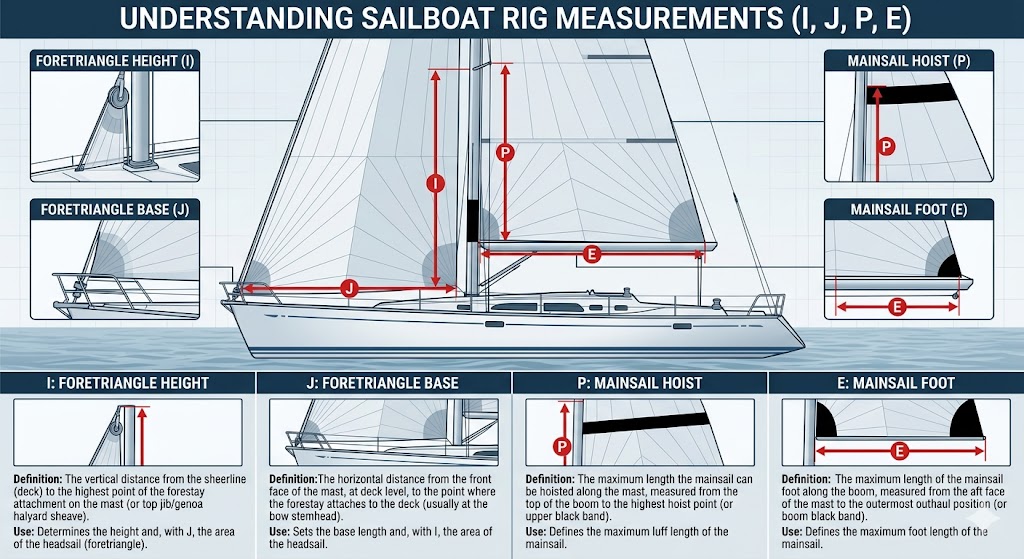
I (Foretriangle Height) 44.25
J (Foretriangle Base) 14.0
P (Mainsail Luff) 38.5
E (Mainsail Foot) 12.5
SA Fore 309.75
SA Main 240.63
Find a Pearson 34 2 For Sale