Back to Search
Pearson 26 Weekender
Designer: William Shaw  ·  Builder: Pearson Yachts (Usa)  ·  First built: 1975
+ Add to Compare
Videos
About the Pearson 26 Weekender

Designed by William Shaw and built by Pearson Yachts from 1975 to 1983, this 26-footer represents a thoughtful approach to affordable coastal cruising during the height of the fiberglass boom. With 300 hulls produced over eight years, the Weekender earned a solid reputation among sailors seeking a capable pocket cruiser that wouldn't break the bank. The boat's fin keel and spade rudder configuration provides responsive handling, while the masthead sloop rig keeps things simple for single-handed or short-handed sailing. At 5,200 pounds displacement with 2,200 pounds of ballast, she strikes a reasonable balance between stability and performance for her size. The fiberglass construction features a balsa-cored deck, which was considered modern engineering for the era and helps reduce weight aloft. Her comfort ratio of 19.65 suggests a relatively stiff, quick motion in a seaway—typical of moderate displacement designs from this period. The capsize screening formula of 2.0 indicates good stability characteristics for coastal and protected water sailing. With 321 square feet of sail area, she offers adequate power for light to moderate conditions while remaining manageable in fresher breezes. This makes the Weekender well-suited for day sailing, weekend coastal cruising, and as an excellent trainer for developing sailing skills.

Core Dimensions
LOA (Length Overall) 26.17 ft / 7.98 m
LWL (Waterline Length) 21.67 ft / 6.61 m
Beam 8.67 ft / 2.64 m
Max Draft 4.00 ft / 1.22 m
Displacement 5,200.00 lb / 2,359 kg
Ballast 2,200.00 lb / 998 kg
Sail Area (Reported) 321.00 ft² / 29.82 m²
Design & Construction
Hull Type Fin w/spade rudder
Rigging Type Masthead Sloop
Construction FG w/balsa cored deck
Designer William Shaw
Builder Pearson Yachts (USA)
First Built 1975
Last Built 1983
Number Built 300
Associations Pearson Yacht Owners Portal
Owner Reviews

No owner reviews yet — be the first to share your experience with this boat.

Known Issues & What to Watch For
High Hull/Deck
The balsa-cored deck is prone to moisture intrusion around deck hardware and chainplates. Once saturated, the balsa core loses structural integrity and produces soft, spongy deck areas that are expensive to repair properly.
Medium Hull/Deck
The deck-to-hull joint on Pearson boats of this era used an external toe rail bolted through the flange. Fastener holes and the joint itself are common water intrusion points, and the aluminum toe rail can corrode and hide underlying laminate damage.
High Keel
The fin keel attachment uses steel keel bolts that are prone to corrosion, particularly where they pass through the wet bilge area. Rust staining around the keel sump and soft or crumbling tabbing around the keel stub are warning signs requiring immediate professional evaluation.
High Hull/Deck
Chainplate backing plates on this model were often small and inadequately glassed in. Over time, the chainplate area can develop stress cracks or delamination in the deck laminate, and the backing plates may have shifted or corroded.
Medium Accommodations
The interior joinery used luan mahogany plywood that is highly susceptible to delamination and rot when exposed to standing bilge water or persistent leaks. Inspect all settee bases, the sole, and any plywood bulkheads carefully.
High Hull/Deck
The rudder on spade-rudder Pearson boats of this period used a fiberglass shell over an internal steel armature. The armature is prone to hidden corrosion, which can cause the rudder shell to crack or delaminate and eventually fail the bearing stock.
Medium Electrical
Wiring in Pearson boats from this era was frequently undersized and used non-tinned copper conductors, which corrode heavily in the marine environment. Wiring in wet areas such as the bilge and near the mast step should be treated as suspect.

Own or have surveyed a Pearson 26 Weekender? Submit a known issue
Performance Ratios
SA/Displacement Sail Area to Displacement ratio measures how much sail power a boat has relative to its weight. Higher values mean more performance and speed.
Under 14 — Heavy cruiser, slow14–18 — Cruising sailboat18–22 — Cruiser/racerOver 22 — Performance racer
17.16
Ballast/Displacement Ballast to Displacement ratio shows what percentage of the boat's total weight is ballast. Higher values generally mean better initial stability and stiffer sail carrying.
30–35% — Typical cruiser35–45% — Stiff performance boatOver 45% — Racing oriented
42.31
Displacement/Length Displacement to Length ratio measures how heavy a boat is relative to its waterline length. Lower values mean a lighter, faster boat.
Under 100 — Ultralight racer100–200 — Light cruiser/racer200–300 — Moderate cruiser300–400 — Heavy cruiserOver 400 — Very heavy
228.13
Comfort Ratio Ted Brewer's Comfort Ratio predicts how comfortable a boat will feel in offshore conditions. Higher values mean a steadier, more comfortable motion in a seaway.
Under 20 — Uncomfortably rough20–30 — Acceptable coastal30–40 — Good offshore comfortOver 40 — Very comfortable offshore
19.65
Capsize Screening Formula The USHS Capsize Screening Formula estimates offshore capsize risk. Lower is safer — values under 2.0 are considered acceptable for offshore sailing.
Under 2.0 — Safe for offshore2.0–2.2 — Borderline offshoreOver 2.2 — Coastal use recommended
2
Hull Speed Hull Speed is the theoretical maximum speed of a displacement hull, calculated from waterline length. Most cruising sailboats reach this speed in moderate conditions. 6.24 kn
S# (Speed Number) The Speed Number (S#) is a quick performance index. Higher values indicate a faster, more powerful design relative to its size.
Under 3.0 — Slow cruiser3.0–5.0 — Average cruiser5.0–7.0 — Performance cruiserOver 7.0 — Racer
2.41
Pounds/Inch Immersion Pounds per Inch Immersion (PPI) tells you how much weight is needed to sink the boat one inch. Useful for calculating how additional gear and stores affect waterline. 671.31 pounds/inch
SA/Displacement (Calc) Calculated Sail Area to Displacement ratio using actual measured sail dimensions rather than reported values. More precise than the reported SA/Disp figure. 17.2
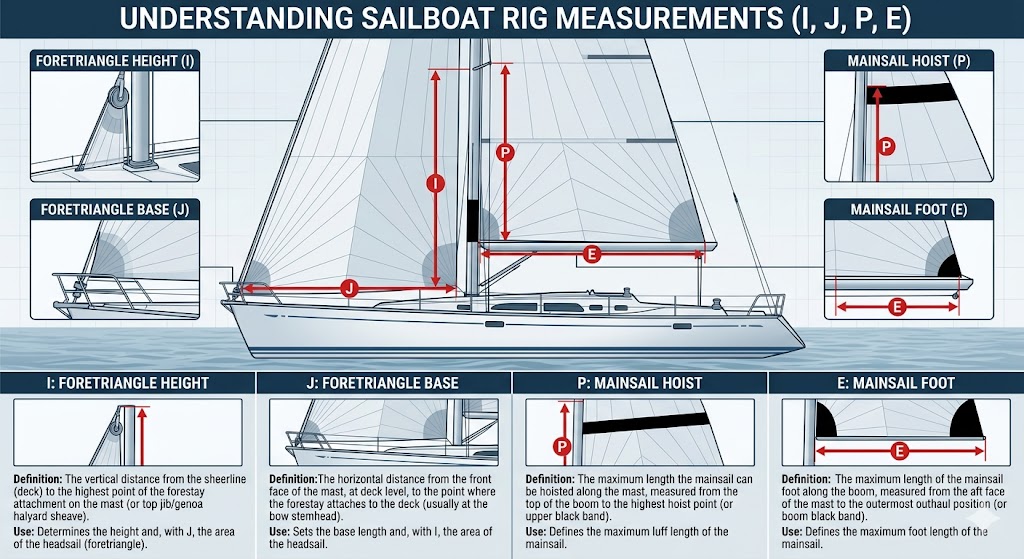
Rig Dimensions
I (Foretriangle Height) 31.50 ft / 9.60 m
J (Foretriangle Base) 11.70 ft / 3.57 m
P (Mainsail Luff) 27.50 ft / 8.38 m
E (Mainsail Foot) 10.00 ft / 3.05 m
SA Fore 184.28 ft² / 17.12 m²
SA Main 137.50 ft² / 12.77 m²
SA Total (100%) 321.78 ft² / 29.89 m²
Est. Forestay Length 33.60 ft / 10.24 m
Mast Height (DWL) 35.16 ft / 10.72 m
Find a Pearson 26 Weekender For Sale