Back to Search
Pearson 10M
Designer: William Shaw  ·  Builder: Pearson Yachts (Usa)  ·  First built: 1973
+ Add to Compare
Videos
About the Pearson 10M

Built during Pearson Yachts' golden era from 1973 to 1981, this William Shaw-designed 33-footer represents classic American cruising sailboat design with 230 hulls launched. The moderate displacement hull features a traditional fin keel with rudder on skeg configuration, providing excellent directional stability and balanced helm characteristics that made Pearson boats beloved by cruising sailors. With a masthead sloop rig and generous sail area, the 10M delivers respectable performance while maintaining the forgiving sailing characteristics Pearson was known for. The fiberglass construction with balsa-cored deck offers a good strength-to-weight ratio, while the substantial ballast-to-displacement ratio contributes to impressive stability and seaworthiness. The boat's moderate beam and draft make it suitable for most East Coast harbors while providing enough interior volume for comfortable cruising. Her conservative design philosophy prioritizes safety and ease of handling over outright speed, making this an excellent choice for coastal cruising and intermediate offshore passages. The 10M's reputation for solid construction and predictable handling has kept these boats popular in the used market, particularly among sailors seeking a traditional American cruiser with proven blue-water capabilities and reasonable maintenance requirements.

Market Price Estimate Beta
Small sample size. This estimate is based on fewer than 5 listings and may not be representative of the true market. Use with caution.
$5,000 – $9,999
typical asking price
Median $7,500  ·  3 listings used
All listings
$5,000 – $9,999 3
Rate a listing price
$
About this estimate
  • Prices are based on recent asking prices from public listings — not actual sale prices, which are typically lower.
  • Condition is not factored in. A well-maintained boat with new sails and engine can be worth significantly more than a project boat of the same model.
  • Location affects price. Boats in landlocked states or areas with fewer buyers often sell for less than those on the coast.
  • Year of manufacture is not filtered. Older examples of this model will generally be priced lower than newer ones.
  • Included equipment varies widely. A boat with a full suite of electronics, dodger, and new standing rigging may command a large premium.
  • Outliers are automatically excluded using statistical filtering to improve accuracy, but some bad data may remain.
Core Dimensions
LOA (Length Overall) 33.04 ft / 10.07 m
LWL (Waterline Length) 28.33 ft / 8.63 m
Beam 11.00 ft / 3.35 m
Max Draft 5.92 ft / 1.80 m
Displacement 12,441.00 lb / 5,643 kg
Ballast 5,445.00 lb / 2,470 kg
Ballast Type Lead
Sail Area (Reported) 524.00 ft² / 48.68 m²
Design & Construction
Hull Type Fin with rudder on skeg
Rigging Type Masthead Sloop
Construction FG w/balsa cored deck
Designer William Shaw
Builder Pearson Yachts (USA)
First Built 1973
Last Built 1981
Number Built 230
Associations Pearson 10M
Owner Reviews

No owner reviews yet — be the first to share your experience with this boat.

Known Issues & What to Watch For
High Hull/Deck
The balsa-cored deck is prone to water intrusion around chainplates, stanchion bases, and deck hardware. Once saturated, the balsa core loses structural integrity and widespread soft spots develop, requiring costly core replacement.
Medium Hull/Deck
The deck-to-hull joint on Pearson boats of this era uses an outward-turning flange bolted and bedded through a toerail. The bedding compound dries out over time, allowing water intrusion into the joint and initiating delamination along the flange.
High Keel
The encapsulated or externally bolted fin keel on early production boats used mild steel keel bolts that are susceptible to corrosion. Rusty staining in the bilge near the keel sump is a warning sign and bolts should be inspected or replaced.
High Hull/Deck
Chainplate knees and backing plates on this model are glassed into the hull liner, making direct inspection difficult. Chainplate-to-deck interface is a known water entry point and the underlying structure can be significantly deteriorated before external signs appear.
Medium Accommodations
Pearson used a molded fiberglass interior liner system on this model that can separate from the hull shell over time. This creates voids that trap moisture, promote mildew, and make bilge access and wiring inspection very difficult.
Medium Engine
Many Pearson 10M boats were delivered with the Universal Atomic 4 gasoline inboard. This engine is now very old and carburetor parts, fuel system components, and exhaust manifolds are problematic. Verify whether conversion to diesel has been done, and if not, budget accordingly.
1973–1978 models
Medium Electrical
Original wiring from the 1970s production runs is typically undersized aluminum or early copper with degraded insulation. Pearson's wiring of this era was not routed to ABYC standards and partial rewiring or full replacement is commonly needed on unrestored boats.
1973–1978 models
High Rigging
The chainplates on this model pass through the deck and are bedded in a known trouble spot. Crevice corrosion at the deck level on stainless chainplates is common and may not be visible without removing interior trim to inspect the full plate.

Own or have surveyed a Pearson 10M? Submit a known issue
Performance Ratios
PHRF Rating PHRF (Performance Handicap Racing Fleet) is a national racing handicap measured in seconds per nautical mile. Lower values indicate faster boats. Ratings are sourced from US Sailing's national database (median across 60+ regional fleets).
Under 0 — Ultralight racer0–90 — Performance racer90–150 — Cruiser/racer150–210 — Typical cruiserOver 210 — Heavy/slow cruiser
147
SA/Displacement Sail Area to Displacement ratio measures how much sail power a boat has relative to its weight. Higher values mean more performance and speed.
Under 14 — Heavy cruiser, slow14–18 — Cruising sailboat18–22 — Cruiser/racerOver 22 — Performance racer
15.67
Ballast/Displacement Ballast to Displacement ratio shows what percentage of the boat's total weight is ballast. Higher values generally mean better initial stability and stiffer sail carrying.
30–35% — Typical cruiser35–45% — Stiff performance boatOver 45% — Racing oriented
43.77
Displacement/Length Displacement to Length ratio measures how heavy a boat is relative to its waterline length. Lower values mean a lighter, faster boat.
Under 100 — Ultralight racer100–200 — Light cruiser/racer200–300 — Moderate cruiser300–400 — Heavy cruiserOver 400 — Very heavy
244.27
Comfort Ratio Ted Brewer's Comfort Ratio predicts how comfortable a boat will feel in offshore conditions. Higher values mean a steadier, more comfortable motion in a seaway.
Under 20 — Uncomfortably rough20–30 — Acceptable coastal30–40 — Good offshore comfortOver 40 — Very comfortable offshore
26.52
Capsize Screening Formula The USHS Capsize Screening Formula estimates offshore capsize risk. Lower is safer — values under 2.0 are considered acceptable for offshore sailing.
Under 2.0 — Safe for offshore2.0–2.2 — Borderline offshoreOver 2.2 — Coastal use recommended
1.9
Hull Speed Hull Speed is the theoretical maximum speed of a displacement hull, calculated from waterline length. Most cruising sailboats reach this speed in moderate conditions. 7.13 kn
S# (Speed Number) The Speed Number (S#) is a quick performance index. Higher values indicate a faster, more powerful design relative to its size.
Under 3.0 — Slow cruiser3.0–5.0 — Average cruiser5.0–7.0 — Performance cruiserOver 7.0 — Racer
2.1
Pounds/Inch Immersion Pounds per Inch Immersion (PPI) tells you how much weight is needed to sink the boat one inch. Useful for calculating how additional gear and stores affect waterline. 1,113.49 pounds/inch
SA/Displacement (Calc) Calculated Sail Area to Displacement ratio using actual measured sail dimensions rather than reported values. More precise than the reported SA/Disp figure. 15.67
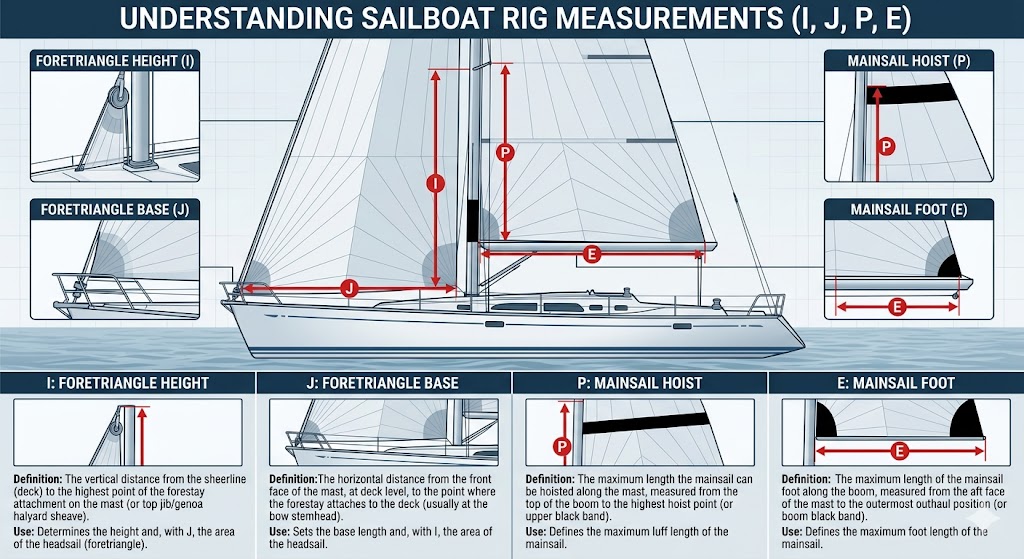
Rig Dimensions
I (Foretriangle Height) 44.00 ft / 13.41 m
J (Foretriangle Base) 14.20 ft / 4.33 m
P (Mainsail Luff) 38.50 ft / 11.73 m
E (Mainsail Foot) 11.00 ft / 3.35 m
SPL/TPS 14.20 ft / 4.33 m
SA Fore 312.40 ft² / 29.02 m²
SA Main 211.75 ft² / 19.67 m²
SA Total (100%) 524.15 ft² / 48.70 m²
Est. Forestay Length 46.23 ft / 14.09 m
Mast Height (DWL) 48.00 ft / 14.63 m
Engine & Accommodations
Engine Make Universal
Engine Model Atomic 4
Engine Type Gas
Fuel Capacity 20 gals / 76 L
Water Capacity 40 gals / 151 L
Find a Pearson 10M For Sale