Back to Search
Niagara 35
Designer: Mark Ellis  ·  Builder: Hinterhoeller Yachts Ltd. (Can)  ·  First built: 1978
+ Add to Compare
About the Niagara 35

Developed by Canadian designer Mark Ellis and built by Hinterhoeller Yachts in Ontario, the Niagara 35 earned a strong reputation as a capable and comfortable cruising sailboat that resonated particularly well with North American sailors seeking a reliable bluewater companion. Introduced in the late 1970s, it became one of the more respected production cruisers to emerge from Canada during that era. Known for its well-balanced hull and seaworthy disposition, the Niagara 35 is well suited to coastal and offshore cruising, offering the kind of confident, predictable handling that appeals to both experienced sailors and those stepping up to bluewater passages for the first time. The design prioritizes comfort and practicality without sacrificing sailing performance, making it a practical choice for extended passages or liveaboard use. The boat developed a loyal following over the years, and a healthy number of examples remain actively sailed today — a testament to the quality of construction and the enduring appeal of the design. Prospective buyers researching the Niagara 35 will generally find a well-regarded hull with a strong owners community behind it.

Market Price Estimate Beta
Small sample size. This estimate is based on fewer than 5 listings and may not be representative of the true market. Use with caution.
$60,000 – $60,000
typical asking price
Median $60,000  ·  2 listings used
All listings
$60,000 – $60,000 2
Rate a listing price
$
About this estimate
  • Prices are based on recent asking prices from public listings — not actual sale prices, which are typically lower.
  • Condition is not factored in. A well-maintained boat with new sails and engine can be worth significantly more than a project boat of the same model.
  • Location affects price. Boats in landlocked states or areas with fewer buyers often sell for less than those on the coast.
  • Year of manufacture is not filtered. Older examples of this model will generally be priced lower than newer ones.
  • Included equipment varies widely. A boat with a full suite of electronics, dodger, and new standing rigging may command a large premium.
  • Outliers are automatically excluded using statistical filtering to improve accuracy, but some bad data may remain.
Core Dimensions
LOA (Length Overall) 35.08 ft / 10.69 m
LWL (Waterline Length) 26.67 ft / 8.13 m
Beam 11.42 ft / 3.48 m
Max Draft 5.17 ft / 1.58 m
Displacement 14,000.00 lb / 6,350 kg
Ballast 5,500.00 lb / 2,495 kg
Ballast Type Lead
Design & Construction
Hull Type Fin w/spade rudder
Rigging Type Masthead Sloop
Construction FG w/balsa cored hull & deck
Designer Mark Ellis
Builder Hinterhoeller Yachts Ltd. (CAN)
First Built 1978
Last Built 1990
Number Built 260
Owner Reviews

No owner reviews yet — be the first to share your experience with this boat.

Known Issues & What to Watch For
High Hull/Deck
The balsa core in the deck is prone to water saturation, particularly around deck hardware, chainplates, and stanchion bases where bedding compounds fail. Saturated balsa loses structural integrity and can be widespread before detection. Tap testing and moisture metering of the entire deck is essential.
High Hull/Deck
The balsa-cored hull topsides, used by Hinterhoeller during this period, can develop delamination if water intrusion occurs at through-hull fittings or damaged gel coat. Tap the hull carefully from waterline upward for any hollow sounds indicating core separation.
Medium Hull/Deck
The deck-to-hull joint on Hinterhoeller boats of this era uses an inward-turning flange bonded and through-bolted, covered by the toerail. The toerail fasteners and sealant can fail, allowing water intrusion into the joint. Inspect the toerail attachment points carefully for weeping or staining below.
High Keel
The fin keel attachment on early Niagara 35s uses internal keel bolts that are susceptible to corrosion, particularly if the bilge is allowed to remain wet. The keel sump area should be inspected closely for rust staining, weeping around bolt heads, and any signs of movement or cracking in the tabbing around the keel stub.
1978–1984 models
High Rigging
The chainplate knees on the Niagara 35 are glassed into the hull liner and are difficult to inspect fully. Water can track down the shrouds and into the deck penetrations, rotting the balsa core around the chainplate area and potentially compromising the chainplate-to-hull bond over time.
Medium Hull/Deck
The spade rudder shaft bearing and gudgeon area is known to develop slop with age, resulting in excessive rudder play. Inspect for bearing wear at both the upper rudder tube exit and the lower pintle, as a sloppy rudder on this design can make the boat difficult to control in heavy weather.
Medium Accommodations
The interior liner on Hinterhoeller-built boats of this period is a one-piece molded pan that traps moisture and debris underneath it. Bilge water and condensation that gets beneath the liner is impossible to dry out and can cause hidden fiberglass degradation and persistent odor. Inspect bilge access points for signs of standing water.
Medium Engine
Many Niagara 35s were fitted with the Universal Atomic 4 gasoline engine or early small Westerbeke/Universal diesel inboards. Boats with the Atomic 4 often had aging fuel systems and carburetors; verify whether the original engine remains or has been replaced with a diesel conversion, which is common and generally preferable.
1978–1983 models
Low Hull/Deck
The anchor locker on the foredeck is not fully isolated from the forward cabin on many examples, allowing water and odors to migrate below. Check the forward bulkhead and locker drain for proper sealing and that the drain is not blocked, which can allow the locker to fill and leak below decks.

Own or have surveyed a Niagara 35? Submit a known issue
Performance Ratios
PHRF Rating PHRF (Performance Handicap Racing Fleet) is a national racing handicap measured in seconds per nautical mile. Lower values indicate faster boats. Ratings are sourced from US Sailing's national database (median across 60+ regional fleets).
Under 0 — Ultralight racer0–90 — Performance racer90–150 — Cruiser/racer150–210 — Typical cruiserOver 210 — Heavy/slow cruiser
156
Ballast/Displacement Ballast to Displacement ratio shows what percentage of the boat's total weight is ballast. Higher values generally mean better initial stability and stiffer sail carrying.
30–35% — Typical cruiser35–45% — Stiff performance boatOver 45% — Racing oriented
39.29
Displacement/Length Displacement to Length ratio measures how heavy a boat is relative to its waterline length. Lower values mean a lighter, faster boat.
Under 100 — Ultralight racer100–200 — Light cruiser/racer200–300 — Moderate cruiser300–400 — Heavy cruiserOver 400 — Very heavy
329.47
Pounds/Inch Immersion Pounds per Inch Immersion (PPI) tells you how much weight is needed to sink the boat one inch. Useful for calculating how additional gear and stores affect waterline. 6.53 pounds/inch
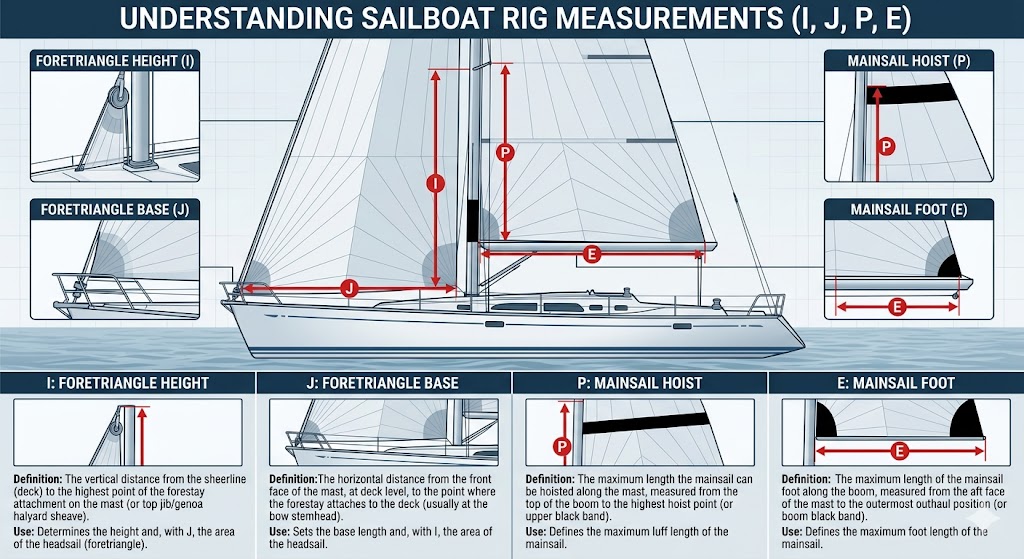
Rig Dimensions
I (Foretriangle Height) 16.53
J (Foretriangle Base) 16.00 ft / 4.88 m
P (Mainsail Luff) 598.00 ft² / 55.56 m²
E (Mainsail Foot) Universal
Engine & Accommodations
Horsepower 35
Fuel Capacity 30 gals / 114 L
Water Capacity 80 gals / 303 L
How It Compares

vs. Cal 35 1979, Santana 35

This boat Similar boats
Dimensions
LOA
Niagara 35 ★
35.1 ft
Cal 35 1979
35.1 ft
Santana 35
35.0 ft
LWL
Niagara 35 ★
26.7 ft
Cal 35 1979
28.8 ft
Santana 35
26.5 ft
Beam
Niagara 35 ★
11.4 ft
Cal 35 1979
11.0 ft
Santana 35
11.9 ft
Displacement
Niagara 35 ★
14 lbs
Cal 35 1979
13 lbs
Santana 35
8 lbs
Ballast
Niagara 35 ★
5 lbs
Cal 35 1979
5 lbs
Santana 35
3 lbs
Performance
PHRF Rating (lower = faster)
Niagara 35 ★
156 s/nm
Cal 35 1979
Santana 35
120 s/nm
Ballast / Disp (higher = stiffer)
Niagara 35 ★
39.3 %
Cal 35 1979
40.0 %
Santana 35
Displacement / Length (lower = lighter)
Niagara 35 ★
329
Cal 35 1979
244
Santana 35
Find a Niagara 35 For Sale