Back to Search
Morgan Out Island 49
Designer: Charles Morgan  ·  Builder: Morgan Yachts (Usa)  ·  First built: 1976
+ Add to Compare
Videos
About the Morgan Out Island 49

Launched in 1976 as one of Charles Morgan's larger cruising designs, this substantial ketch represents the era when American builders prioritized comfort and seaworthiness over racing performance. With only six hulls produced, the Out Island 49 stands as a rare example of Morgan's approach to serious bluewater cruising. The masthead ketch rig provides excellent sail handling options for offshore passages, while the long keel configuration delivers the directional stability and gentle motion that made Morgan designs popular among long-distance cruisers. At 43,000 pounds displacement, this is a solidly built vessel that won't be pushed around by heavy weather, though the substantial weight does limit performance in light air. The impressive comfort ratio of 40.28 indicates a boat designed for extended living aboard, with the motion characteristics that make ocean passages more pleasant. The moderate sail area to displacement ratio suggests this isn't a speed demon, but rather a steady performer that prioritizes safety and comfort over raw performance. Morgan's fiberglass construction was well-regarded during this period, and the long keel design offers excellent tracking and the ability to take the ground safely. For serious cruising sailors seeking a capable offshore platform with classic character, the Out Island 49 represents old-school American cruising yacht philosophy at its most substantial.

Core Dimensions
LOA (Length Overall) 49.00 ft / 14.94 m
LWL (Waterline Length) 43.00 ft / 13.11 m
Beam 15.00 ft / 4.57 m
Max Draft 5.30 ft / 1.62 m
Displacement 43,000.00 lb / 19,504 kg
Sail Area (Reported) 914.00 ft² / 84.91 m²
Design & Construction
Hull Type Long Keel
Rigging Type Masthead Ketch
Construction FG
Designer Charles Morgan
Builder Morgan Yachts (USA)
First Built 1976
Number Built 6
Owner Reviews

No owner reviews yet — be the first to share your experience with this boat.

Known Issues & What to Watch For
High Hull/Deck
The deck-to-hull joint on Morgan Out Island series boats uses an external aluminum toerail that also serves as the clamping mechanism for the hull-deck joint. This joint is prone to weeping and water intrusion, particularly at fastener points, leading to core saturation in the deck edges.
High Hull/Deck
The balsa core used extensively in the deck and cockpit areas of the Out Island 49 is highly susceptible to water intrusion and rot, particularly around deck hardware, chainplates, and stanchion bases. Wet core areas are frequently found and can be widespread.
High Keel
The full keel on the Out Island 49 was attached using large keel bolts that are prone to corrosion and weeping at the keel-to-hull interface. The interior bilge area near the keel sump should be carefully inspected for rust staining, soft laminate, and signs of movement.
Medium Hull/Deck
The large trunk cabin with numerous port lights was known to develop leaks at the port frames as the bedding compound ages. Water intrusion behind the cabin liner is common and can go undetected, causing hidden fiberglass and wood framing deterioration.
High Rigging
The chainplate knees on the Out Island 49 are glassed to the interior liner rather than through-bolted to primary structural members on some builds, making them a structural concern. Chainplate backing plates and attachment points should be thoroughly inspected for movement, cracking, or gelcoat stress fractures.
Low Accommodations
The interior wood joinery, often teak, is held in place partially by the liner system and is prone to delaminating from the hull liner as adhesives and fasteners fail with age. Significant areas of loose or detached joinery are common on boats of this vintage.
Medium Engine
The Out Island 49 was typically fitted with a Perkins 4-108 or similar older diesel. The engine beds on Morgan boats of this era were known to be lightly constructed and can develop softness or delamination, leading to engine alignment problems and excessive vibration.
Medium Hull/Deck
The cockpit sole and bridgedeck area frequently show evidence of delamination and wet balsa core due to the large flat areas and numerous through-cockpit fasteners. Sounding the cockpit sole carefully with a mallet is essential.
High Electrical
Wiring on Morgan Out Island boats of this era is typically undersized aluminum or early tin-plated copper that has corroded and become brittle. The original DC wiring harnesses are often in poor condition and may present fire or failure risks, and a full rewire is commonly required.

Own or have surveyed a Morgan Out Island 49? Submit a known issue
Performance Ratios
SA/Displacement Sail Area to Displacement ratio measures how much sail power a boat has relative to its weight. Higher values mean more performance and speed.
Under 14 — Heavy cruiser, slow14–18 — Cruising sailboat18–22 — Cruiser/racerOver 22 — Performance racer
11.97
Displacement/Length Displacement to Length ratio measures how heavy a boat is relative to its waterline length. Lower values mean a lighter, faster boat.
Under 100 — Ultralight racer100–200 — Light cruiser/racer200–300 — Moderate cruiser300–400 — Heavy cruiserOver 400 — Very heavy
241.44
Comfort Ratio Ted Brewer's Comfort Ratio predicts how comfortable a boat will feel in offshore conditions. Higher values mean a steadier, more comfortable motion in a seaway.
Under 20 — Uncomfortably rough20–30 — Acceptable coastal30–40 — Good offshore comfortOver 40 — Very comfortable offshore
40.28
Capsize Screening Formula The USHS Capsize Screening Formula estimates offshore capsize risk. Lower is safer — values under 2.0 are considered acceptable for offshore sailing.
Under 2.0 — Safe for offshore2.0–2.2 — Borderline offshoreOver 2.2 — Coastal use recommended
1.72
Hull Speed Hull Speed is the theoretical maximum speed of a displacement hull, calculated from waterline length. Most cruising sailboats reach this speed in moderate conditions. 8.79 kn
S# (Speed Number) The Speed Number (S#) is a quick performance index. Higher values indicate a faster, more powerful design relative to its size.
Under 3.0 — Slow cruiser3.0–5.0 — Average cruiser5.0–7.0 — Performance cruiserOver 7.0 — Racer
1.7
Pounds/Inch Immersion Pounds per Inch Immersion (PPI) tells you how much weight is needed to sink the boat one inch. Useful for calculating how additional gear and stores affect waterline. 2,304.66 pounds/inch
SA/Displacement (Calc) Calculated Sail Area to Displacement ratio using actual measured sail dimensions rather than reported values. More precise than the reported SA/Disp figure. 11.97
Rig Dimensions
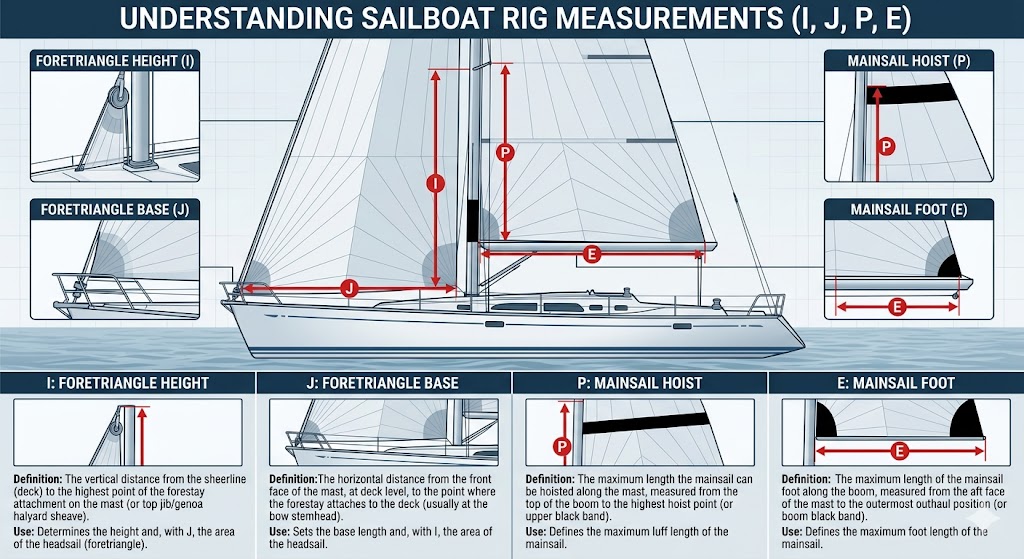
I (Foretriangle Height) 58.00 ft / 17.68 m
J (Foretriangle Base) 17.30 ft / 5.27 m
P (Mainsail Luff) 50.00 ft / 15.24 m
E (Mainsail Foot) 16.50 ft / 5.03 m
SA Fore 501.70 ft² / 46.61 m²
SA Main 412.50 ft² / 38.32 m²
SA Total (100%) 914.20 ft² / 84.93 m²
Est. Forestay Length 60.53 ft / 18.45 m
Find a Morgan Out Island 49 For Sale