Back to Search
Morgan 42 2
Designer: Charles Morgan  ·  Builder: Morgan Yachts (Usa)  ·  First built: 1969
+ Add to Compare
Videos
About the Morgan 42 2

Introduced in 1969 by renowned designer Charles Morgan, this classic 42-footer represents the golden era of American fiberglass yacht construction. Built by Morgan Yachts during a time when the company was establishing its reputation for solid, seaworthy cruising sailboats, the Morgan 42 2 became a popular choice among serious coastal and offshore cruisers. The design features a traditional fin keel with rudder mounted on a skeg, providing excellent directional stability and balanced helm characteristics that make extended passages more comfortable. With a displacement of 18,500 pounds and substantial ballast of 8,700 pounds, this masthead sloop offers the stability and sea-kindly motion that cruising sailors appreciate in challenging conditions. The boat's moderate sail area of 767 square feet and SA/Displacement ratio of 17.61 indicate a design optimized for steady progress rather than racing performance. The comfort ratio of 32.56 confirms the Morgan 42 2's suitability for extended cruising, while the capsize screening formula of 1.74 suggests good offshore capability when properly handled. Many examples of this model have completed extensive ocean passages, testament to Charles Morgan's focus on creating robust, reliable cruising platforms that prioritize safety and comfort over speed.

Core Dimensions
LOA (Length Overall) 42.00 ft / 12.80 m
LWL (Waterline Length) 30.50 ft / 9.30 m
Beam 11.50 ft / 3.51 m
Max Draft 6.00 ft / 1.83 m
Displacement 18,500.00 lb / 8,391 kg
Ballast 8,700.00 lb / 3,946 kg
Ballast Type Lead
Sail Area (Reported) 767.00 ft² / 71.26 m²
Design & Construction
Hull Type Fin with rudder on skeg
Rigging Type Masthead Sloop
Construction FG
Designer Charles Morgan
Builder Morgan Yachts (USA)
First Built 1969
Owner Reviews

No owner reviews yet — be the first to share your experience with this boat.

Known Issues & What to Watch For
High Hull/Deck
Morgan's deck-to-hull joint on early production boats used a through-bolted external aluminum toe rail to clamp the joint, which is prone to leaking as the sealant ages. Water intrusion into the joint can cause delamination of the deck core (balsa or foam) along the entire perimeter.
early 1970s production
High Hull/Deck
Balsa-cored decks used by Morgan during this era are prone to core rot around any deck hardware penetration where bedding compound has failed. Chainplates, stanchion bases, and winch pads are especially vulnerable and should be probed and sounded carefully.
High Keel
The encapsulated lead or cast iron keel attachment on the Morgan 42 can develop weeping at the keel-to-hull joint, allowing water intrusion that is difficult to detect from inside. The keel sump area should be inspected for rust staining or soft laminate indicating water tracking up through the joint.
High Rigging
The chainplate knees on these boats are glassed into the hull liner and are difficult to inspect. Morgan's glassing schedule for chainplate backing was sometimes inadequate, leading to chainplate pull-through failure under heavy sailing loads. Compression cracks in the liner near chainplates are a warning sign.
Medium Hull/Deck
The skeg-mounted rudder on this model is known to develop bearing slop over time; the gudgeons and pintles corrode and the skeg itself can develop cracks at its root where it meets the hull, especially if the boat has experienced grounding.
Medium Accommodations
Morgan's interior liner system on these boats is bonded in sections and was prone to separating from the hull, creating voids and damp pockets that are difficult to dry out and can mask structural issues beneath. Check for soft spots or movement in the liner panels.
Medium Electrical
Original wiring from the late 1960s and early 1970s Morgan boats commonly used aluminum wiring in some runs and undersized conductors by modern standards. Most boats this age have had partial rewiring that may be patchwork; a full wiring audit is strongly recommended.
pre-1975 production
Medium Engine
Many Morgan 42s of this vintage were originally fitted with gasoline engines (Universal or Palmer), and while many have been converted to diesel, the engine compartment ventilation and fuel system may not have been brought up to current ABYC standards during conversion. Verify fuel tank material, age, and fill/vent routing.

Own or have surveyed a Morgan 42 2? Submit a known issue
Performance Ratios
SA/Displacement Sail Area to Displacement ratio measures how much sail power a boat has relative to its weight. Higher values mean more performance and speed.
Under 14 — Heavy cruiser, slow14–18 — Cruising sailboat18–22 — Cruiser/racerOver 22 — Performance racer
17.61
Ballast/Displacement Ballast to Displacement ratio shows what percentage of the boat's total weight is ballast. Higher values generally mean better initial stability and stiffer sail carrying.
30–35% — Typical cruiser35–45% — Stiff performance boatOver 45% — Racing oriented
47.03
Displacement/Length Displacement to Length ratio measures how heavy a boat is relative to its waterline length. Lower values mean a lighter, faster boat.
Under 100 — Ultralight racer100–200 — Light cruiser/racer200–300 — Moderate cruiser300–400 — Heavy cruiserOver 400 — Very heavy
291.09
Comfort Ratio Ted Brewer's Comfort Ratio predicts how comfortable a boat will feel in offshore conditions. Higher values mean a steadier, more comfortable motion in a seaway.
Under 20 — Uncomfortably rough20–30 — Acceptable coastal30–40 — Good offshore comfortOver 40 — Very comfortable offshore
32.56
Capsize Screening Formula The USHS Capsize Screening Formula estimates offshore capsize risk. Lower is safer — values under 2.0 are considered acceptable for offshore sailing.
Under 2.0 — Safe for offshore2.0–2.2 — Borderline offshoreOver 2.2 — Coastal use recommended
1.74
Hull Speed Hull Speed is the theoretical maximum speed of a displacement hull, calculated from waterline length. Most cruising sailboats reach this speed in moderate conditions. 7.40 kn
S# (Speed Number) The Speed Number (S#) is a quick performance index. Higher values indicate a faster, more powerful design relative to its size.
Under 3.0 — Slow cruiser3.0–5.0 — Average cruiser5.0–7.0 — Performance cruiserOver 7.0 — Racer
1.86
Pounds/Inch Immersion Pounds per Inch Immersion (PPI) tells you how much weight is needed to sink the boat one inch. Useful for calculating how additional gear and stores affect waterline. 1,253.27 pounds/inch
SA/Displacement (Calc) Calculated Sail Area to Displacement ratio using actual measured sail dimensions rather than reported values. More precise than the reported SA/Disp figure. 17.6
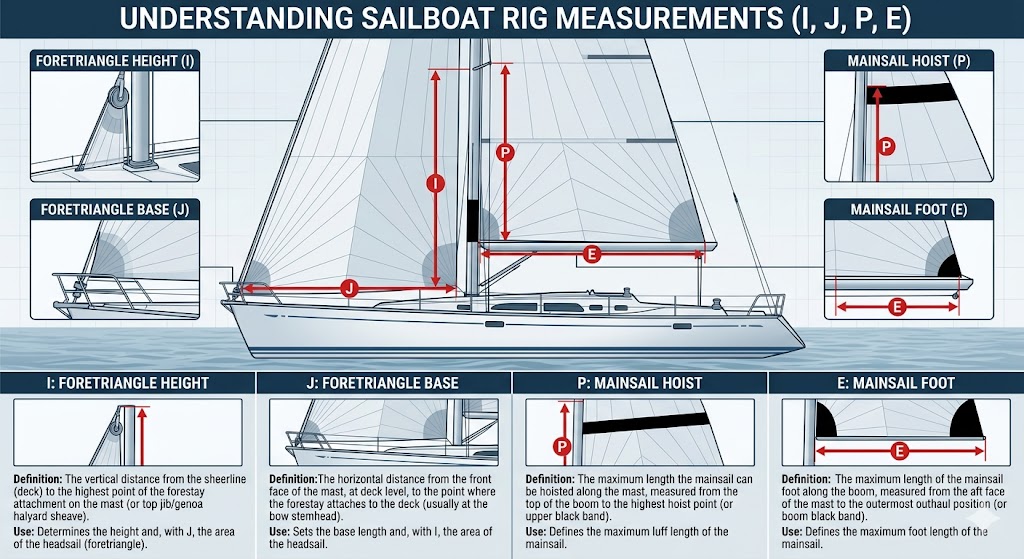
Rig Dimensions
I (Foretriangle Height) 50.00 ft / 15.24 m
J (Foretriangle Base) 16.75 ft / 5.11 m
P (Mainsail Luff) 43.50 ft / 13.26 m
E (Mainsail Foot) 16.00 ft / 4.88 m
SA Fore 418.75 ft² / 38.90 m²
SA Main 348.00 ft² / 32.33 m²
SA Total (100%) 766.75 ft² / 71.23 m²
Est. Forestay Length 52.73 ft / 16.07 m
Engine & Accommodations
Engine Make Universal
Engine Model Atomic 4
Engine Type Diesel
Horsepower 30
Fuel Capacity 30 gals / 114 L
Water Capacity 70 gals / 265 L
Find a Morgan 42 2 For Sale