Back to Search
Maple Leaf 48
Designer: Stan Huntingford  ·  Builder: Cooper Yachts  ·  First built: 1972
+ Add to Compare
About the Maple Leaf 48

Built for sailors seeking a substantial cruising platform, this 48-foot sailboat represents classic design principles adapted for comfortable long-distance voyaging. The Maple Leaf 48 emerged during an era when builders prioritized seaworthiness and interior volume over pure performance, creating vessels well-suited for extended coastal cruising and offshore passages. With her generous beam and traditional hull form, this design offers the stability and space that cruising sailors value most. The cockpit layout emphasizes safety and ease of handling, while the interior provides the amenities necessary for extended time aboard. Her construction reflects the solid building standards typical of quality cruising boats from this period. The Maple Leaf 48 appeals particularly to sailors planning serious coastal exploration or considering offshore adventures. Her size and design characteristics suggest good load-carrying capacity for extended provisioning, while maintaining the sailing performance needed for enjoyable passages. This boat would suit couples or small crews looking for a capable platform that doesn't sacrifice comfort for seaworthiness, making her an interesting option in the competitive 48-foot cruising market for those prioritizing proven design over cutting-edge features.

Core Dimensions
LOA (Length Overall) 47.67 ft / 14.53 m
LWL (Waterline Length) 40.50 ft / 12.34 m
Beam 14.67 ft / 4.47 m
Max Draft 6.50 ft / 1.98 m
Displacement 34,000.00 lb / 15,422 kg
Ballast 9,500.00 lb / 4,309 kg
Sail Area (Reported) 1,120.00 ft² / 104.05 m²
Design & Construction
Hull Type Fin with rudder on skeg
Rigging Type Cutter
Construction FG
Designer Stan Huntingford
Builder Cooper Yachts
First Built 1972
Owner Reviews

No owner reviews yet — be the first to share your experience with this boat.
Performance Ratios
SA/Displacement Sail Area to Displacement ratio measures how much sail power a boat has relative to its weight. Higher values mean more performance and speed.
Under 14 — Heavy cruiser, slow14–18 — Cruising sailboat18–22 — Cruiser/racerOver 22 — Performance racer
17.15
Comfort Ratio Ted Brewer's Comfort Ratio predicts how comfortable a boat will feel in offshore conditions. Higher values mean a steadier, more comfortable motion in a seaway.
Under 20 — Uncomfortably rough20–30 — Acceptable coastal30–40 — Good offshore comfortOver 40 — Very comfortable offshore
34.46
Capsize Screening Formula The USHS Capsize Screening Formula estimates offshore capsize risk. Lower is safer — values under 2.0 are considered acceptable for offshore sailing.
Under 2.0 — Safe for offshore2.0–2.2 — Borderline offshoreOver 2.2 — Coastal use recommended
1.82
Hull Speed Hull Speed is the theoretical maximum speed of a displacement hull, calculated from waterline length. Most cruising sailboats reach this speed in moderate conditions. 8.53
S# (Speed Number) The Speed Number (S#) is a quick performance index. Higher values indicate a faster, more powerful design relative to its size.
Under 3.0 — Slow cruiser3.0–5.0 — Average cruiser5.0–7.0 — Performance cruiserOver 7.0 — Racer
2.1
Pounds/Inch Immersion Pounds per Inch Immersion (PPI) tells you how much weight is needed to sink the boat one inch. Useful for calculating how additional gear and stores affect waterline. 2.0
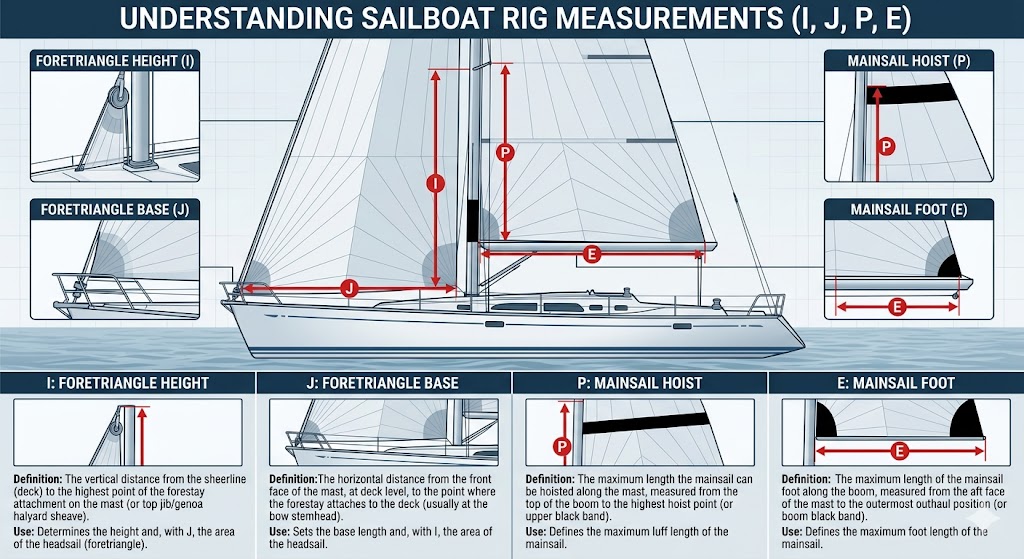
Rig Dimensions
I (Foretriangle Height) 52.5
J (Foretriangle Base) 20.0
P (Mainsail Luff) 46.0
E (Mainsail Foot) 18.0
SA Fore 525.0
SA Main 414.0
Find a Maple Leaf 48 For Sale