Back to Search
Macgregor 26X
Designer: Roger Macgregor  ·  Builder: Macgregor Yachts Inc. (Usa)  ·  First built: 1995
+ Add to Compare
Videos
Macgregor 26X
Photo: Ahunt / CC0
About the Macgregor 26X

Designed by Roger Macgregor and produced from 1995 to 2003, this versatile 26-footer represents the company's approach to accessible sailing with practical features for recreational sailors. With 5,000 units built over its production run, the 26X became a popular choice among those seeking an affordable entry into sailing or a capable boat for coastal adventures. The fractional sloop rig and centerboard configuration make this boat well-suited for shallow water exploration and easy launching from trailer ramps. The centerboard trunk system allows sailors to reduce draft significantly when needed, opening up access to beaches and shallow anchorages that would be off-limits to deeper fixed-keel boats. This flexibility makes it particularly appealing for coastal cruising, day sailing, and exploring protected waters. Built with fiberglass construction and featuring a displacement of 3,750 pounds with 1,400 pounds of ballast, the design prioritizes stability and ease of handling over ultimate performance. The sail area of 281 square feet provides adequate power for recreational sailing while remaining manageable for smaller crews. The boat's design characteristics suggest it's best suited for protected waters and coastal sailing rather than offshore passages, making it an excellent choice for weekend sailors and those learning the fundamentals of sailing.

Market Price Estimate Beta
$7,500 – $18,000
typical asking price · boat only
Median $12,000  ·  21 listings used
Boat only
$7,500 – $18,000 21
With trailer
$6,900 – $18,000 6
Rate a listing price
$
About this estimate
  • Prices are based on recent asking prices from public listings — not actual sale prices, which are typically lower.
  • Condition is not factored in. A well-maintained boat with new sails and engine can be worth significantly more than a project boat of the same model.
  • Location affects price. Boats in landlocked states or areas with fewer buyers often sell for less than those on the coast.
  • Year of manufacture is not filtered. Older examples of this model will generally be priced lower than newer ones.
  • Included equipment varies widely. A boat with a full suite of electronics, dodger, and new standing rigging may command a large premium.
  • Outliers are automatically excluded using statistical filtering to improve accuracy, but some bad data may remain.
Core Dimensions
LOA (Length Overall) 25.82 ft / 7.87 m
LWL (Waterline Length) 23.00 ft / 7.01 m
Beam 7.83 ft / 2.39 m
Max Draft 5.50 ft / 1.68 m
Min Draft 0.75 ft / 0.23 m
Displacement 3,750.00 lb / 1,701 kg
Ballast 1,400.00 lb / 635 kg
Ballast Type Water
Sail Area (Reported) 281.00 ft² / 26.11 m²
Headroom 5.92 ft / 1.80 m
Design & Construction
Hull Type Centerboard (Trunk)
Rigging Type Fractional Sloop
Construction FG
Designer Roger Macgregor
Builder Macgregor Yachts Inc. (USA)
First Built 1995
Last Built 2003
Number Built 5000
Related Sailboats Macgregor 26M
Owner Reviews

No owner reviews yet — be the first to share your experience with this boat.

Known Issues & What to Watch For
High Hull/Deck
The centerboard trunk is a known weak point — the trunk-to-hull joint frequently develops cracks and leaks, especially after grounding or repeated trailer launching. Water intrusion into the trunk area can be difficult to seal permanently.
Medium Hull/Deck
The hull is extremely lightly built for its size to achieve the low weight needed for trailering and motoring performance. This results in a flexible hull that can develop stress cracks around chainplates, stanchion bases, and the mast step area under sailing loads.
Medium Hull/Deck
Deck hardware bedding fails regularly due to the thin deck laminate. Stanchion bases, cleats, and turning blocks are prone to pulling loose or allowing water intrusion, and backing plates are often undersized from the factory.
High Keel
The swing centerboard (typically aluminum or steel) is prone to corrosion and wear at the pivot pin. The pennant line that raises and lowers the board chafes and fails with little warning; a failed pennant leaves the board uncontrolled and can damage the trunk.
Medium Rigging
The mast is deck-stepped on a relatively thin, unsupported cabin top. The mast step area is prone to cracking and compression damage, and the partner reinforcement is marginal for offshore or heavy-air use.
High Rigging
Chainplate attachment points are bolted through a relatively thin hull side without adequate internal reinforcement in many examples. Chainplate pull-through or local laminate cracking is a known issue that warrants close inspection.
High Engine
The 50 hp outboard motor well aft is the defining feature of the 26X, but the transom and motor well area sustain significant stress from large outboard use. Delamination and cracking around the motor well and transom cut-out should be carefully inspected.
Medium Engine
The large outboard well can take on water at anchor or in following seas if the outboard is tilted up, as the well drain design is marginal. Repeated flooding of the well area accelerates transom delamination.
Low Accommodations
Interior joinery and cabinetry are very lightly constructed and use stapled rather than screwed or glassed attachment in many areas, leading to widespread delamination and separation of interior components over time.
High Hull/Deck
The water ballast system (approximately 200 gallons) relies on valves and through-hull fittings that are often neglected. Valve seizure, failed hose connections, and corroded fittings in the ballast circuit are common and can result in uncontrolled flooding.

Own or have surveyed a Macgregor 26X? Submit a known issue
Performance Ratios
SA/Displacement Sail Area to Displacement ratio measures how much sail power a boat has relative to its weight. Higher values mean more performance and speed.
Under 14 — Heavy cruiser, slow14–18 — Cruising sailboat18–22 — Cruiser/racerOver 22 — Performance racer
18.68
Ballast/Displacement Ballast to Displacement ratio shows what percentage of the boat's total weight is ballast. Higher values generally mean better initial stability and stiffer sail carrying.
30–35% — Typical cruiser35–45% — Stiff performance boatOver 45% — Racing oriented
37.33
Displacement/Length Displacement to Length ratio measures how heavy a boat is relative to its waterline length. Lower values mean a lighter, faster boat.
Under 100 — Ultralight racer100–200 — Light cruiser/racer200–300 — Moderate cruiser300–400 — Heavy cruiserOver 400 — Very heavy
137.59
Comfort Ratio Ted Brewer's Comfort Ratio predicts how comfortable a boat will feel in offshore conditions. Higher values mean a steadier, more comfortable motion in a seaway.
Under 20 — Uncomfortably rough20–30 — Acceptable coastal30–40 — Good offshore comfortOver 40 — Very comfortable offshore
15.67
Capsize Screening Formula The USHS Capsize Screening Formula estimates offshore capsize risk. Lower is safer — values under 2.0 are considered acceptable for offshore sailing.
Under 2.0 — Safe for offshore2.0–2.2 — Borderline offshoreOver 2.2 — Coastal use recommended
2.02
Hull Speed Hull Speed is the theoretical maximum speed of a displacement hull, calculated from waterline length. Most cruising sailboats reach this speed in moderate conditions. 6.43 kn
S# (Speed Number) The Speed Number (S#) is a quick performance index. Higher values indicate a faster, more powerful design relative to its size.
Under 3.0 — Slow cruiser3.0–5.0 — Average cruiser5.0–7.0 — Performance cruiserOver 7.0 — Racer
3.4
Pounds/Inch Immersion Pounds per Inch Immersion (PPI) tells you how much weight is needed to sink the boat one inch. Useful for calculating how additional gear and stores affect waterline. 643.48 pounds/inch
SA/Displacement (Calc) Calculated Sail Area to Displacement ratio using actual measured sail dimensions rather than reported values. More precise than the reported SA/Disp figure. 16.02
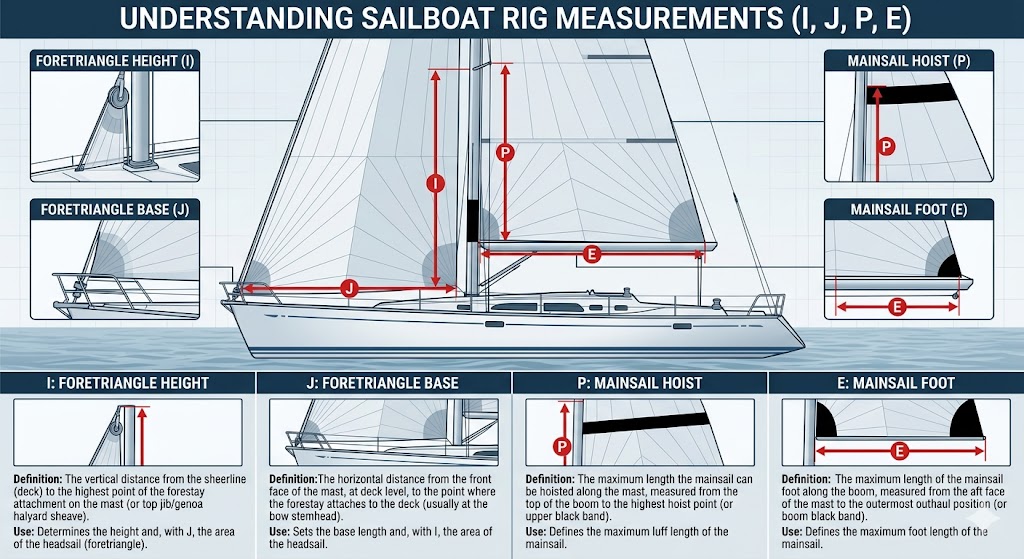
Rig Dimensions
I (Foretriangle Height) 23.00 ft / 7.01 m
J (Foretriangle Base) 9.67 ft / 2.95 m
P (Mainsail Luff) 25.00 ft / 7.62 m
E (Mainsail Foot) 10.38 ft / 3.16 m
SA Fore 111.21 ft² / 10.33 m²
SA Main 129.75 ft² / 12.05 m²
SA Total (100%) 240.96 ft² / 22.39 m²
Est. Forestay Length 24.95 ft / 7.60 m
Engine & Accommodations
Fuel Capacity 18 gals / 68 L
Water Capacity 10 gals / 38 L
Resources & Community
Find a Macgregor 26X For Sale