Back to Search
Knarr
Designer: Erling Kristoffersen  ·  First built: 1946
+ Add to Compare
About the Knarr

Drawing inspiration from ancient Norse vessels, this distinctive sailboat emerged as a popular one-design keelboat that has captured the attention of sailors seeking both competitive racing and enjoyable day sailing. Originally designed in Norway, the Knarr represents a successful blend of traditional Scandinavian boat-building principles with modern sailing performance. Built for versatility, this keelboat excels in protected waters and coastal sailing conditions. Its moderate displacement and well-balanced design make it particularly appealing to sailors who appreciate responsive handling without excessive complexity. The boat's reputation centers around its forgiving sailing characteristics and ability to perform well across varying wind conditions. Racing enthusiasts have embraced the Knarr for fleet competition, where its one-design status ensures close, skill-based racing. The class has maintained active fleets in several regions, particularly where sailors value traditional design aesthetics combined with competitive sailing opportunities. Beyond racing, the boat serves admirably for recreational sailing, offering enough cockpit space for comfortable day trips while remaining manageable for smaller crews. The Knarr's enduring appeal lies in its honest sailing qualities and connection to maritime heritage, making it an attractive choice for sailors seeking character alongside performance.

Core Dimensions
LOA (Length Overall) 30.33 ft / 9.24 m
LWL (Waterline Length) 20.37 ft / 6.21 m
Beam 6.95 ft / 2.12 m
Max Draft 4.26 ft / 1.30 m
Displacement 4,905.00 lb / 2,225 kg
Ballast 2,822.00 lb / 1,280 kg
Sail Area (Reported) 286.00 ft² / 26.57 m²
Design & Construction
Hull Type Fin Keel
Rigging Type Fractional Sloop
Construction Wood/FG
Designer Erling Kristoffersen
First Built 1946
Owner Reviews

No owner reviews yet — be the first to share your experience with this boat.
Performance Ratios
SA/Displacement Sail Area to Displacement ratio measures how much sail power a boat has relative to its weight. Higher values mean more performance and speed.
Under 14 — Heavy cruiser, slow14–18 — Cruising sailboat18–22 — Cruiser/racerOver 22 — Performance racer
15.9
Comfort Ratio Ted Brewer's Comfort Ratio predicts how comfortable a boat will feel in offshore conditions. Higher values mean a steadier, more comfortable motion in a seaway.
Under 20 — Uncomfortably rough20–30 — Acceptable coastal30–40 — Good offshore comfortOver 40 — Very comfortable offshore
24.52
Capsize Screening Formula The USHS Capsize Screening Formula estimates offshore capsize risk. Lower is safer — values under 2.0 are considered acceptable for offshore sailing.
Under 2.0 — Safe for offshore2.0–2.2 — Borderline offshoreOver 2.2 — Coastal use recommended
1.64
Hull Speed Hull Speed is the theoretical maximum speed of a displacement hull, calculated from waterline length. Most cruising sailboats reach this speed in moderate conditions. 6.05
S# (Speed Number) The Speed Number (S#) is a quick performance index. Higher values indicate a faster, more powerful design relative to its size.
Under 3.0 — Slow cruiser3.0–5.0 — Average cruiser5.0–7.0 — Performance cruiserOver 7.0 — Racer
1.82
Pounds/Inch Immersion Pounds per Inch Immersion (PPI) tells you how much weight is needed to sink the boat one inch. Useful for calculating how additional gear and stores affect waterline. 505.85
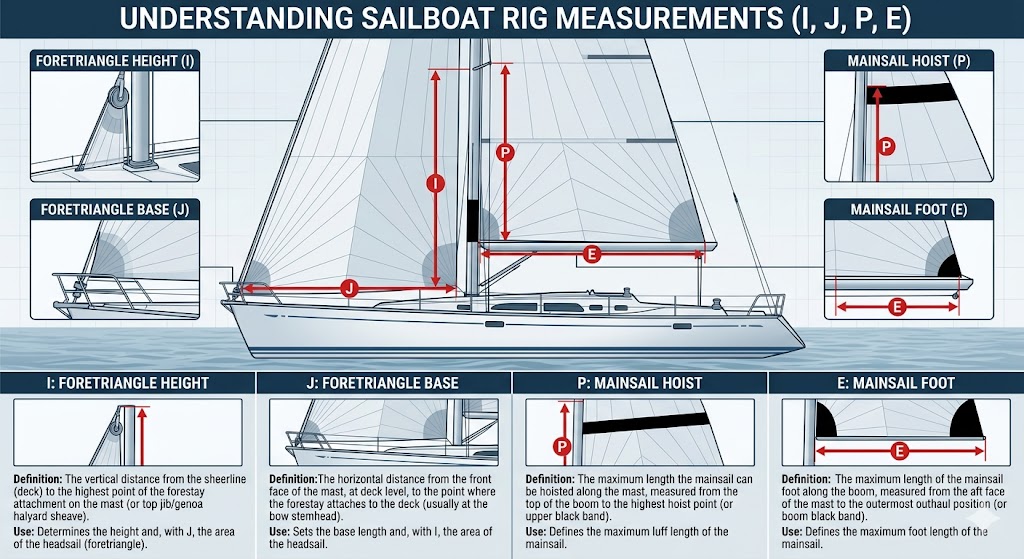
Rig Dimensions
I (Foretriangle Height) 25.43
J (Foretriangle Base) 6.56
P (Mainsail Luff) 31.0
E (Mainsail Foot) 11.06
SA Fore 83.41
SA Main 171.43
Find a Knarr For Sale