Back to Search
J70
Designer: Alan Johnstone  ·  Builder: J Boats (Usa)  ·  First built: 2012
+ Add to Compare
About the J70

Designed by Alan Johnstone and launched in 2012, the J70 has quickly established itself as one of the most popular keelboats in modern one-design racing. With over 1,100 boats built by J Boats USA, this fractional sloop represents the sweet spot between performance and accessibility that has made it a global phenomenon on racing circuits. The J70's lightweight fiberglass construction and aggressive sail area-to-displacement ratio of 24.58 deliver exciting performance characteristics that reward skilled boat handling. At just 1,790 pounds with a fin keel and transom-hung rudder configuration, the design prioritizes responsiveness and speed over comfort, reflected in its notably low comfort ratio of 9.12. The boat's 226 square feet of sail area provides plenty of power for competitive racing while remaining manageable for smaller crews. This design excels in organized fleet racing and sailing club competitions, where its strict one-design rules ensure close, tactical racing. The J70's popularity has spawned active racing fleets worldwide, with major regattas and championship series attracting hundreds of entries. While primarily built for racing, the boat's stable platform and moderate draft of 4.92 feet also make it suitable for spirited day sailing in coastal waters.

Core Dimensions
LOA (Length Overall) 22.74 ft / 6.93 m
LWL (Waterline Length) 20.47 ft / 6.24 m
Beam 7.38 ft / 2.25 m
Max Draft 4.92 ft / 1.50 m
Displacement 1,790.00 lb / 812 kg
Ballast 628.00 lb / 285 kg
Ballast Type Lead
Sail Area (Reported) 226.00 ft² / 21.00 m²
Design & Construction
Hull Type Fin w/transom hung rudder
Rigging Type Fractional Sloop
Construction FG
Designer Alan Johnstone
Builder J Boats (USA)
First Built 2012
Number Built 1100
Associations J/70 Class Association
Owner Reviews

No owner reviews yet — be the first to share your experience with this boat.
Performance Ratios
SA/Displacement Sail Area to Displacement ratio measures how much sail power a boat has relative to its weight. Higher values mean more performance and speed.
Under 14 — Heavy cruiser, slow14–18 — Cruising sailboat18–22 — Cruiser/racerOver 22 — Performance racer
24.58
Ballast/Displacement Ballast to Displacement ratio shows what percentage of the boat's total weight is ballast. Higher values generally mean better initial stability and stiffer sail carrying.
30–35% — Typical cruiser35–45% — Stiff performance boatOver 45% — Racing oriented
35.08
Displacement/Length Displacement to Length ratio measures how heavy a boat is relative to its waterline length. Lower values mean a lighter, faster boat.
Under 100 — Ultralight racer100–200 — Light cruiser/racer200–300 — Moderate cruiser300–400 — Heavy cruiserOver 400 — Very heavy
93.16
Comfort Ratio Ted Brewer's Comfort Ratio predicts how comfortable a boat will feel in offshore conditions. Higher values mean a steadier, more comfortable motion in a seaway.
Under 20 — Uncomfortably rough20–30 — Acceptable coastal30–40 — Good offshore comfortOver 40 — Very comfortable offshore
9.12
Capsize Screening Formula The USHS Capsize Screening Formula estimates offshore capsize risk. Lower is safer — values under 2.0 are considered acceptable for offshore sailing.
Under 2.0 — Safe for offshore2.0–2.2 — Borderline offshoreOver 2.2 — Coastal use recommended
2.43
Hull Speed Hull Speed is the theoretical maximum speed of a displacement hull, calculated from waterline length. Most cruising sailboats reach this speed in moderate conditions. 6.06 kn
S# (Speed Number) The Speed Number (S#) is a quick performance index. Higher values indicate a faster, more powerful design relative to its size.
Under 3.0 — Slow cruiser3.0–5.0 — Average cruiser5.0–7.0 — Performance cruiserOver 7.0 — Racer
5.6
Pounds/Inch Immersion Pounds per Inch Immersion (PPI) tells you how much weight is needed to sink the boat one inch. Useful for calculating how additional gear and stores affect waterline. 539.78 pounds/inch
SA/Displacement (Calc) Calculated Sail Area to Displacement ratio using actual measured sail dimensions rather than reported values. More precise than the reported SA/Disp figure. 24.61
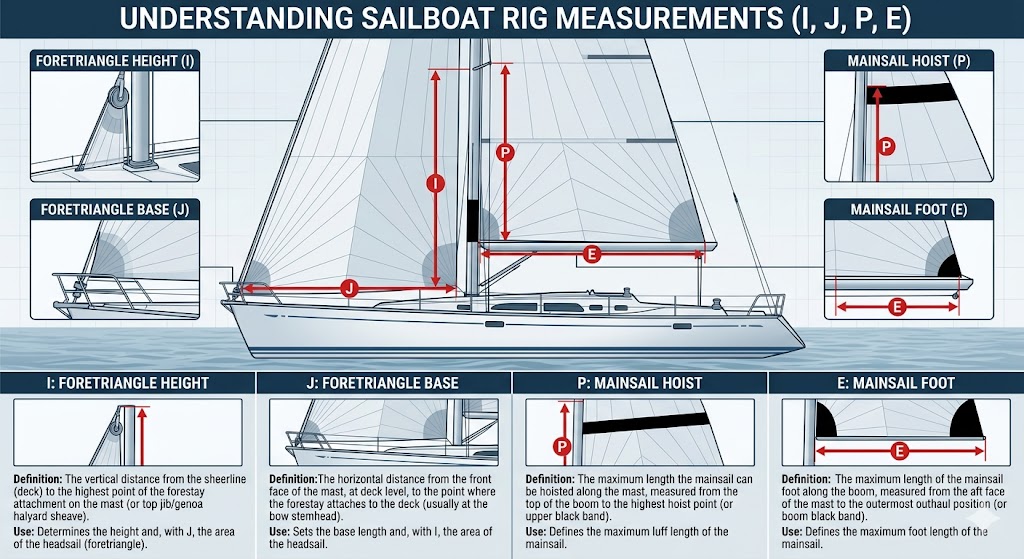
Rig Dimensions
I (Foretriangle Height) 26.77 ft / 8.16 m
J (Foretriangle Base) 7.68 ft / 2.34 m
P (Mainsail Luff) 26.16 ft / 7.97 m
E (Mainsail Foot) 9.44 ft / 2.88 m
ISP (Spinnaker Luff) 30.15 ft / 9.19 m
SA Fore 102.80 ft² / 9.55 m²
SA Main 123.48 ft² / 11.47 m²
SA Total (100%) 226.28 ft² / 21.02 m²
Est. Forestay Length 27.85 ft / 8.49 m
Find a J70 For Sale