Back to Search
J33
Designer: Rodney S. Johnstone  ·  Builder: J Boats Tillotson Pearson  ·  First built: 1988
+ Add to Compare
About the J33

Limited information surrounds this lesser-known sailboat model, making the J33 something of an enigma in the sailing world. What can be pieced together suggests a boat that likely fits within the performance-oriented segment of the market, given the "J" designation that often appears in racing-focused designs. Without comprehensive specifications readily available, potential buyers should approach the J33 with careful consideration and thorough independent research. The scarcity of detailed information could indicate either a limited production run or a regional design that didn't achieve widespread distribution. This reality makes finding parts, documentation, or experienced service providers potentially challenging. For sailors considering a J33, conducting a comprehensive marine survey becomes even more critical than usual. The boat's actual sailing characteristics, build quality, and intended use profile would need to be assessed through hands-on evaluation rather than relying on published specifications or widespread owner experiences. While some boats thrive despite limited documentation, the J33's sparse available information suggests it may appeal primarily to sailors comfortable with less conventional choices or those who discover a particular example in exceptional condition at an attractive price point.

Core Dimensions
LOA (Length Overall) 33.50 ft / 10.21 m
LWL (Waterline Length) 28.00 ft / 8.53 m
Beam 11.00 ft / 3.35 m
Max Draft 6.17 ft / 1.88 m
Displacement 8,100.00 lb / 3,674 kg
Ballast 3,180.00 lb / 1,442 kg
Sail Area (Reported) 561.00 ft² / 52.12 m²
Design & Construction
Hull Type Fin w/spade rudder
Rigging Type Masthead Sloop
Construction FG
Designer Rodney S. Johnstone
Builder J Boats Tillotson Pearson
First Built 1988
Last Built 1991
Owner Reviews

No owner reviews yet — be the first to share your experience with this boat.
Performance Ratios
SA/Displacement Sail Area to Displacement ratio measures how much sail power a boat has relative to its weight. Higher values mean more performance and speed.
Under 14 — Heavy cruiser, slow14–18 — Cruising sailboat18–22 — Cruiser/racerOver 22 — Performance racer
22.33
Comfort Ratio Ted Brewer's Comfort Ratio predicts how comfortable a boat will feel in offshore conditions. Higher values mean a steadier, more comfortable motion in a seaway.
Under 20 — Uncomfortably rough20–30 — Acceptable coastal30–40 — Good offshore comfortOver 40 — Very comfortable offshore
17.32
Capsize Screening Formula The USHS Capsize Screening Formula estimates offshore capsize risk. Lower is safer — values under 2.0 are considered acceptable for offshore sailing.
Under 2.0 — Safe for offshore2.0–2.2 — Borderline offshoreOver 2.2 — Coastal use recommended
2.19
Hull Speed Hull Speed is the theoretical maximum speed of a displacement hull, calculated from waterline length. Most cruising sailboats reach this speed in moderate conditions. 7.09
S# (Speed Number) The Speed Number (S#) is a quick performance index. Higher values indicate a faster, more powerful design relative to its size.
Under 3.0 — Slow cruiser3.0–5.0 — Average cruiser5.0–7.0 — Performance cruiserOver 7.0 — Racer
3.83
Pounds/Inch Immersion Pounds per Inch Immersion (PPI) tells you how much weight is needed to sink the boat one inch. Useful for calculating how additional gear and stores affect waterline. 1.0
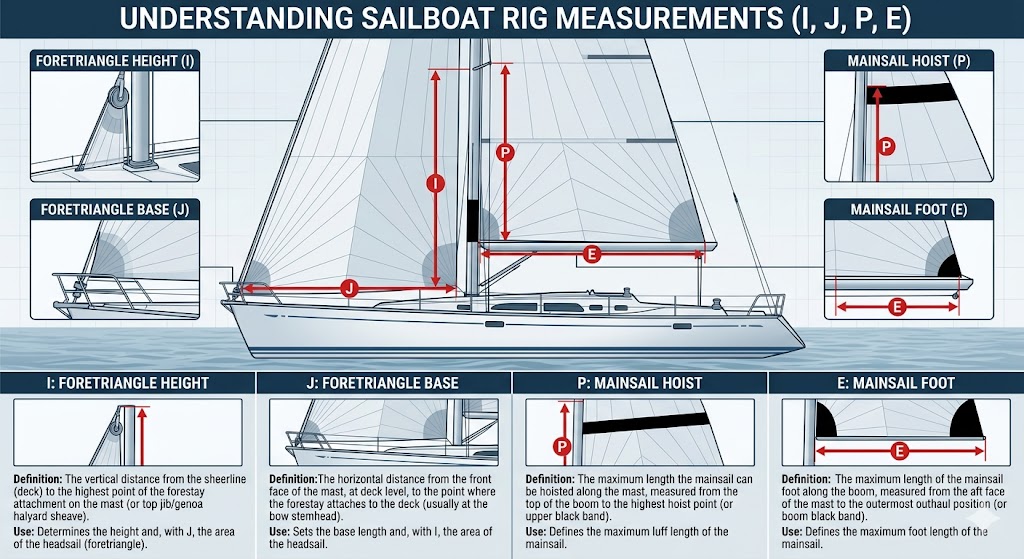
Rig Dimensions
I (Foretriangle Height) 44.1
J (Foretriangle Base) 12.6
P (Mainsail Luff) 39.0
E (Mainsail Foot) 14.5
SA Fore 277.83
SA Main 282.75
Find a J33 For Sale