Back to Search
Island Packet 44
Designer: Robert K. Johnson  ·  Builder: Island Packet Yachts (Usa)  ·  First built: 1992
+ Add to Compare
Videos
About the Island Packet 44

Built between 1992 and 1996 with only 35 hulls produced, this Robert K. Johnson-designed cruiser represents Island Packet's commitment to traditional bluewater sailing. The fiberglass construction features a full long keel configuration that delivers exceptional tracking and directional stability, making it an ideal choice for serious offshore cruising and extended passages. The cutter rig provides versatility in various wind conditions, allowing crews to balance sail plan efficiently during long ocean crossings. With a displacement of 27,900 pounds and substantial ballast of 12,500 pounds, this vessel offers the solid, seaworthy feel that Island Packet became renowned for among cruising sailors. The generous beam of 13.16 feet creates spacious interior accommodations while maintaining excellent stability. The boat's comfort ratio of 35.54 indicates a motion that favors comfort over speed, typical of cruising-oriented designs intended for extended living aboard. The moderate draft of 4.83 feet opens up cruising grounds while the long keel provides protection for the propeller and rudder in challenging conditions. This design philosophy made Island Packet a respected name among sailors seeking capable, comfortable cruising boats rather than racing machines, and the 44 continues that tradition with proven ocean-crossing capability.

Core Dimensions
LOA (Length Overall) 44.00 ft / 13.41 m
LWL (Waterline Length) 37.16 ft / 11.33 m
Beam 13.16 ft / 4.01 m
Max Draft 4.83 ft / 1.47 m
Displacement 27,900.00 lb / 12,655 kg
Ballast 12,500.00 lb / 5,670 kg
Sail Area (Reported) 1,082.00 ft² / 100.52 m²
Design & Construction
Hull Type Long Keel
Rigging Type Cutter
Construction FG
Designer Robert K. Johnson
Builder Island Packet Yachts (USA)
First Built 1992
Last Built 1996
Number Built 35
Associations Official Island Packet Yacht Owners Association
Owner Reviews

No owner reviews yet — be the first to share your experience with this boat.

Known Issues & What to Watch For
Medium Hull/Deck
Island Packet used a hull-to-deck joint bonded and through-bolted with an outward-turning flange on these models. The toe rail fasteners and joint sealant are known to fail, allowing water intrusion into the deck laminate and core, particularly along the side decks near the chainplates.
High Hull/Deck
The balsa-cored deck sections on Island Packet 44s are prone to core saturation and delamination, especially around deck hardware bases, windlass mounting areas, and stanchion bases where fastener bedding has failed over time. Tap testing the entire deck is essential.
High Keel
The full-length encapsulated keel on the IP44 uses a lead ballast pour inside a fiberglass shell. The keel-to-hull joint can develop stress cracks and weeping, and the fiberglass shell itself can crack or delaminate near the forward end of the keel where hobby-horsing stress is concentrated.
High Keel
Water can intrude into the encapsulated keel cavity through cracks in the fiberglass shell, leading to internal delamination that is difficult to detect without moisture metering. Elevated moisture readings at the keel shell should be investigated carefully before purchase.
High Rigging
The chainplate backing plates on the IP44 are glassed into the hull liner and bonded to the interior structure. Inspection is difficult, and the bonding can fail or corrode without visible signs from the cabin interior; any chainplate movement or weeping deck stains above them warrants removal and inspection.
Medium Hull/Deck
The integral swim platform on these models can develop delamination and gelcoat crazing, and the through-hull fittings in this area are sometimes inaccessible without removal of interior joinery.
Medium Engine
Many IP44s of this era were fitted with the Perkins 4-108 diesel. These engines are now well past their service life and commonly suffer from worn injectors, failing heat exchangers, and corroded raw water impeller housings. Verify that a full engine service history exists and assess for a potential repowering.
1992–1996 models
Medium Electrical
Island Packet's factory wiring on early 1990s hulls used undersized wire runs to some DC circuits and relied heavily on ring terminals that corrode in the bilge environment. The main electrical panel area should be inspected for evidence of overheating, corrosion at terminal strips, and non-factory additions that may have overloaded original circuits.
1992–1996 models
Low Accommodations
The teak and holly cabin sole on these boats is bonded directly to a fiberglass sub-sole, and the adhesive and fasteners are known to fail, causing sections to lift or delaminate. Squeaking or soft sections underfoot indicate this problem.
Medium Hull/Deck
The portlight frames, particularly the fixed ports in the cabin sides, are known to leak on this generation of Island Packets. The acrylic or lexan lenses develop crazing and the bedding compound hardens and separates, allowing water into the cabin and potentially into cored areas around the frames.

Own or have surveyed a Island Packet 44? Submit a known issue
Performance Ratios
PHRF Rating PHRF (Performance Handicap Racing Fleet) is a national racing handicap measured in seconds per nautical mile. Lower values indicate faster boats. Ratings are sourced from US Sailing's national database (median across 60+ regional fleets).
Under 0 — Ultralight racer0–90 — Performance racer90–150 — Cruiser/racer150–210 — Typical cruiserOver 210 — Heavy/slow cruiser
114
SA/Displacement Sail Area to Displacement ratio measures how much sail power a boat has relative to its weight. Higher values mean more performance and speed.
Under 14 — Heavy cruiser, slow14–18 — Cruising sailboat18–22 — Cruiser/racerOver 22 — Performance racer
18.9
Ballast/Displacement Ballast to Displacement ratio shows what percentage of the boat's total weight is ballast. Higher values generally mean better initial stability and stiffer sail carrying.
30–35% — Typical cruiser35–45% — Stiff performance boatOver 45% — Racing oriented
44.8
Displacement/Length Displacement to Length ratio measures how heavy a boat is relative to its waterline length. Lower values mean a lighter, faster boat.
Under 100 — Ultralight racer100–200 — Light cruiser/racer200–300 — Moderate cruiser300–400 — Heavy cruiserOver 400 — Very heavy
242.73
Comfort Ratio Ted Brewer's Comfort Ratio predicts how comfortable a boat will feel in offshore conditions. Higher values mean a steadier, more comfortable motion in a seaway.
Under 20 — Uncomfortably rough20–30 — Acceptable coastal30–40 — Good offshore comfortOver 40 — Very comfortable offshore
35.54
Capsize Screening Formula The USHS Capsize Screening Formula estimates offshore capsize risk. Lower is safer — values under 2.0 are considered acceptable for offshore sailing.
Under 2.0 — Safe for offshore2.0–2.2 — Borderline offshoreOver 2.2 — Coastal use recommended
1.74
Hull Speed Hull Speed is the theoretical maximum speed of a displacement hull, calculated from waterline length. Most cruising sailboats reach this speed in moderate conditions. 8.17 kn
S# (Speed Number) The Speed Number (S#) is a quick performance index. Higher values indicate a faster, more powerful design relative to its size.
Under 3.0 — Slow cruiser3.0–5.0 — Average cruiser5.0–7.0 — Performance cruiserOver 7.0 — Racer
2.13
Pounds/Inch Immersion Pounds per Inch Immersion (PPI) tells you how much weight is needed to sink the boat one inch. Useful for calculating how additional gear and stores affect waterline. 1,747.34 pounds/inch
SA/Displacement (Calc) Calculated Sail Area to Displacement ratio using actual measured sail dimensions rather than reported values. More precise than the reported SA/Disp figure. 15.87
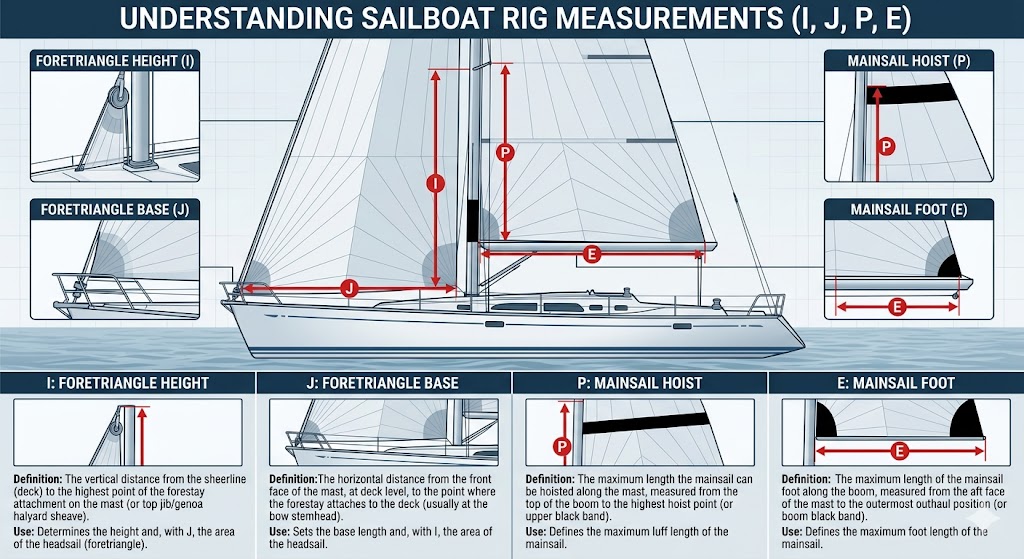
Rig Dimensions
I (Foretriangle Height) 54.75 ft / 16.69 m
J (Foretriangle Base) 18.42 ft / 5.61 m
P (Mainsail Luff) 47.60 ft / 14.51 m
E (Mainsail Foot) 17.00 ft / 5.18 m
SA Fore 504.25 ft² / 46.85 m²
SA Main 404.60 ft² / 37.59 m²
SA Total (100%) 908.85 ft² / 84.43 m²
Est. Forestay Length 57.77 ft / 17.61 m
Engine & Accommodations
Engine Make Yanmar
Engine Type Diesel
Resources & Community
Find a Island Packet 44 For Sale