Back to Search
Island Packet 40
Designer: Bob Johnson  ·  Builder: Island Packet Yachts (Usa)  ·  First built: 1994
+ Add to Compare
Videos
About the Island Packet 40

Built between 1994 and 2000 with 139 hulls produced, this Bob Johnson-designed cruiser represents Island Packet's commitment to comfortable, seaworthy passage-making. The 40-footer showcases the builder's signature full keel design philosophy, prioritizing directional stability and sea-kindly motion over racing performance. With its traditional long keel configuration and cutter rig, this yacht excels at offshore cruising and coastal exploration. The substantial displacement of 22,800 pounds, combined with 10,000 pounds of ballast, creates a stable platform that handles heavy weather with confidence. The moderate sail area to displacement ratio of 18.12 suggests easy handling and comfortable sailing in varying conditions rather than blazing speed. The comfort ratio of 32.6 indicates excellent motion characteristics in seaway, while the capsize screening formula of 1.83 demonstrates good stability margins for offshore work. Island Packet's reputation for quality fiberglass construction and thoughtful interior layouts makes this model particularly appealing to serious cruisers seeking a proven bluewater design. The hull's theoretical speed of 7.81 knots reflects its displacement nature, delivering steady progress rather than thrilling performance. This yacht suits sailors prioritizing safety, comfort, and reliability over speed, making it ideal for extended cruising adventures.

Core Dimensions
LOA (Length Overall) 40.00 ft / 12.19 m
LWL (Waterline Length) 34.00 ft / 10.36 m
Beam 12.92 ft / 3.94 m
Max Draft 4.67 ft / 1.42 m
Displacement 22,800.00 lb / 10,342 kg
Ballast 10,000.00 lb / 4,536 kg
Ballast Type Lead
Sail Area (Reported) 907.00 ft² / 84.26 m²
Design & Construction
Hull Type Long Keel
Rigging Type Cutter
Construction FG
Designer Bob Johnson
Builder Island Packet Yachts (USA)
First Built 1994
Last Built 2000
Number Built 139
Associations Official Island Packet Yacht Owners Association
Owner Reviews

No owner reviews yet — be the first to share your experience with this boat.

Known Issues & What to Watch For
Medium Hull/Deck
Island Packet's full-length inner liner is bonded to the hull using a resin-rich secondary bond. On the IP40, this liner-to-hull bond can fail in the bow sections, creating voids that trap water and are difficult to detect without moisture metering or destructive inspection.
High Hull/Deck
The integral bow pulpit and anchor platform on IP40s is a heavily cored fiberglass structure prone to core saturation around the windlass mounting bolts. Water intrusion here is common and can lead to significant delamination of the platform if fasteners are not properly bedded and maintained.
High Hull/Deck
Deck hardware on IP40s is typically mounted through balsa-cored deck sections. The balsa core around chainplates, stanchion bases, and sheet lead blocks is prone to saturation and rot, particularly where original bedding compound has dried out over time.
Medium Keel
The full-keel/skeg configuration uses encapsulated ballast. The joint between the lead ballast encapsulation and the fiberglass shell can develop stress cracks at the turn of the bilge, allowing water intrusion into the encapsulated section. This is difficult to detect and can mask ongoing degradation.
Medium Rigging
Island Packet 40s were fitted with an in-boom or in-mast furling mainsail system on many units. These systems, particularly the Selden and ProFurl units of this era, are known for jamming and UV degradation of the internal sail fabric, and are expensive to refit or replace.
High Rigging
The chainplate attachment on the IP40 runs through the deck and is glassed to the inner liner below. Inspection of the actual chainplate-to-structure connection requires removal of interior joinery panels and is frequently skipped; hidden corrosion and liner bond failures at this point are a known concern.
Medium Engine
Most IP40s were fitted with a Perkins 4-108 or Universal M-40/M-50 diesel engine. These engines are well-regarded but the engine room access on the IP40 is tight, making raw water impeller changes, belt replacements, and heat exchanger service difficult. Deferred maintenance on these components due to poor access is a common finding.
Medium Electrical
Island Packet's factory wiring of this era used a comprehensive but complex 12V DC system with a large AC shorepower setup. The terminal blocks and bus bars located beneath the navigation station are prone to corrosion and loose connections after 25+ years, and the original wiring diagrams are often missing from the boat.
Low Accommodations
The teak and holly sole on IP40s is bonded over the inner liner and is prone to delamination and squeaking as the adhesive bond deteriorates. Sections of the sole in the main saloon and companionway area frequently need rebonding or replacement.

Own or have surveyed a Island Packet 40? Submit a known issue
Performance Ratios
PHRF Rating PHRF (Performance Handicap Racing Fleet) is a national racing handicap measured in seconds per nautical mile. Lower values indicate faster boats. Ratings are sourced from US Sailing's national database (median across 60+ regional fleets).
Under 0 — Ultralight racer0–90 — Performance racer90–150 — Cruiser/racer150–210 — Typical cruiserOver 210 — Heavy/slow cruiser
141
SA/Displacement Sail Area to Displacement ratio measures how much sail power a boat has relative to its weight. Higher values mean more performance and speed.
Under 14 — Heavy cruiser, slow14–18 — Cruising sailboat18–22 — Cruiser/racerOver 22 — Performance racer
18.12
Ballast/Displacement Ballast to Displacement ratio shows what percentage of the boat's total weight is ballast. Higher values generally mean better initial stability and stiffer sail carrying.
30–35% — Typical cruiser35–45% — Stiff performance boatOver 45% — Racing oriented
43.86
Displacement/Length Displacement to Length ratio measures how heavy a boat is relative to its waterline length. Lower values mean a lighter, faster boat.
Under 100 — Ultralight racer100–200 — Light cruiser/racer200–300 — Moderate cruiser300–400 — Heavy cruiserOver 400 — Very heavy
258.97
Comfort Ratio Ted Brewer's Comfort Ratio predicts how comfortable a boat will feel in offshore conditions. Higher values mean a steadier, more comfortable motion in a seaway.
Under 20 — Uncomfortably rough20–30 — Acceptable coastal30–40 — Good offshore comfortOver 40 — Very comfortable offshore
32.6
Capsize Screening Formula The USHS Capsize Screening Formula estimates offshore capsize risk. Lower is safer — values under 2.0 are considered acceptable for offshore sailing.
Under 2.0 — Safe for offshore2.0–2.2 — Borderline offshoreOver 2.2 — Coastal use recommended
1.83
Hull Speed Hull Speed is the theoretical maximum speed of a displacement hull, calculated from waterline length. Most cruising sailboats reach this speed in moderate conditions. 7.81 kn
S# (Speed Number) The Speed Number (S#) is a quick performance index. Higher values indicate a faster, more powerful design relative to its size.
Under 3.0 — Slow cruiser3.0–5.0 — Average cruiser5.0–7.0 — Performance cruiserOver 7.0 — Racer
1.95
Pounds/Inch Immersion Pounds per Inch Immersion (PPI) tells you how much weight is needed to sink the boat one inch. Useful for calculating how additional gear and stores affect waterline. 1,569.60 pounds/inch
SA/Displacement (Calc) Calculated Sail Area to Displacement ratio using actual measured sail dimensions rather than reported values. More precise than the reported SA/Disp figure. 15.47
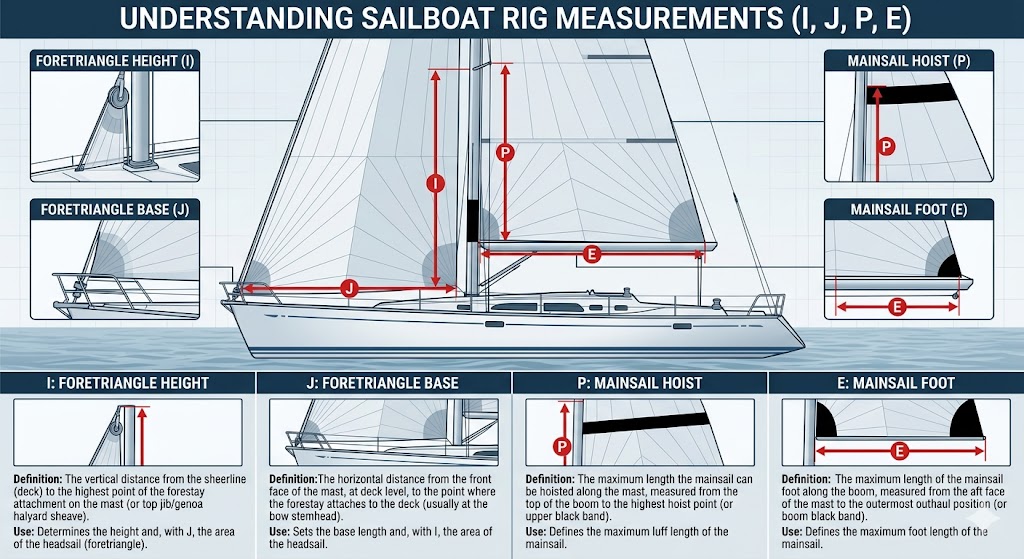
Rig Dimensions
I (Foretriangle Height) 49.83 ft / 15.19 m
J (Foretriangle Base) 17.75 ft / 5.41 m
P (Mainsail Luff) 42.83 ft / 13.05 m
E (Mainsail Foot) 15.50 ft / 4.72 m
SA Fore 442.24 ft² / 41.09 m²
SA Main 331.93 ft² / 30.84 m²
SA Total (100%) 774.17 ft² / 71.92 m²
Est. Forestay Length 52.90 ft / 16.12 m
Mast Height (DWL) 53.67 ft / 16.36 m
Engine & Accommodations
Engine Make Yanmar
Engine Model 4JH3BE
Engine Type Diesel
Horsepower 56
Fuel Capacity 90 gals / 341 L
Water Capacity 170 gals / 644 L
How It Compares

vs. Baba 40, Panda 40, Tashiba 40

This boat Similar boats
Dimensions
LOA
Island Packet 40 ★
40.0 ft
Baba 40
39.8 ft
Panda 40
39.9 ft
Tashiba 40
39.9 ft
LWL
Island Packet 40 ★
34.0 ft
Baba 40
34.5 ft
Panda 40
34.5 ft
Tashiba 40
34.5 ft
Beam
Island Packet 40 ★
12.9 ft
Baba 40
12.8 ft
Panda 40
12.8 ft
Tashiba 40
12.8 ft
Displacement
Island Packet 40 ★
22 lbs
Baba 40
29 lbs
Panda 40
29 lbs
Tashiba 40
29 lbs
Ballast
Island Packet 40 ★
10 lbs
Baba 40
12 lbs
Panda 40
12 lbs
Tashiba 40
10 lbs
Sail Area
Island Packet 40 ★
907 sq ft
Baba 40
864 sq ft
Panda 40
859 sq ft
Tashiba 40
865 sq ft
Performance
PHRF Rating (lower = faster)
Island Packet 40 ★
141 s/nm
Baba 40
179 s/nm
Panda 40
164 s/nm
Tashiba 40
138 s/nm
SA / Displacement (higher = more powerful)
Island Packet 40 ★
18.1
Baba 40
14.7
Panda 40
14.6
Tashiba 40
14.7
Ballast / Disp (higher = stiffer)
Island Packet 40 ★
43.9 %
Baba 40
Panda 40
Tashiba 40
34.5 %
Comfort Ratio (higher = more comfortable offshore)
Island Packet 40 ★
32.6
Baba 40
41.5
Panda 40
41.5
Tashiba 40
41.5
Capsize Screening (lower = safer)
Island Packet 40 ★
1.83
Baba 40
1.67
Panda 40
1.67
Tashiba 40
1.67
Displacement / Length (lower = lighter)
Island Packet 40 ★
258
Baba 40
Panda 40
Tashiba 40
315
Hull Speed
Island Packet 40 ★
7.8 kts
Baba 40
7.9 kts
Panda 40
7.9 kts
Tashiba 40
7.9 kts
Speed Number (higher = faster)
Island Packet 40 ★
2.0
Baba 40
1.5
Panda 40
1.5
Tashiba 40
1.5
Resources & Community
Find a Island Packet 40 For Sale