Back to Search
Island Packet 37
Designer: Robert K. Johnson  ·  Builder: Island Packet Yachts (Usa)  ·  First built: 1994
+ Add to Compare
Videos
About the Island Packet 37

Built from 1994 to 1998 with only 60 hulls produced, this Robert K. Johnson-designed cruiser represents Island Packet's commitment to traditional bluewater sailing values. The cutter rig and long keel configuration create a boat that prioritizes seaworthiness and comfort over speed, making it an excellent choice for serious offshore cruising and extended liveaboard adventures. With a displacement of 18,500 pounds and substantial ballast of 8,200 pounds, this yacht offers the stability and tracking that long-distance cruisers demand. The long keel design, while sacrificing some maneuverability in tight quarters, provides exceptional directional stability and self-steering capabilities on ocean passages. The generous beam of 12.16 feet creates spacious accommodations below, while the moderate draft of 4.5 feet allows access to many cruising destinations. The comfort ratio of 30.85 confirms this boat's reputation as a smooth, comfortable sea boat that handles heavy weather with aplomb. Island Packet's quality fiberglass construction and attention to detail have earned the brand a loyal following among serious cruising sailors. While not suited for racing or those seeking sporty performance, this yacht excels as a capable, safe platform for exploring distant horizons with confidence and comfort.

Market Price Estimate Beta
$89,900 – $240,000
typical asking price
Median $139,900  ·  5 listings used
All listings
$89,900 – $240,000 5
Rate a listing price
$
About this estimate
  • Prices are based on recent asking prices from public listings — not actual sale prices, which are typically lower.
  • Condition is not factored in. A well-maintained boat with new sails and engine can be worth significantly more than a project boat of the same model.
  • Location affects price. Boats in landlocked states or areas with fewer buyers often sell for less than those on the coast.
  • Year of manufacture is not filtered. Older examples of this model will generally be priced lower than newer ones.
  • Included equipment varies widely. A boat with a full suite of electronics, dodger, and new standing rigging may command a large premium.
  • Outliers are automatically excluded using statistical filtering to improve accuracy, but some bad data may remain.
Core Dimensions
LOA (Length Overall) 38.58 ft / 11.76 m
LWL (Waterline Length) 31.00 ft / 9.45 m
Beam 12.16 ft / 3.71 m
Max Draft 4.50 ft / 1.37 m
Displacement 18,500.00 lb / 8,391 kg
Ballast 8,200.00 lb / 3,719 kg
Sail Area (Reported) 800.00 ft² / 74.32 m²
Design & Construction
Hull Type Long Keel
Rigging Type Cutter
Construction FG
Designer Robert K. Johnson
Builder Island Packet Yachts (USA)
First Built 1994
Last Built 1998
Number Built 60
Owner Reviews

No owner reviews yet — be the first to share your experience with this boat.

Known Issues & What to Watch For
Medium Hull/Deck
Island Packet's full-length inner liner is bonded to the hull, which can trap moisture and make inspection of the hull laminate beneath the liner nearly impossible. Delamination or water intrusion between the liner and hull shell is a known concern that a standard survey cannot fully assess.
High Hull/Deck
The deck hardware on IP37s is heavily loaded and mounted through a balsa-cored deck. Core rot around chainplates, stanchion bases, and windlass mounts is a recurring issue, particularly where original sealant has aged and allowed water intrusion into the balsa core.
High Keel
The full-encapsulated lead keel design used by Island Packet means the keel ballast is integral to the hull. While structurally robust, any cracking at the keel-to-hull junction can allow water ingress into the encapsulated ballast cavity, leading to internal voids or hull stress that is difficult to detect without moisture metering and careful inspection of the keel stub.
High Rigging
The chainplate backing plates on the IP37 are embedded within the inner liner structure, making direct visual inspection of the chainplate-to-hull attachment points difficult. Chainplate fastener corrosion and liner stress cracking around these points should be carefully probed.
Medium Engine
IP37s of this era were commonly fitted with the Universal M35 or M40 diesel. The raw water impeller housing and heat exchanger on these engines are known to corrode and fail, and the engine beds in Island Packet boats can trap bilge water against the engine mounts, accelerating corrosion of motor mounts and engine bed hardware.
Medium Hull/Deck
The bowsprit and its deck penetration are a known moisture entry point on the IP37. The stainless steel bowsprit fitting bears significant load from the anchor roller and headstay, and the underlying balsa core around the penetration is frequently found to be saturated or rotted on boats from this production era.
Medium Electrical
Island Packet routed much of the DC wiring behind the bonded inner liner, making access for inspection and repair extremely difficult. Wiring from this production era (mid-1990s) is approaching the end of its service life, and chafing or corrosion on inaccessible runs is a known concern.
Low Accommodations
The teak and holly cabin sole on the IP37 is prone to delamination and discoloration from bilge moisture working up through the sole panels. Inspection of sole panel edges and the underlying structural pan for moisture and soft spots is advisable.

Own or have surveyed a Island Packet 37? Submit a known issue
Performance Ratios
PHRF Rating PHRF (Performance Handicap Racing Fleet) is a national racing handicap measured in seconds per nautical mile. Lower values indicate faster boats. Ratings are sourced from US Sailing's national database (median across 60+ regional fleets).
Under 0 — Ultralight racer0–90 — Performance racer90–150 — Cruiser/racer150–210 — Typical cruiserOver 210 — Heavy/slow cruiser
168
SA/Displacement Sail Area to Displacement ratio measures how much sail power a boat has relative to its weight. Higher values mean more performance and speed.
Under 14 — Heavy cruiser, slow14–18 — Cruising sailboat18–22 — Cruiser/racerOver 22 — Performance racer
18.37
Ballast/Displacement Ballast to Displacement ratio shows what percentage of the boat's total weight is ballast. Higher values generally mean better initial stability and stiffer sail carrying.
30–35% — Typical cruiser35–45% — Stiff performance boatOver 45% — Racing oriented
44.32
Displacement/Length Displacement to Length ratio measures how heavy a boat is relative to its waterline length. Lower values mean a lighter, faster boat.
Under 100 — Ultralight racer100–200 — Light cruiser/racer200–300 — Moderate cruiser300–400 — Heavy cruiserOver 400 — Very heavy
277.23
Comfort Ratio Ted Brewer's Comfort Ratio predicts how comfortable a boat will feel in offshore conditions. Higher values mean a steadier, more comfortable motion in a seaway.
Under 20 — Uncomfortably rough20–30 — Acceptable coastal30–40 — Good offshore comfortOver 40 — Very comfortable offshore
30.85
Capsize Screening Formula The USHS Capsize Screening Formula estimates offshore capsize risk. Lower is safer — values under 2.0 are considered acceptable for offshore sailing.
Under 2.0 — Safe for offshore2.0–2.2 — Borderline offshoreOver 2.2 — Coastal use recommended
1.84
Hull Speed Hull Speed is the theoretical maximum speed of a displacement hull, calculated from waterline length. Most cruising sailboats reach this speed in moderate conditions. 7.46 kn
S# (Speed Number) The Speed Number (S#) is a quick performance index. Higher values indicate a faster, more powerful design relative to its size.
Under 3.0 — Slow cruiser3.0–5.0 — Average cruiser5.0–7.0 — Performance cruiserOver 7.0 — Racer
1.78
Pounds/Inch Immersion Pounds per Inch Immersion (PPI) tells you how much weight is needed to sink the boat one inch. Useful for calculating how additional gear and stores affect waterline. 1,346.92 pounds/inch
SA/Displacement (Calc) Calculated Sail Area to Displacement ratio using actual measured sail dimensions rather than reported values. More precise than the reported SA/Disp figure. 15.26
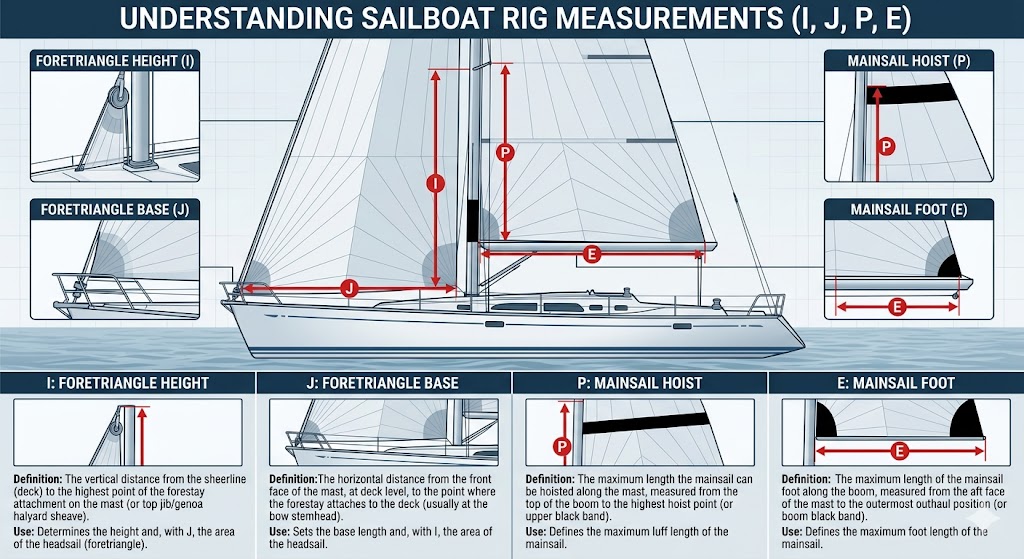
Rig Dimensions
I (Foretriangle Height) 45.83 ft / 13.97 m
J (Foretriangle Base) 16.67 ft / 5.08 m
P (Mainsail Luff) 39.00 ft / 11.89 m
E (Mainsail Foot) 14.50 ft / 4.42 m
SA Fore 381.99 ft² / 35.49 m²
SA Main 282.75 ft² / 26.27 m²
SA Total (100%) 664.74 ft² / 61.76 m²
Est. Forestay Length 48.77 ft / 14.87 m
Mast Height (DWL) 49.50 ft / 15.09 m
Engine & Accommodations
Engine Type Diesel
Horsepower 38
Fuel Capacity 50 gals / 189 L
Water Capacity 90 gals / 341 L
Find a Island Packet 37 For Sale