Back to Search
Irwin 52
Designer: Ted Irwin  ·  Builder: Irwin Yachts (Usa)  ·  First built: 1976
+ Add to Compare
Videos
About the Irwin 52

Launched in 1976 and produced through 1985, this substantial cruising ketch represents Ted Irwin's vision of a comfortable offshore sailing yacht during the golden age of American fiberglass boat building. With 250 hulls completed over nearly a decade of production, the design proved popular among serious cruising sailors seeking a capable bluewater platform. The staysail ketch configuration provides excellent sail handling flexibility for shorthanded crews, while the generous beam of over 15 feet creates spacious interior accommodations that made these boats popular with liveaboard cruisers. The fin keel with rudder mounted on a protective skeg offers a good balance of performance and protection, particularly valuable when exploring remote anchorages or dealing with floating debris offshore. Built by Irwin Yachts in Florida, these boats earned a reputation for solid construction and practical layouts suited to extended cruising. The moderate displacement and sail area provide steady performance without being overpowered, while the comfort ratio suggests good motion at sea. The capsize screening number indicates reasonable offshore capability for experienced crews. Today, these boats remain sought after by sailors planning serious cruising adventures, offering proven offshore capability with the spacious accommodations that made Irwin's larger designs particularly appealing to the cruising community.

Market Price Estimate Beta
Small sample size. This estimate is based on fewer than 5 listings and may not be representative of the true market. Use with caution.
$60,000 – $60,000
typical asking price
Median $60,000  ·  2 listings used
All listings
$60,000 – $60,000 2
Rate a listing price
$
About this estimate
  • Prices are based on recent asking prices from public listings — not actual sale prices, which are typically lower.
  • Condition is not factored in. A well-maintained boat with new sails and engine can be worth significantly more than a project boat of the same model.
  • Location affects price. Boats in landlocked states or areas with fewer buyers often sell for less than those on the coast.
  • Year of manufacture is not filtered. Older examples of this model will generally be priced lower than newer ones.
  • Included equipment varies widely. A boat with a full suite of electronics, dodger, and new standing rigging may command a large premium.
  • Outliers are automatically excluded using statistical filtering to improve accuracy, but some bad data may remain.
Core Dimensions
LOA (Length Overall) 52.00 ft / 15.85 m
LWL (Waterline Length) 44.00 ft / 13.41 m
Beam 15.33 ft / 4.67 m
Max Draft 7.00 ft / 2.13 m
Displacement 55,000.00 lb / 24,948 kg
Ballast 16,100.00 lb / 7,303 kg
Sail Area (Reported) 1,370.00 ft² / 127.28 m²
Design & Construction
Hull Type Fin with rudder on skeg
Rigging Type Staysail Ketch
Construction FG
Designer Ted Irwin
Builder Irwin Yachts (USA)
First Built 1976
Last Built 1985
Number Built 250
Associations Irwin Facebook Group
Owner Reviews

No owner reviews yet — be the first to share your experience with this boat.

Known Issues & What to Watch For
High Hull/Deck
Irwin used a pan-style inner liner bonded to the hull shell on the 52, and the bond between the liner and hull can fail over time, leading to flexing, water entrapment, and delamination in the bilge and under-sole areas that is very difficult to detect without moisture metering or destructive inspection.
High Hull/Deck
The deck hardware on Irwin 52s was frequently through-bolted into cored deck sections without adequate backing plates or proper sealing of core penetrations. Water intrusion into the balsa or foam core around chainplates, stanchion bases, and cleats is extremely common, resulting in widespread soft deck areas.
High Hull/Deck
The hull-to-deck joint on Irwin 52s relies on an inward-turned flange that is bolted and bedded, but the joint is prone to separation and leaking, particularly in the bow section and at the stern quarters. This joint should be probed carefully for movement and sealant failure.
High Keel
The fin keel attachment on these boats uses steel keel bolts that are prone to corrosion and weeping. The sump area around the keel stub is often filled with debris and standing water, accelerating bolt corrosion. Keel bolt inspection and possible replacement is commonly required on boats of this era.
High Rigging
The chainplate knees on the Irwin 52 are glassed directly to the hull liner rather than to the hull shell itself, which means chainplate loads are transferred into the liner rather than the structural hull. This arrangement can cause liner delamination and chainplate pullout under heavy sailing loads.
Medium Rigging
Irwin 52s were built with a fractional or masthead ketch rig depending on the year and configuration; the mast partners and compression post alignment have been noted to shift over time due to liner flexing, causing mast base compression issues and misalignment that should be carefully assessed.
High Hull/Deck
The skeg supporting the rudder on these vessels was lightly constructed and is vulnerable to impact damage and delamination at the skeg-to-hull join. Surveyors have noted cracking and separation at this junction on a significant number of Irwin 52s inspected.
Medium Accommodations
The interior joinery on Irwin 52s was produced to a budget standard and the plywood used in cabinetry frequently shows delamination, swelling, and mold penetration due to chronically damp bilge conditions associated with the liner construction. Full interior wood replacement is common on older examples.
Medium Electrical
Irwin's factory wiring on 1970s–early 1980s production used undersized wire runs and non-tinned copper in a wet environment, leading to widespread corrosion and deterioration of the original electrical harness. A full rewire is frequently necessary on unrestored boats.
1976–1982 models
Medium Engine
The engine compartment on the Irwin 52 is tight and poorly ventilated by modern standards, and the original engine beds are glassed into the liner rather than the hull, leading to soft or cracked engine mounts over time. Engine alignment problems are a recurring issue.

Own or have surveyed a Irwin 52? Submit a known issue
Performance Ratios
PHRF Rating PHRF (Performance Handicap Racing Fleet) is a national racing handicap measured in seconds per nautical mile. Lower values indicate faster boats. Ratings are sourced from US Sailing's national database (median across 60+ regional fleets).
Under 0 — Ultralight racer0–90 — Performance racer90–150 — Cruiser/racer150–210 — Typical cruiserOver 210 — Heavy/slow cruiser
117
SA/Displacement Sail Area to Displacement ratio measures how much sail power a boat has relative to its weight. Higher values mean more performance and speed.
Under 14 — Heavy cruiser, slow14–18 — Cruising sailboat18–22 — Cruiser/racerOver 22 — Performance racer
15.22
Ballast/Displacement Ballast to Displacement ratio shows what percentage of the boat's total weight is ballast. Higher values generally mean better initial stability and stiffer sail carrying.
30–35% — Typical cruiser35–45% — Stiff performance boatOver 45% — Racing oriented
29.27
Displacement/Length Displacement to Length ratio measures how heavy a boat is relative to its waterline length. Lower values mean a lighter, faster boat.
Under 100 — Ultralight racer100–200 — Light cruiser/racer200–300 — Moderate cruiser300–400 — Heavy cruiserOver 400 — Very heavy
288.24
Comfort Ratio Ted Brewer's Comfort Ratio predicts how comfortable a boat will feel in offshore conditions. Higher values mean a steadier, more comfortable motion in a seaway.
Under 20 — Uncomfortably rough20–30 — Acceptable coastal30–40 — Good offshore comfortOver 40 — Very comfortable offshore
48.32
Capsize Screening Formula The USHS Capsize Screening Formula estimates offshore capsize risk. Lower is safer — values under 2.0 are considered acceptable for offshore sailing.
Under 2.0 — Safe for offshore2.0–2.2 — Borderline offshoreOver 2.2 — Coastal use recommended
1.62
Hull Speed Hull Speed is the theoretical maximum speed of a displacement hull, calculated from waterline length. Most cruising sailboats reach this speed in moderate conditions. 8.89 kn
S# (Speed Number) The Speed Number (S#) is a quick performance index. Higher values indicate a faster, more powerful design relative to its size.
Under 3.0 — Slow cruiser3.0–5.0 — Average cruiser5.0–7.0 — Performance cruiserOver 7.0 — Racer
1.51
Pounds/Inch Immersion Pounds per Inch Immersion (PPI) tells you how much weight is needed to sink the boat one inch. Useful for calculating how additional gear and stores affect waterline. 2,410.13 pounds/inch
SA/Displacement (Calc) Calculated Sail Area to Displacement ratio using actual measured sail dimensions rather than reported values. More precise than the reported SA/Disp figure. 13.27
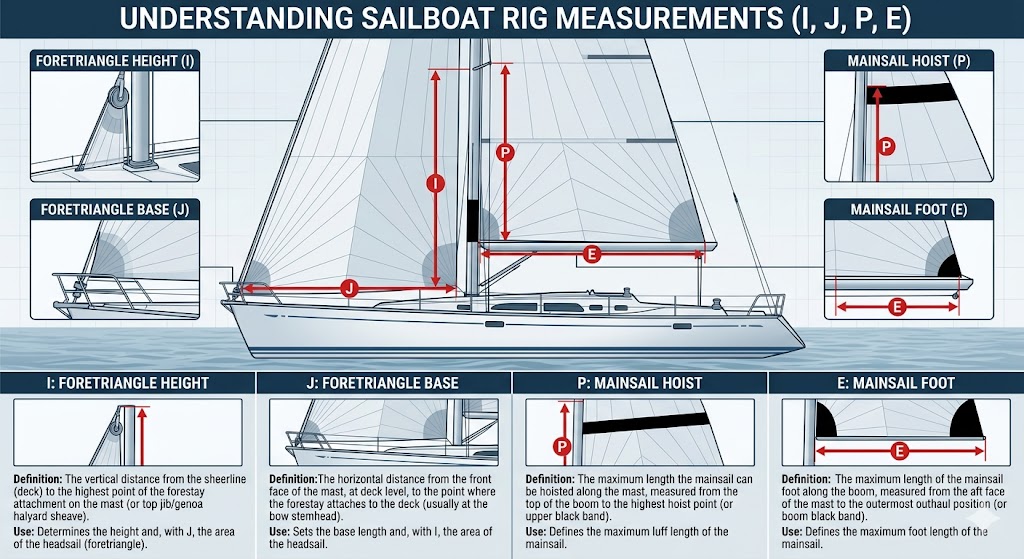
Rig Dimensions
I (Foretriangle Height) 59.33 ft / 18.08 m
J (Foretriangle Base) 22.21 ft / 6.77 m
P (Mainsail Luff) 53.50 ft / 16.31 m
E (Mainsail Foot) 20.00 ft / 6.10 m
SA Fore 658.86 ft² / 61.21 m²
SA Main 535.00 ft² / 49.70 m²
SA Total (100%) 1,193.86 ft² / 110.91 m²
Est. Forestay Length 63.35 ft / 19.31 m
Mast Height (DWL) 67.00 ft / 20.42 m
Engine & Accommodations
Engine Make Perkins
Engine Model 4-236
Engine Type Diesel
Horsepower 85
Find a Irwin 52 For Sale