Back to Search
Irwin 37 3
Designer: Ted Irwin  ·  Builder: Irwin Yachts (Usa)  ·  First built: 1976
+ Add to Compare
Videos
About the Irwin 37 3

Designed by Ted Irwin and built by Irwin Yachts starting in 1976, this 37-footer represents the builder's approach to affordable cruising sailboats during the height of the fiberglass boat boom. The Irwin 37 3 features a cutter rig configuration that provides versatility for various wind conditions, making it well-suited for coastal cruising and moderate offshore passages. With a fin keel and rudder-on-skeg configuration, the boat offers a good balance between performance and directional stability. The generous beam of 11.50 feet provides ample interior volume while maintaining reasonable sailing characteristics. At 20,000 pounds displacement with 7,800 pounds of ballast, the boat carries enough weight for stability in heavier conditions while remaining manageable for a small crew. The comfort ratio of 37.23 indicates a motion that favors seakindliness over speed, typical of cruising-oriented designs from this era. The capsize screening formula of 1.7 suggests reasonable offshore capability, though the boat is primarily suited for coastal and near-coastal cruising rather than extended blue-water voyaging. Irwin Yachts built affordable boats that appealed to sailors seeking solid construction and practical layouts, making this model a sensible choice for weekend cruising and short-term liveaboard situations.

Core Dimensions
LOA (Length Overall) 37.00 ft / 11.28 m
LWL (Waterline Length) 30.00 ft / 9.14 m
Beam 11.50 ft / 3.51 m
Max Draft 4.00 ft / 1.22 m
Displacement 20,000.00 lb / 9,072 kg
Ballast 7,800.00 lb / 3,538 kg
Sail Area (Reported) 630.00 ft² / 58.53 m²
Design & Construction
Hull Type Fin with rudder on skeg
Rigging Type Cutter
Construction FG
Designer Ted Irwin
Builder Irwin Yachts (USA)
First Built 1976
Associations Irwin Facebook Group
Owner Reviews

No owner reviews yet — be the first to share your experience with this boat.

Known Issues & What to Watch For
High Hull/Deck
Irwin used a hull-to-deck joint that relied heavily on sealant rather than a robust mechanical connection with through-bolting. On the 37, this joint is prone to weeping and separation, particularly along the toerail, allowing water intrusion into the deck core.
High Hull/Deck
Balsa core was used extensively in the deck construction. Around chainplates, stanchion bases, and hardware penetrations, the core is frequently found saturated or rotted due to inadequate original bedding and years of fastener weeping.
High Keel
The fin keel attachment on early Irwin 37s used a relatively shallow keel sump with steel keel bolts that are prone to corrosion and weeping. Keel bolt encapsulation makes direct inspection difficult; soft or stained areas in the bilge near the keel sump are a serious warning sign.
High Rigging
Chainplate backing plates were often undersized or inadequately bonded, and the chainplates pass through the deck without proper deck-level sealing. Water intrusion at these points accelerates core rot and can compromise chainplate integrity over time.
Medium Hull/Deck
The large cockpit design on the Irwin 37 features cockpit drains that are often of marginal diameter. Drain hoses frequently collapse or kink over time, slowing cockpit drainage — a concern in heavy weather situations.
Low Accommodations
Interior joinery in Irwin boats of this era used lightweight teak-faced plywood that delaminates and swells with repeated exposure to moisture. Overhead liners and hull-side panels are particularly prone to separation and sagging.
Medium Electrical
Irwin's original wiring from 1970s production used undersized wire runs with minimal circuit protection and non-tinned copper wire. Corrosion and insulation degradation in the original wiring harness is common; partial or full rewiring is often necessary on unrestored examples.
Medium Engine
The engine compartment on the Irwin 37 is relatively tight, making access to the raw water pump, heat exchanger, and transmission difficult. Many boats of this era were fitted with older Universal or Perkins diesels whose heat exchanger end caps and impeller housings are difficult to service without partial engine removal.

Own or have surveyed a Irwin 37 3? Submit a known issue
Performance Ratios
SA/Displacement Sail Area to Displacement ratio measures how much sail power a boat has relative to its weight. Higher values mean more performance and speed.
Under 14 — Heavy cruiser, slow14–18 — Cruising sailboat18–22 — Cruiser/racerOver 22 — Performance racer
13.73
Ballast/Displacement Ballast to Displacement ratio shows what percentage of the boat's total weight is ballast. Higher values generally mean better initial stability and stiffer sail carrying.
30–35% — Typical cruiser35–45% — Stiff performance boatOver 45% — Racing oriented
39
Displacement/Length Displacement to Length ratio measures how heavy a boat is relative to its waterline length. Lower values mean a lighter, faster boat.
Under 100 — Ultralight racer100–200 — Light cruiser/racer200–300 — Moderate cruiser300–400 — Heavy cruiserOver 400 — Very heavy
330.69
Comfort Ratio Ted Brewer's Comfort Ratio predicts how comfortable a boat will feel in offshore conditions. Higher values mean a steadier, more comfortable motion in a seaway.
Under 20 — Uncomfortably rough20–30 — Acceptable coastal30–40 — Good offshore comfortOver 40 — Very comfortable offshore
37.23
Capsize Screening Formula The USHS Capsize Screening Formula estimates offshore capsize risk. Lower is safer — values under 2.0 are considered acceptable for offshore sailing.
Under 2.0 — Safe for offshore2.0–2.2 — Borderline offshoreOver 2.2 — Coastal use recommended
1.7
Hull Speed Hull Speed is the theoretical maximum speed of a displacement hull, calculated from waterline length. Most cruising sailboats reach this speed in moderate conditions. 7.34 kn
S# (Speed Number) The Speed Number (S#) is a quick performance index. Higher values indicate a faster, more powerful design relative to its size.
Under 3.0 — Slow cruiser3.0–5.0 — Average cruiser5.0–7.0 — Performance cruiserOver 7.0 — Racer
1.29
Pounds/Inch Immersion Pounds per Inch Immersion (PPI) tells you how much weight is needed to sink the boat one inch. Useful for calculating how additional gear and stores affect waterline. 1,232.72 pounds/inch
SA/Displacement (Calc) Calculated Sail Area to Displacement ratio using actual measured sail dimensions rather than reported values. More precise than the reported SA/Disp figure. 13.72
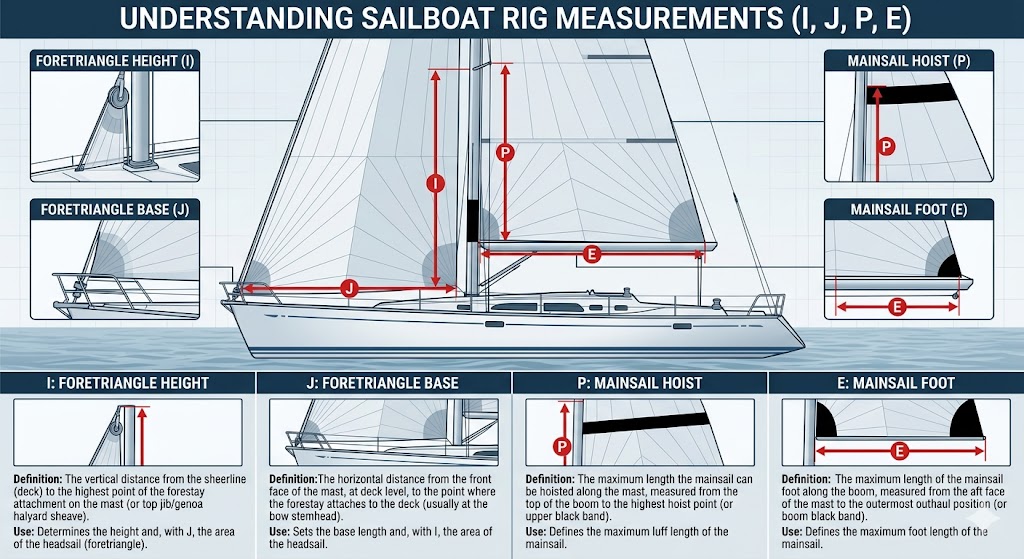
Rig Dimensions
I (Foretriangle Height) 42.00 ft / 12.80 m
J (Foretriangle Base) 17.60 ft / 5.36 m
P (Mainsail Luff) 35.60 ft / 10.85 m
E (Mainsail Foot) 14.60 ft / 4.45 m
SA Fore 369.60 ft² / 34.34 m²
SA Main 259.88 ft² / 24.14 m²
SA Total (100%) 629.48 ft² / 58.48 m²
Est. Forestay Length 45.54 ft / 13.88 m
Mast Height (DWL) 46.00 ft / 14.02 m
Engine & Accommodations
Engine Make Perkins
Engine Model 4-108
Engine Type Diesel
Fuel Capacity 85 gals / 322 L
Water Capacity 180 gals / 681 L
Find a Irwin 37 3 For Sale