Back to Search
Irwin 32
Designer: Ted Irwin  ·  Builder: Irwin Yachts (Usa)  ·  First built: 1970
+ Add to Compare
Videos
About the Irwin 32

Built from 1970 to 1974, this Ted Irwin-designed cruiser represents solid early-1970s sailboat construction with a focus on comfortable coastal cruising. The fiberglass hull combines traditional lines with practical accommodations, making it an appealing choice for sailors seeking an affordable entry into larger boat ownership. With its masthead sloop rig and moderate sail area, the Irwin 32 delivers steady performance without being overly demanding to handle. The keel/centerboard configuration offers versatility, allowing access to shallow anchorages while maintaining good upwind performance when the board is deployed. At 11,500 pounds with 5,000 pounds of ballast, she provides reassuring stability for extended coastal passages. The boat's comfort ratio of 31.93 suggests a motion that favors relaxed cruising over athletic sailing, while the capsize screening value of 1.72 indicates reasonable offshore capability for experienced crews. Her hull speed of 6.70 knots reflects typical performance expectations for this era of cruising designs. Ted Irwin's reputation for practical, well-built boats shines through in this model, which has earned respect among budget-conscious cruisers. The Irwin 32 suits sailors prioritizing comfort and reliability over racing performance, making it ideal for weekend coastal exploration and extended gunkholing adventures.

Core Dimensions
LOA (Length Overall) 32.00 ft / 9.75 m
LWL (Waterline Length) 25.00 ft / 7.62 m
Beam 9.67 ft / 2.95 m
Max Draft 7.83 ft / 2.39 m
Min Draft 3.50 ft / 1.07 m
Displacement 11,500.00 lb / 5,216 kg
Ballast 5,000.00 lb / 2,268 kg
Ballast Type Lead
Sail Area (Reported) 498.00 ft² / 46.27 m²
Design & Construction
Hull Type Keel/Cbrd.
Rigging Type Masthead Sloop
Construction FG
Designer Ted Irwin
Builder Irwin Yachts (USA)
First Built 1970
Last Built 1974
Associations Irwin Facebook Group
Owner Reviews

No owner reviews yet — be the first to share your experience with this boat.

Known Issues & What to Watch For

No known issues documented for this model yet.

Own or have surveyed a Irwin 32? Submit a known issue
Performance Ratios
PHRF Rating PHRF (Performance Handicap Racing Fleet) is a national racing handicap measured in seconds per nautical mile. Lower values indicate faster boats. Ratings are sourced from US Sailing's national database (median across 60+ regional fleets).
Under 0 — Ultralight racer0–90 — Performance racer90–150 — Cruiser/racer150–210 — Typical cruiserOver 210 — Heavy/slow cruiser
177
SA/Displacement Sail Area to Displacement ratio measures how much sail power a boat has relative to its weight. Higher values mean more performance and speed.
Under 14 — Heavy cruiser, slow14–18 — Cruising sailboat18–22 — Cruiser/racerOver 22 — Performance racer
15.69
Ballast/Displacement Ballast to Displacement ratio shows what percentage of the boat's total weight is ballast. Higher values generally mean better initial stability and stiffer sail carrying.
30–35% — Typical cruiser35–45% — Stiff performance boatOver 45% — Racing oriented
43.48
Displacement/Length Displacement to Length ratio measures how heavy a boat is relative to its waterline length. Lower values mean a lighter, faster boat.
Under 100 — Ultralight racer100–200 — Light cruiser/racer200–300 — Moderate cruiser300–400 — Heavy cruiserOver 400 — Very heavy
328.57
Comfort Ratio Ted Brewer's Comfort Ratio predicts how comfortable a boat will feel in offshore conditions. Higher values mean a steadier, more comfortable motion in a seaway.
Under 20 — Uncomfortably rough20–30 — Acceptable coastal30–40 — Good offshore comfortOver 40 — Very comfortable offshore
31.93
Capsize Screening Formula The USHS Capsize Screening Formula estimates offshore capsize risk. Lower is safer — values under 2.0 are considered acceptable for offshore sailing.
Under 2.0 — Safe for offshore2.0–2.2 — Borderline offshoreOver 2.2 — Coastal use recommended
1.72
Hull Speed Hull Speed is the theoretical maximum speed of a displacement hull, calculated from waterline length. Most cruising sailboats reach this speed in moderate conditions. 6.70 kn
S# (Speed Number) The Speed Number (S#) is a quick performance index. Higher values indicate a faster, more powerful design relative to its size.
Under 3.0 — Slow cruiser3.0–5.0 — Average cruiser5.0–7.0 — Performance cruiserOver 7.0 — Racer
1.45
Pounds/Inch Immersion Pounds per Inch Immersion (PPI) tells you how much weight is needed to sink the boat one inch. Useful for calculating how additional gear and stores affect waterline. 863.80 pounds/inch
SA/Displacement (Calc) Calculated Sail Area to Displacement ratio using actual measured sail dimensions rather than reported values. More precise than the reported SA/Disp figure. 15.7
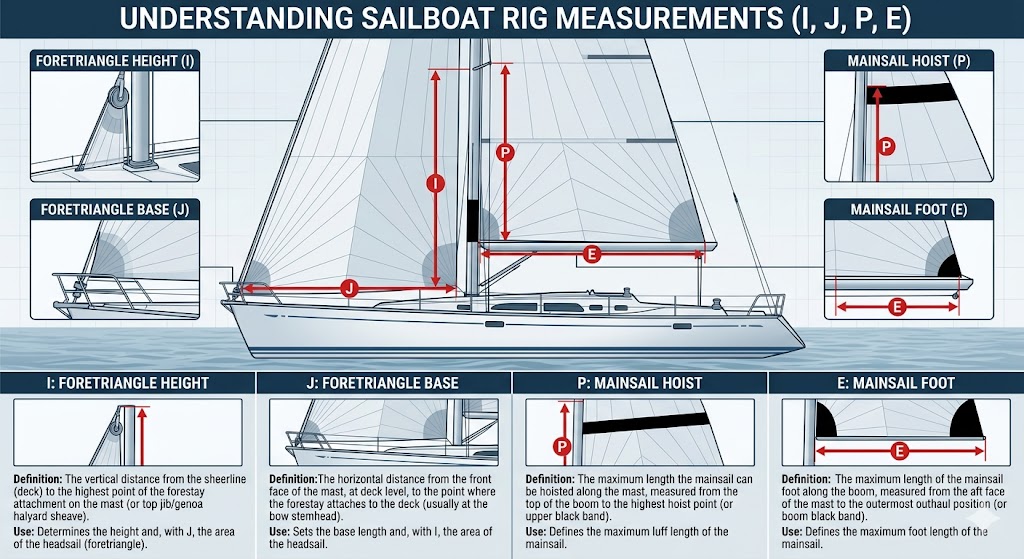
Rig Dimensions
I (Foretriangle Height) 39.50 ft / 12.04 m
J (Foretriangle Base) 13.00 ft / 3.96 m
P (Mainsail Luff) 34.50 ft / 10.52 m
E (Mainsail Foot) 14.00 ft / 4.27 m
SA Fore 256.75 ft² / 23.85 m²
SA Main 241.50 ft² / 22.44 m²
SA Total (100%) 498.25 ft² / 46.29 m²
Est. Forestay Length 41.58 ft / 12.67 m
Engine & Accommodations
Engine Make Universal
Engine Model Atomic 4
Engine Type Gas
Horsepower 30
Find a Irwin 32 For Sale