Back to Search
Irwin 31
Designer: Ted Irwin  ·  Builder: Irwin Yachts (Usa)  ·  First built: 1968
+ Add to Compare
Videos
Irwin 31
Photo: Ahunt / CC0
About the Irwin 31

Launched in 1968, this Ted Irwin design represents one of the earlier entries in the production cruising sailboat market that would flourish throughout the following decades. The Irwin 31 combines traditional proportions with practical features that made it an attractive choice for coastal cruising and weekend sailing. With a displacement of 9,600 pounds and substantial ballast of 3,800 pounds, this masthead sloop offers reassuring stability for cruising sailors. The 7.5-foot draft provides good upwind performance while remaining manageable for most harbors and anchorages. The fiberglass construction with balsa-cored decking reflects quality building practices of the era, delivering both strength and reduced weight aloft. The boat's sail area of 448 square feet and SA/Displacement ratio of 15.92 indicate moderate performance characteristics well-suited to comfortable cruising rather than racing. The comfort ratio of 29.37 suggests a motion that favors seaworthiness over speed, while the capsize screening value of 1.81 falls within acceptable ranges for coastal sailing. Built by Irwin Yachts in the USA, this design helped establish the builder's reputation for producing affordable, well-constructed cruising boats. The 25-horsepower auxiliary engine provides adequate power for maneuvering and charging systems during extended cruising.

Core Dimensions
LOA (Length Overall) 31.08 ft / 9.47 m
LWL (Waterline Length) 22.25 ft / 6.78 m
Beam 9.58 ft / 2.92 m
Max Draft 7.50 ft / 2.29 m
Min Draft 3.33 ft / 1.01 m
Displacement 9,600.00 lb / 4,354 kg
Ballast 3,800.00 lb / 1,724 kg
Ballast Type Lead
Sail Area (Reported) 448.00 ft² / 41.62 m²
Design & Construction
Hull Type Keel/Cbrd.
Rigging Type Masthead Sloop
Construction FG w/balsa cored deck
Designer Ted Irwin
Builder Irwin Yachts (USA)
First Built 1968
Associations Irwin Facebook Group
Owner Reviews

No owner reviews yet — be the first to share your experience with this boat.

Known Issues & What to Watch For
High Hull/Deck
The balsa-cored deck is prone to water intrusion around deck hardware, chainplates, and stanchion bases, leading to core rot. Irwin's deck hardware installation practices of this era were not consistently well-bedded, making wet or punky core a very common finding on surveys.
Medium Hull/Deck
The deck-to-hull joint on early Irwin boats used an outward-turning flange secured with through-bolts and typically covered by an aluminum toe rail. This joint is known to leak and should be carefully inspected for separation, water intrusion, and fastener corrosion.
1968–1975 models
High Keel
The centerboard trunk on the keel/centerboard configuration is prone to leaking where it meets the hull. The pivot pin and pendant hardware for the centerboard are also subject to corrosion and wear, and replacement parts can be difficult to source.
High Keel
The centerboard pendant and its attachment hardware inside the trunk are difficult to inspect and frequently deteriorate undetected. Failure of the pendant can result in the board dropping or becoming inoperable at sea.
Medium Hull/Deck
Irwin used relatively thin fiberglass layups in the hull on early 31s, and stress cracking around the keel trunk area and chainplate attachment points is commonly reported. These cracks should be assessed carefully to rule out structural flexing.
1968–1978 models
High Rigging
Chainplate attachment on the Irwin 31 is often through the deck or to interior bulkheads that are not fully bonded to the hull. Bulkhead delamination or fastener pull-through at chainplate locations has been reported and warrants close inspection.
Medium Accommodations
Interior joinerwork and bulkhead bonding on Irwin boats of this era is often done with minimal or deteriorated tabbing. Bulkheads may have separated from the hull liner over time, reducing structural integrity and causing cosmetic damage.
Medium Hull/Deck
The rudder on the Irwin 31 is a fiberglass shell construction that can develop internal voids and water intrusion. Waterlogged rudders are a known issue and can affect steering feel; sounding the rudder during survey is essential.

Own or have surveyed a Irwin 31? Submit a known issue
Performance Ratios
PHRF Rating PHRF (Performance Handicap Racing Fleet) is a national racing handicap measured in seconds per nautical mile. Lower values indicate faster boats. Ratings are sourced from US Sailing's national database (median across 60+ regional fleets).
Under 0 — Ultralight racer0–90 — Performance racer90–150 — Cruiser/racer150–210 — Typical cruiserOver 210 — Heavy/slow cruiser
192
SA/Displacement Sail Area to Displacement ratio measures how much sail power a boat has relative to its weight. Higher values mean more performance and speed.
Under 14 — Heavy cruiser, slow14–18 — Cruising sailboat18–22 — Cruiser/racerOver 22 — Performance racer
15.92
Ballast/Displacement Ballast to Displacement ratio shows what percentage of the boat's total weight is ballast. Higher values generally mean better initial stability and stiffer sail carrying.
30–35% — Typical cruiser35–45% — Stiff performance boatOver 45% — Racing oriented
39.58
Displacement/Length Displacement to Length ratio measures how heavy a boat is relative to its waterline length. Lower values mean a lighter, faster boat.
Under 100 — Ultralight racer100–200 — Light cruiser/racer200–300 — Moderate cruiser300–400 — Heavy cruiserOver 400 — Very heavy
389.07
Comfort Ratio Ted Brewer's Comfort Ratio predicts how comfortable a boat will feel in offshore conditions. Higher values mean a steadier, more comfortable motion in a seaway.
Under 20 — Uncomfortably rough20–30 — Acceptable coastal30–40 — Good offshore comfortOver 40 — Very comfortable offshore
29.37
Capsize Screening Formula The USHS Capsize Screening Formula estimates offshore capsize risk. Lower is safer — values under 2.0 are considered acceptable for offshore sailing.
Under 2.0 — Safe for offshore2.0–2.2 — Borderline offshoreOver 2.2 — Coastal use recommended
1.81
Hull Speed Hull Speed is the theoretical maximum speed of a displacement hull, calculated from waterline length. Most cruising sailboats reach this speed in moderate conditions. 6.32 kn
S# (Speed Number) The Speed Number (S#) is a quick performance index. Higher values indicate a faster, more powerful design relative to its size.
Under 3.0 — Slow cruiser3.0–5.0 — Average cruiser5.0–7.0 — Performance cruiserOver 7.0 — Racer
1.13
Pounds/Inch Immersion Pounds per Inch Immersion (PPI) tells you how much weight is needed to sink the boat one inch. Useful for calculating how additional gear and stores affect waterline. 761.63 pounds/inch
SA/Displacement (Calc) Calculated Sail Area to Displacement ratio using actual measured sail dimensions rather than reported values. More precise than the reported SA/Disp figure. 15.92
Rig Dimensions
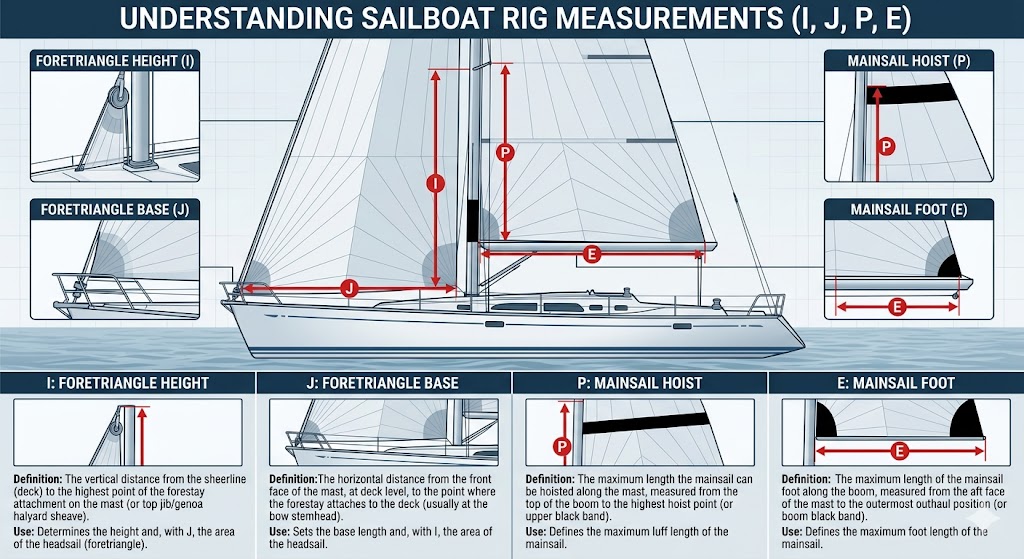
I (Foretriangle Height) 37.00 ft / 11.28 m
J (Foretriangle Base) 12.10 ft / 3.69 m
P (Mainsail Luff) 32.00 ft / 9.75 m
E (Mainsail Foot) 14.00 ft / 4.27 m
SA Fore 223.85 ft² / 20.80 m²
SA Main 224.00 ft² / 20.81 m²
SA Total (100%) 447.85 ft² / 41.61 m²
Est. Forestay Length 38.93 ft / 11.87 m
Engine & Accommodations
Engine Make Universal
Engine Model Atomic 4
Engine Type Gas
Horsepower 25
Fuel Capacity 25 gals / 95 L
Water Capacity 50 gals / 189 L
How It Compares

vs. Catalina 310, Hughes 31, Island Packet 31, Offshore 31 Cheoy Lee, Seafarer 31 Mkii

This boat Similar boats
Dimensions
LOA
Irwin 31 ★
31.1 ft
Catalina 310
31.0 ft
Hughes 31
31.0 ft
Island Packet 31
31.0 ft
Offshore 31 Cheoy Lee
31.0 ft
Seafarer 31 Mkii
31.0 ft
LWL
Irwin 31 ★
22.3 ft
Catalina 310
26.5 ft
Hughes 31
24.0 ft
Island Packet 31
27.8 ft
Offshore 31 Cheoy Lee
23.3 ft
Seafarer 31 Mkii
25.1 ft
Beam
Irwin 31 ★
9.6 ft
Catalina 310
11.5 ft
Hughes 31
9.7 ft
Island Packet 31
11.6 ft
Offshore 31 Cheoy Lee
8.8 ft
Seafarer 31 Mkii
9.8 ft
Displacement
Irwin 31 ★
9 lbs
Catalina 310
10 lbs
Hughes 31
9 lbs
Island Packet 31
11 lbs
Offshore 31 Cheoy Lee
10 lbs
Seafarer 31 Mkii
10 lbs
Ballast
Irwin 31 ★
3 lbs
Catalina 310
4 lbs
Hughes 31
3 lbs
Island Packet 31
4 lbs
Offshore 31 Cheoy Lee
3 lbs
Seafarer 31 Mkii
4 lbs
Sail Area
Irwin 31 ★
448 sq ft
Catalina 310
493 sq ft
Hughes 31
Island Packet 31
530 sq ft
Offshore 31 Cheoy Lee
403 sq ft
Seafarer 31 Mkii
Performance
PHRF Rating (lower = faster)
Irwin 31 ★
192 s/nm
Catalina 310
177 s/nm
Hughes 31
191 s/nm
Island Packet 31
186 s/nm
Offshore 31 Cheoy Lee
Seafarer 31 Mkii
SA / Displacement (higher = more powerful)
Irwin 31 ★
15.9
Catalina 310
16.7
Hughes 31
Island Packet 31
17.2
Offshore 31 Cheoy Lee
13.3
Seafarer 31 Mkii
Ballast / Disp (higher = stiffer)
Irwin 31 ★
39.6 %
Catalina 310
38.8 %
Hughes 31
36.8 %
Island Packet 31
40.9 %
Offshore 31 Cheoy Lee
35.5 %
Seafarer 31 Mkii
47.1 %
Comfort Ratio (higher = more comfortable offshore)
Irwin 31 ★
29.4
Catalina 310
22.1
Hughes 31
Island Packet 31
22.6
Offshore 31 Cheoy Lee
35.9
Seafarer 31 Mkii
Capsize Screening (lower = safer)
Irwin 31 ★
1.81
Catalina 310
2.12
Hughes 31
Island Packet 31
2.09
Offshore 31 Cheoy Lee
1.59
Seafarer 31 Mkii
Displacement / Length (lower = lighter)
Irwin 31 ★
389
Catalina 310
247
Hughes 31
293
Island Packet 31
229
Offshore 31 Cheoy Lee
376
Seafarer 31 Mkii
291
Hull Speed
Irwin 31 ★
6.3 kts
Catalina 310
6.9 kts
Hughes 31
Island Packet 31
7.1 kts
Offshore 31 Cheoy Lee
6.5 kts
Seafarer 31 Mkii
Speed Number (higher = faster)
Irwin 31 ★
1.1
Catalina 310
2.2
Hughes 31
Island Packet 31
2.4
Offshore 31 Cheoy Lee
1.0
Seafarer 31 Mkii
Resources & Community
Find a Irwin 31 For Sale