Back to Search
Hunter 45 Ds
Designer: Glenn Henderson  ·  Builder: Hunter Marine (Usa)  ·  First built: 2006
+ Add to Compare
Videos
Hunter 45 Ds
Photo: Ahunt / CC0
About the Hunter 45 Ds

Launched in 2006, this Glenn Henderson-designed cruiser represents Hunter Marine's focus on accessible performance sailing for the coastal and offshore cruising market. The 45 Ds combines a modern fin keel with spade rudder configuration and a generous 14.50-foot beam to deliver both stability and interior volume that appeals to serious cruising sailors. With a displacement of nearly 23,000 pounds and a ballast-to-displacement ratio of 32%, the boat strikes a balance between seaworthiness and sailing performance. The Bermuda-rigged sloop carries 833 square feet of sail area, providing adequate power for varied conditions while remaining manageable for shorthanded sailing. Her hull speed of 8.39 knots reflects the boat's cruising-oriented nature rather than racing aspirations. The boat's comfort ratio of 24.64 indicates a relatively stiff, quick motion that experienced sailors often prefer over a more cushioned ride, while the capsize screening formula of 2.05 falls within acceptable parameters for coastal cruising with occasional offshore passages. Hunter's fiberglass construction and the reliable 54-horsepower auxiliary engine round out a package designed for couples or small crews seeking comfortable, capable cruising performance along coastlines and to nearby offshore destinations.

Core Dimensions
LOA (Length Overall) 44.82 ft / 13.66 m
LWL (Waterline Length) 39.17 ft / 11.94 m
Beam 14.50 ft / 4.42 m
Max Draft 6.50 ft / 1.98 m
Displacement 22,937.00 lb / 10,404 kg
Ballast 7,238.00 lb / 3,283 kg
Ballast Type Iron
Sail Area (Reported) 833.00 ft² / 77.39 m²
Design & Construction
Hull Type Fin w/spade rudder
Rigging Type B&R
Construction FG
Designer Glenn Henderson
Builder Hunter Marine (USA)
First Built 2006
Owner Reviews

No owner reviews yet — be the first to share your experience with this boat.

Known Issues & What to Watch For
Medium Hull/Deck
The deck grid system used by Hunter on the 45DS is a molded inner liner bonded to the deck. Delamination between the liner and hull/deck can occur, particularly in the bow area and around chainplates, often telegraphing as creaking or flexing underfoot.
High Hull/Deck
Chainplate knees are glassed into the liner rather than through-bolted to structural bulkheads. This arrangement can allow chainplate movement and stress cracking in the deck laminate around the chainplate covers, which can lead to water intrusion into the cored deck.
Medium Hull/Deck
Hunter used balsa core in the deck throughout this model's production. Areas around stanchion bases, cleats, and hardware frequently show compression or rot in the core due to inadequate bedding or through-bolt backing plates, especially at lifeline stanchions.
High Keel
The shoal-draft keel option uses a bulb keel with a relatively thin stub. Inspect the keel-to-hull joint carefully for cracking or weeping, as the joint on some examples has shown stress cracking under sailing loads.
High Rigging
The mast on the 45DS is deck-stepped on a compression post that transfers load to the keel structure. The compression post base and its connection to the interior liner should be inspected for signs of movement or cracking in the surrounding fiberglass tabbing.
Medium Rigging
Hunter's in-mast furling mainsail system, standard on many 45DS builds, is prone to UV degradation of the sail material due to constant storage inside the mast, and the furling mechanism can jam if the sail is not properly profiled. Replacement sails for in-mast systems are expensive.
Medium Engine
Most 45DS models were fitted with a Yanmar 4JH diesel. The engine compartment access is tight and the raw water impeller and heat exchanger can be difficult to service. Overheating issues have been reported due to restricted raw water flow in neglected examples.
Medium Electrical
Hunter's factory wiring on the 45DS used a centralized electrical panel with runs that pass through the liner cavities, making tracing and repair of wiring faults difficult. Corrosion at terminal blocks inside sealed liner spaces is a known problem on boats used in saltwater.
Medium Accommodations
The large windows and portlights in the raised saloon/pilot house area are a signature feature of the 45DS but are known to leak at their frames over time. Water intrusion here can damage the interior joinery and the balsa-cored hull sides in the saloon area.
Low Hull/Deck
The twin helm station pedestals and associated cockpit locker lids on the 45DS are prone to hinge and latch failures, and the cockpit seat bases can develop soft spots from water intrusion into the balsa core around the hinge hardware.

Own or have surveyed a Hunter 45 Ds? Submit a known issue
Performance Ratios
SA/Displacement Sail Area to Displacement ratio measures how much sail power a boat has relative to its weight. Higher values mean more performance and speed.
Under 14 — Heavy cruiser, slow14–18 — Cruising sailboat18–22 — Cruiser/racerOver 22 — Performance racer
16.57
Ballast/Displacement Ballast to Displacement ratio shows what percentage of the boat's total weight is ballast. Higher values generally mean better initial stability and stiffer sail carrying.
30–35% — Typical cruiser35–45% — Stiff performance boatOver 45% — Racing oriented
31.56
Displacement/Length Displacement to Length ratio measures how heavy a boat is relative to its waterline length. Lower values mean a lighter, faster boat.
Under 100 — Ultralight racer100–200 — Light cruiser/racer200–300 — Moderate cruiser300–400 — Heavy cruiserOver 400 — Very heavy
170.38
Comfort Ratio Ted Brewer's Comfort Ratio predicts how comfortable a boat will feel in offshore conditions. Higher values mean a steadier, more comfortable motion in a seaway.
Under 20 — Uncomfortably rough20–30 — Acceptable coastal30–40 — Good offshore comfortOver 40 — Very comfortable offshore
24.64
Capsize Screening Formula The USHS Capsize Screening Formula estimates offshore capsize risk. Lower is safer — values under 2.0 are considered acceptable for offshore sailing.
Under 2.0 — Safe for offshore2.0–2.2 — Borderline offshoreOver 2.2 — Coastal use recommended
2.05
Hull Speed Hull Speed is the theoretical maximum speed of a displacement hull, calculated from waterline length. Most cruising sailboats reach this speed in moderate conditions. 8.39 kn
S# (Speed Number) The Speed Number (S#) is a quick performance index. Higher values indicate a faster, more powerful design relative to its size.
Under 3.0 — Slow cruiser3.0–5.0 — Average cruiser5.0–7.0 — Performance cruiserOver 7.0 — Racer
3.02
Pounds/Inch Immersion Pounds per Inch Immersion (PPI) tells you how much weight is needed to sink the boat one inch. Useful for calculating how additional gear and stores affect waterline. 2,029.40 pounds/inch
SA/Displacement (Calc) Calculated Sail Area to Displacement ratio using actual measured sail dimensions rather than reported values. More precise than the reported SA/Disp figure. 16.58
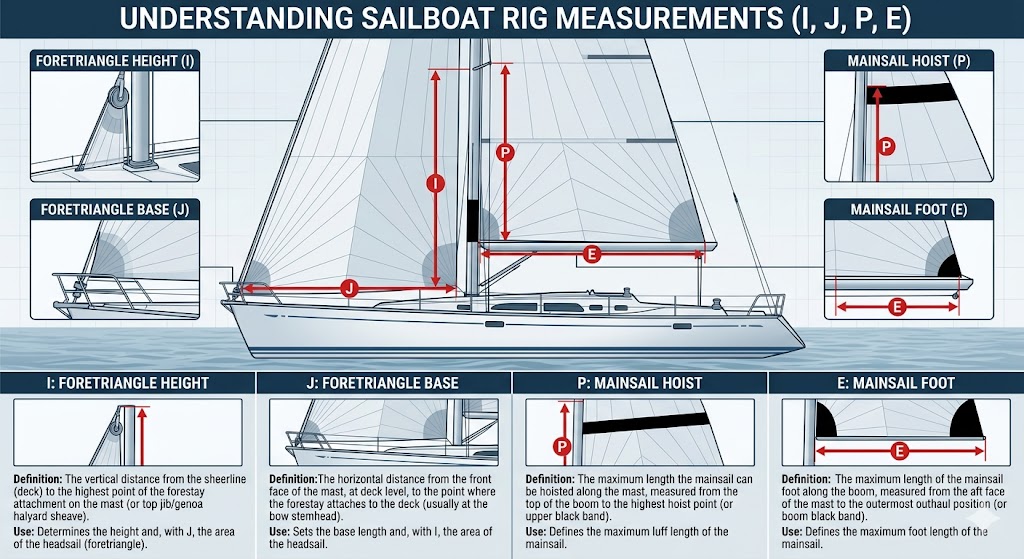
Rig Dimensions
I (Foretriangle Height) 47.93 ft / 14.61 m
J (Foretriangle Base) 14.67 ft / 4.47 m
P (Mainsail Luff) 46.49 ft / 14.17 m
E (Mainsail Foot) 20.73 ft / 6.32 m
SA Fore 351.57 ft² / 32.66 m²
SA Main 481.87 ft² / 44.77 m²
SA Total (100%) 833.44 ft² / 77.43 m²
Est. Forestay Length 50.12 ft / 15.28 m
Engine & Accommodations
Engine Make Yanmar
Engine Type Diesel
Horsepower 54
Fuel Capacity 66 gals / 250 L
Water Capacity 140 gals / 530 L
How It Compares

vs. Bavaria 45, Hunter 45 Legend, Tartan 4400

This boat Similar boats
Dimensions
LOA
Hunter 45 Ds ★
44.8 ft
Bavaria 45
45.0 ft
Hunter 45 Legend
45.0 ft
Tartan 4400
45.0 ft
LWL
Hunter 45 Ds ★
39.2 ft
Bavaria 45
Hunter 45 Legend
38.6 ft
Tartan 4400
37.5 ft
Beam
Hunter 45 Ds ★
14.5 ft
Bavaria 45
Hunter 45 Legend
14.3 ft
Tartan 4400
14.1 ft
Displacement
Hunter 45 Ds ★
22 lbs
Bavaria 45
Hunter 45 Legend
23 lbs
Tartan 4400
24 lbs
Ballast
Hunter 45 Ds ★
7 lbs
Bavaria 45
Hunter 45 Legend
9 lbs
Tartan 4400
9 lbs
Sail Area
Hunter 45 Ds ★
833 sq ft
Bavaria 45
Hunter 45 Legend
900 sq ft
Tartan 4400
Performance
PHRF Rating (lower = faster)
Hunter 45 Ds ★
Bavaria 45
Hunter 45 Legend
83 s/nm
Tartan 4400
96 s/nm
SA / Displacement (higher = more powerful)
Hunter 45 Ds ★
16.6
Bavaria 45
Hunter 45 Legend
17.8
Tartan 4400
Ballast / Disp (higher = stiffer)
Hunter 45 Ds ★
31.6 %
Bavaria 45
Hunter 45 Legend
40.0 %
Tartan 4400
37.5 %
Comfort Ratio (higher = more comfortable offshore)
Hunter 45 Ds ★
24.6
Bavaria 45
Hunter 45 Legend
25.3
Tartan 4400
Capsize Screening (lower = safer)
Hunter 45 Ds ★
2.05
Bavaria 45
Hunter 45 Legend
2.01
Tartan 4400
Displacement / Length (lower = lighter)
Hunter 45 Ds ★
170
Bavaria 45
Hunter 45 Legend
178
Tartan 4400
Hull Speed
Hunter 45 Ds ★
8.4 kts
Bavaria 45
Hunter 45 Legend
8.3 kts
Tartan 4400
Speed Number (higher = faster)
Hunter 45 Ds ★
3.0
Bavaria 45
Hunter 45 Legend
Tartan 4400
2.8
Resources & Community
Find a Hunter 45 Ds For Sale