Back to Search
Hunter 36 Legend
Designer: Glen Henderson  ·  Builder: Hunter Marine  ·  First built: 2001
+ Add to Compare
Videos
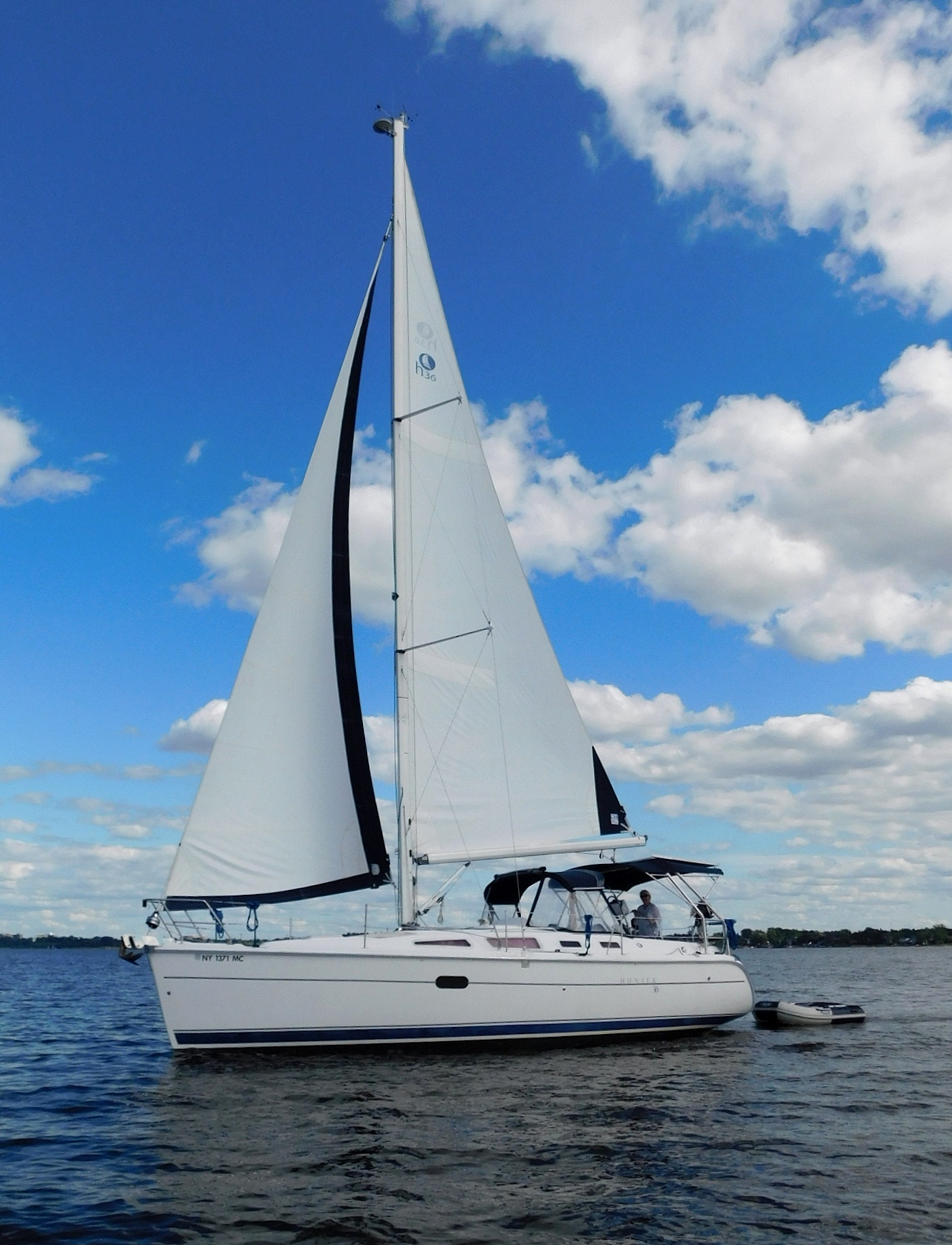
Hunter 36 Legend
Photo: Ahunt / CC0
About the Hunter 36 Legend

Designed by Glen Henderson and built by Hunter Marine starting in 2001, this 36-footer represents Hunter's commitment to creating accessible cruising sailboats for the recreational market. The Legend features a modern fin keel with spade rudder configuration and fiberglass construction, delivering predictable handling characteristics that appeal to both newer sailors and experienced cruisers seeking comfort over racing performance. With a displacement of 14,220 pounds and 5,075 pounds of ballast, the Hunter 36 Legend offers stability for coastal cruising and short offshore passages. The boat's 12.34-foot beam provides generous interior volume, a hallmark of Hunter's design philosophy that prioritizes livability. Her sail area of 721 square feet and Bermuda rigged configuration deliver adequate performance for cruising, while the theoretical hull speed of 7.52 knots matches expectations for a moderate displacement cruiser. The comfort ratio of 23.59 indicates this boat prioritizes ease of motion over racing speed, making it well-suited for extended coastal cruising and weekend sailing. The capsize screening formula of 2.04 suggests reasonable stability for protected waters and moderate conditions. Hunter Marine built a reputation for value-oriented cruising boats, and the 36 Legend continues this tradition with practical features and straightforward systems that appeal to cruising sailors seeking reliability over cutting-edge performance.

Core Dimensions
LOA (Length Overall) 35.73 ft / 10.89 m
LWL (Waterline Length) 31.53 ft / 9.61 m
Beam 12.34 ft / 3.76 m
Max Draft 5.00 ft / 1.52 m
Displacement 14,220.00 lb / 6,450 kg
Ballast 5,075.00 lb / 2,302 kg
Sail Area (Reported) 721.00 ft² / 66.98 m²
Headroom 6.42 ft / 1.96 m
Design & Construction
Hull Type Fin w/spade rudder
Rigging Type B&R
Construction FG
Designer Glen Henderson
Builder Hunter Marine
First Built 2001
Owner Reviews

No owner reviews yet — be the first to share your experience with this boat.

Known Issues & What to Watch For
Medium Hull/Deck
Hunter's hull-to-deck joint on this era of boats uses a toerail-bolted flange that is prone to leaking. Water intrusion along the joint can migrate below decks and cause core saturation in the side decks.
Medium Hull/Deck
The balsa-cored deck used throughout Hunter production of this period is known to absorb water around chainplate and hardware penetrations, leading to soft spots particularly around the mast base, shroud chainplates, and stanchion bases. Tap-testing the deck carefully is essential.
High Keel
The fin keel attachment on this era of Hunter uses a shallow sump with relatively few keel bolts. Keel-to-hull joint cracking and weeping are reported, and the joint should be inspected carefully for movement, stress cracking, or rust staining indicating fastener corrosion.
Medium Rigging
Hunter used an deck-stepped, fractional rig on this model with a relatively flexible mast. The mast compression post below the deck step has been known to cause localized fiberglass cracking and core compression in the cabin top; inspect the area around the post base carefully.
High Rigging
The chainplate backing plates on Hunter boats of this era are often undersized aluminum plates embedded in the balsa-cored deck rather than running to structural bulkheads, leading to pull-through risk if core is saturated. Verify backing plate integrity.
Medium Hull/Deck
Portlight and hatch frames on this model are known to leak at their bedding, allowing water into the cabin top core. Check the interior headliner around all ports for staining or soft areas.
Medium Engine
The Universal or Yanmar diesel installations in this Hunter model are positioned in a relatively tight, deep companionway engine compartment that makes routine maintenance and impeller replacement difficult, and ventilation to the engine bay can be inadequate, contributing to overheating if raw water flow is marginal.
Low Accommodations
The holding tank and through-hull plumbing arrangements on this model are known to be complex and cramped, with short hose runs that are difficult to inspect or replace. Check all hoses for hardness, cracking, or odor permeation.

Own or have surveyed a Hunter 36 Legend? Submit a known issue
Performance Ratios
SA/Displacement Sail Area to Displacement ratio measures how much sail power a boat has relative to its weight. Higher values mean more performance and speed.
Under 14 — Heavy cruiser, slow14–18 — Cruising sailboat18–22 — Cruiser/racerOver 22 — Performance racer
19.73
Ballast/Displacement Ballast to Displacement ratio shows what percentage of the boat's total weight is ballast. Higher values generally mean better initial stability and stiffer sail carrying.
30–35% — Typical cruiser35–45% — Stiff performance boatOver 45% — Racing oriented
35.69
Displacement/Length Displacement to Length ratio measures how heavy a boat is relative to its waterline length. Lower values mean a lighter, faster boat.
Under 100 — Ultralight racer100–200 — Light cruiser/racer200–300 — Moderate cruiser300–400 — Heavy cruiserOver 400 — Very heavy
202.53
Comfort Ratio Ted Brewer's Comfort Ratio predicts how comfortable a boat will feel in offshore conditions. Higher values mean a steadier, more comfortable motion in a seaway.
Under 20 — Uncomfortably rough20–30 — Acceptable coastal30–40 — Good offshore comfortOver 40 — Very comfortable offshore
23.59
Capsize Screening Formula The USHS Capsize Screening Formula estimates offshore capsize risk. Lower is safer — values under 2.0 are considered acceptable for offshore sailing.
Under 2.0 — Safe for offshore2.0–2.2 — Borderline offshoreOver 2.2 — Coastal use recommended
2.04
Hull Speed Hull Speed is the theoretical maximum speed of a displacement hull, calculated from waterline length. Most cruising sailboats reach this speed in moderate conditions. 7.52 kn
S# (Speed Number) The Speed Number (S#) is a quick performance index. Higher values indicate a faster, more powerful design relative to its size.
Under 3.0 — Slow cruiser3.0–5.0 — Average cruiser5.0–7.0 — Performance cruiserOver 7.0 — Racer
2.71
Pounds/Inch Immersion Pounds per Inch Immersion (PPI) tells you how much weight is needed to sink the boat one inch. Useful for calculating how additional gear and stores affect waterline. 1,390.23 pounds/inch
SA/Displacement (Calc) Calculated Sail Area to Displacement ratio using actual measured sail dimensions rather than reported values. More precise than the reported SA/Disp figure. 17.29
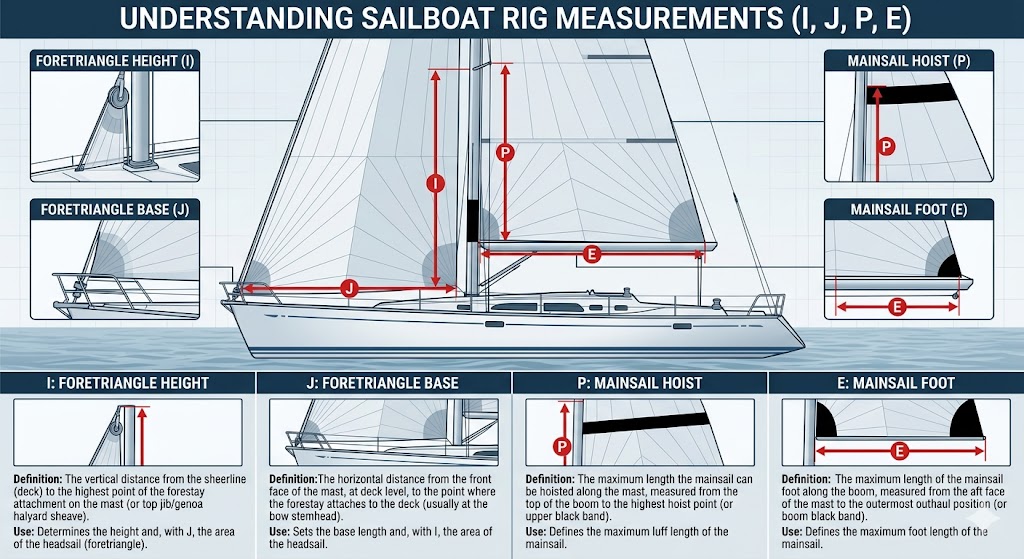
Rig Dimensions
I (Foretriangle Height) 44.82 ft / 13.66 m
J (Foretriangle Base) 13.16 ft / 4.01 m
P (Mainsail Luff) 44.95 ft / 13.70 m
E (Mainsail Foot) 15.00 ft / 4.57 m
SA Fore 294.92 ft² / 27.40 m²
SA Main 337.13 ft² / 31.32 m²
SA Total (100%) 632.05 ft² / 58.72 m²
Est. Forestay Length 46.71 ft / 14.24 m
Mast Height (DWL) 55.25 ft / 16.84 m
Engine & Accommodations
Engine Type Diesel
Horsepower 29
Fuel Capacity 38 gals / 144 L
Water Capacity 75 gals / 284 L
LOD 34.64 ft / 10.56 m
Resources & Community
Find a Hunter 36 Legend For Sale