Back to Search
Hunter 23
Designer: Hunter Design Team  ·  Builder: Hunter Marine (Usa)  ·  First built: 1984
+ Add to Compare
Videos
About the Hunter 23

Designed as an accessible entry point into sailboat ownership, this compact Hunter represents the builder's commitment to creating affordable, user-friendly vessels for recreational sailors. The Hunter 23 embodies the classic characteristics that made Hunter Marine a household name among weekend warriors and sailing families throughout the late 20th century. Built with Hunter's signature emphasis on interior volume and ease of handling, this boat maximizes living space within its modest footprint while maintaining straightforward sailing characteristics that won't intimidate newer sailors. The design philosophy prioritizes comfort and practicality over pure performance, making it well-suited for coastal cruising, day sailing, and learning the fundamentals of sailboat handling. Like other Hunter designs from this era, the 23 likely features a relatively wide beam that enhances stability and interior roominess, though this comes at some cost to windward performance. The boat's forgiving nature and predictable handling characteristics make it an excellent choice for those transitioning from smaller dinghies or seeking a manageable weekend cruiser for protected waters. For budget-conscious sailors prioritizing comfort and ease of use over racing performance, the Hunter 23 offers solid value in the entry-level cruising market.

Featured in Keel Index Articles
Market Price Estimate Beta
$2,000 – $7,900
typical asking price
Median $4,000  ·  13 listings used
All listings
$2,000 – $7,900 13
Rate a listing price
$
About this estimate
  • Prices are based on recent asking prices from public listings — not actual sale prices, which are typically lower.
  • Condition is not factored in. A well-maintained boat with new sails and engine can be worth significantly more than a project boat of the same model.
  • Location affects price. Boats in landlocked states or areas with fewer buyers often sell for less than those on the coast.
  • Year of manufacture is not filtered. Older examples of this model will generally be priced lower than newer ones.
  • Included equipment varies widely. A boat with a full suite of electronics, dodger, and new standing rigging may command a large premium.
  • Outliers are automatically excluded using statistical filtering to improve accuracy, but some bad data may remain.
Core Dimensions
LOA (Length Overall) 23.25 ft / 7.09 m
LWL (Waterline Length) 20.25 ft / 6.17 m
Beam 8.25 ft / 2.51 m
Max Draft 3.50 ft / 1.07 m
Displacement 3,600 lb / 1,633 kg
Ballast 1,350 lb / 612 kg
Sail Area (Reported) 238 ft² / 22.11 m²
Design & Construction
Hull Type Fin w/spade rudder
Rigging Type Masthead Sloop
Construction FG
Designer Hunter Design Team
Builder Hunter Marine (USA)
First Built 1984
Last Built 1991
Number Built 1000
Owner Reviews

No owner reviews yet — be the first to share your experience with this boat.
Performance Ratios
PHRF Rating PHRF (Performance Handicap Racing Fleet) is a national racing handicap measured in seconds per nautical mile. Lower values indicate faster boats. Ratings are sourced from US Sailing's national database (median across 60+ regional fleets).
Under 0 — Ultralight racer0–90 — Performance racer90–150 — Cruiser/racer150–210 — Typical cruiserOver 210 — Heavy/slow cruiser
243
SA/Displacement Sail Area to Displacement ratio measures how much sail power a boat has relative to its weight. Higher values mean more performance and speed.
Under 14 — Heavy cruiser, slow14–18 — Cruising sailboat18–22 — Cruiser/racerOver 22 — Performance racer
16.19
Ballast/Displacement Ballast to Displacement ratio shows what percentage of the boat's total weight is ballast. Higher values generally mean better initial stability and stiffer sail carrying.
30–35% — Typical cruiser35–45% — Stiff performance boatOver 45% — Racing oriented
37.5
Displacement/Length Displacement to Length ratio measures how heavy a boat is relative to its waterline length. Lower values mean a lighter, faster boat.
Under 100 — Ultralight racer100–200 — Light cruiser/racer200–300 — Moderate cruiser300–400 — Heavy cruiserOver 400 — Very heavy
193.54
Pounds/Inch Immersion Pounds per Inch Immersion (PPI) tells you how much weight is needed to sink the boat one inch. Useful for calculating how additional gear and stores affect waterline. 3.58 pounds/inch
Rig Dimensions
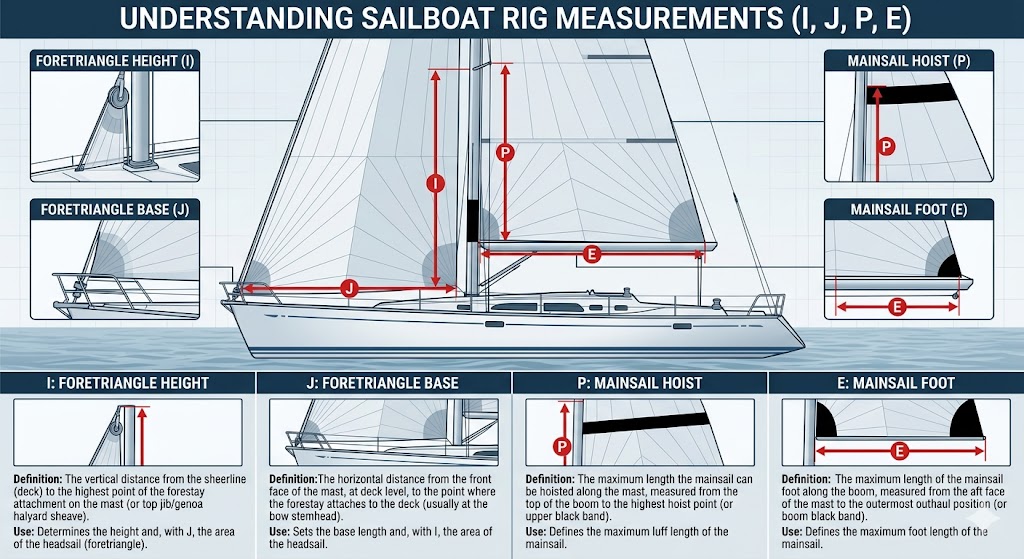
I (Foretriangle Height) 20.83
J (Foretriangle Base) 8.50 ft / 2.59 m
P (Mainsail Luff) 236.00 ft² / 21.93 m²
E (Mainsail Foot) 145.71
Find a Hunter 23 For Sale