Back to Search
Harmony 22
Designer: Chris Bjerregaard  ·  Builder: Harmony Yachts/Gloucester Yachts (Usa)  ·  First built: 1977
+ Add to Compare
About the Harmony 22

Given the scarcity of detailed specifications, the Harmony 22 appears to be a lesser-documented entry in the small sailboat market. This 22-foot vessel likely represents a compact cruising design intended for coastal waters and protected bays, typical of boats in this size range. Small sailboats bearing the Harmony name generally emphasize simplicity and affordability, making them attractive options for beginning sailors or those seeking a manageable weekend cruiser. The 22-foot length suggests a boat capable of accommodating two to four people for daysailing, with basic overnight capabilities for a couple. Without extensive documentation available, potential buyers should approach this model with careful inspection of construction quality and rigging condition. The limited information suggests this may be from a smaller manufacturer or a model with relatively short production runs, which could impact parts availability and resale value. For sailors considering coastal exploration and casual cruising, a boat of this size offers the advantage of trailerable convenience and modest marina fees. However, the sparse specification data available through typical marine industry channels indicates buyers should rely heavily on physical inspection and sea trials when evaluating any Harmony 22 opportunity.

Core Dimensions
LOA (Length Overall) 22.00 ft / 6.71 m
LWL (Waterline Length) 19.50 ft / 5.94 m
Beam 9.50 ft / 2.90 m
Max Draft 4.75 ft / 1.45 m
Displacement 3,000.00 lb / 1,361 kg
Ballast 1,100.00 lb / 499 kg
Design & Construction
Hull Type Daggerboard
Rigging Type Fractional Sloop
Construction FG
Designer Chris Bjerregaard
Builder Harmony Yachts/Gloucester Yachts (USA)
First Built 1977
Number Built 37
Owner Reviews

No owner reviews yet — be the first to share your experience with this boat.
Performance Ratios
PHRF Rating PHRF (Performance Handicap Racing Fleet) is a national racing handicap measured in seconds per nautical mile. Lower values indicate faster boats. Ratings are sourced from US Sailing's national database (median across 60+ regional fleets).
Under 0 — Ultralight racer0–90 — Performance racer90–150 — Cruiser/racer150–210 — Typical cruiserOver 210 — Heavy/slow cruiser
192
Ballast/Displacement Ballast to Displacement ratio shows what percentage of the boat's total weight is ballast. Higher values generally mean better initial stability and stiffer sail carrying.
30–35% — Typical cruiser35–45% — Stiff performance boatOver 45% — Racing oriented
36.67
Displacement/Length Displacement to Length ratio measures how heavy a boat is relative to its waterline length. Lower values mean a lighter, faster boat.
Under 100 — Ultralight racer100–200 — Light cruiser/racer200–300 — Moderate cruiser300–400 — Heavy cruiserOver 400 — Very heavy
180.62
Pounds/Inch Immersion Pounds per Inch Immersion (PPI) tells you how much weight is needed to sink the boat one inch. Useful for calculating how additional gear and stores affect waterline. 3.97 pounds/inch
Rig Dimensions
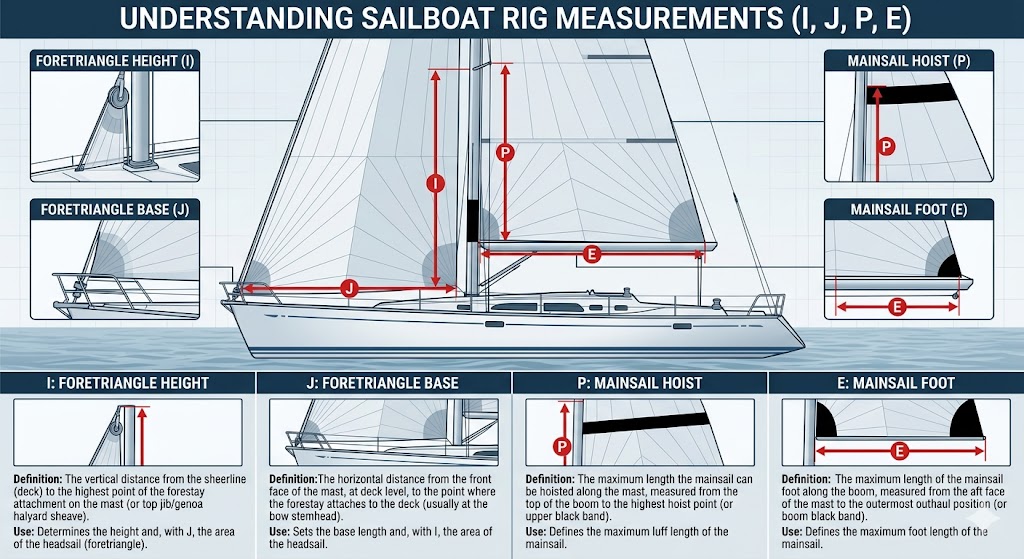
I (Foretriangle Height) 0.90 ft / 0.27 m
J (Foretriangle Base) 7.80 ft / 2.38 m
P (Mainsail Luff) 248.00 ft² / 23.04 m²
E (Mainsail Foot) 180.62
Find a Harmony 22 For Sale