Back to Search
Gulfstream 30 Ss
Designer: Sparkman & Stephens  ·  Builder: Robert Derecktor  ·  First built: 1955
+ Add to Compare
About the Gulfstream 30 Ss

With limited documentation available, the Gulfstream 30 Ss represents one of the more elusive entries in the 30-foot sailboat category. This relative obscurity shouldn't discourage serious sailors, as many lesser-known designs from this era offer excellent value and solid sailing characteristics that their famous counterparts possess. Based on typical design trends for boats of this size and naming convention, the Gulfstream 30 Ss likely falls into the coastal cruiser category, designed for weekend getaways and extended coastal passages rather than transoceanic voyaging. The "Ss" designation suggests this may be a sport version or special configuration of a base Gulfstream 30 model, potentially featuring updated rigging, interior layout, or performance enhancements. For prospective buyers, the scarcity of readily available information means extra due diligence is essential. Arranging a thorough marine survey becomes even more critical, and connecting with existing owners through sailing forums or yacht clubs could provide valuable insights into the boat's real-world performance, maintenance requirements, and any common issues. This research-intensive approach often leads to discovering hidden gems in the used boat market.

Core Dimensions
LOA (Length Overall) 30.33 ft / 9.24 m
LWL (Waterline Length) 22.25 ft / 6.78 m
Beam 8.03 ft / 2.45 m
Max Draft 4.58 ft / 1.40 m
Displacement 7,700.00 lb / 3,493 kg
Sail Area (Reported) 390.00 ft² / 36.23 m²
Design & Construction
Hull Type Fin Keel
Rigging Type Masthead Sloop
Construction Wood
Designer Sparkman & Stephens
Builder Robert Derecktor
First Built 1955
Owner Reviews

No owner reviews yet — be the first to share your experience with this boat.
Performance Ratios
PHRF Rating PHRF (Performance Handicap Racing Fleet) is a national racing handicap measured in seconds per nautical mile. Lower values indicate faster boats. Ratings are sourced from US Sailing's national database (median across 60+ regional fleets).
Under 0 — Ultralight racer0–90 — Performance racer90–150 — Cruiser/racer150–210 — Typical cruiserOver 210 — Heavy/slow cruiser
216
SA/Displacement Sail Area to Displacement ratio measures how much sail power a boat has relative to its weight. Higher values mean more performance and speed.
Under 14 — Heavy cruiser, slow14–18 — Cruising sailboat18–22 — Cruiser/racerOver 22 — Performance racer
16.05
Comfort Ratio Ted Brewer's Comfort Ratio predicts how comfortable a boat will feel in offshore conditions. Higher values mean a steadier, more comfortable motion in a seaway.
Under 20 — Uncomfortably rough20–30 — Acceptable coastal30–40 — Good offshore comfortOver 40 — Very comfortable offshore
30.07
Capsize Screening Formula The USHS Capsize Screening Formula estimates offshore capsize risk. Lower is safer — values under 2.0 are considered acceptable for offshore sailing.
Under 2.0 — Safe for offshore2.0–2.2 — Borderline offshoreOver 2.2 — Coastal use recommended
1.63
Hull Speed Hull Speed is the theoretical maximum speed of a displacement hull, calculated from waterline length. Most cruising sailboats reach this speed in moderate conditions. 6.32
S# (Speed Number) The Speed Number (S#) is a quick performance index. Higher values indicate a faster, more powerful design relative to its size.
Under 3.0 — Slow cruiser3.0–5.0 — Average cruiser5.0–7.0 — Performance cruiserOver 7.0 — Racer
1.68
Pounds/Inch Immersion Pounds per Inch Immersion (PPI) tells you how much weight is needed to sink the boat one inch. Useful for calculating how additional gear and stores affect waterline. 638.4
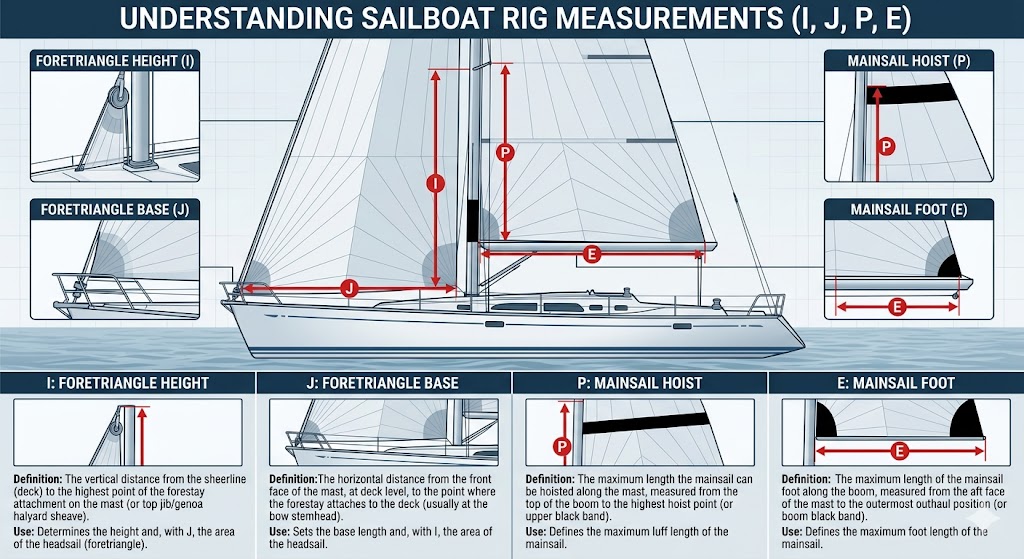
Rig Dimensions
I (Foretriangle Height) 34.99
J (Foretriangle Base) 11.27
P (Mainsail Luff) 30.0
E (Mainsail Foot) 15.0
SA Fore 197.17
SA Main 225.0
Find a Gulfstream 30 Ss For Sale